Showing posts with label Women in Politics. Show all posts

Saturday, August 8, 2020

Too Much Pot Brownie?

New York Times columnist Maureen Dowd published a not-very-well-edited column this morning, claiming that it had been 36 years since "a man and a woman ran together on a Democratic Party ticket." This caused political/history nerds such as myself to scratch our heads. What about Hillary and Tim, a mere four years ago? How quickly they forget.

A howl of outrage went up on the Twitterverse and the offending sentence was quickly fixed, although the NYT can't bring themselves to apologize for the error:


Fortunately for history, Daniel Larison had grabbed a screenshot of the original NYTimes Opinion tweet:


Hillary weighed in too:


It was entertaining, but all is well for the moment and there's not much else to say except c'mon Joe Biden, put us all out of our quadriennial Veepstakes misery and announce your pick soon!

But wait. "A very vivid hallucination," "Too much pot brownie"? What's that about? Hill is referring to a column Dowd published on June 3, 2014. Titled Don't Harsh Our Mellow, Dude, this is what it said:

The caramel-chocolate flavored candy bar looked so innocent, like the Sky Bars I used to love as a child.

Sitting in my hotel room in Denver, I nibbled off the end and then, when nothing happened, nibbled some more. I figured if I was reporting on the social revolution rocking Colorado in January, the giddy culmination of pot Prohibition, I should try a taste of legal, edible pot from a local shop.

What could go wrong with a bite or two?

Everything, as it turned out.

Not at first. For an hour, I felt nothing. I figured I’d order dinner from room service and return to my more mundane drugs of choice, chardonnay and mediocre-movies-on-demand.

But then I felt a scary shudder go through my body and brain. I barely made it from the desk to the bed, where I lay curled up in a hallucinatory state for the next eight hours. I was thirsty but couldn’t move to get water. Or even turn off the lights. I was panting and paranoid, sure that when the room-service waiter knocked and I didn’t answer, he’d call the police and have me arrested for being unable to handle my candy.

I strained to remember where I was or even what I was wearing, touching my green corduroy jeans and staring at the exposed-brick wall. As my paranoia deepened, I became convinced that I had died and no one was telling me.

It took all night before it began to wear off, distressingly slowly. The next day, a medical consultant at an edibles plant where I was conducting an interview mentioned that candy bars like that are supposed to be cut into 16 pieces for novices; but that recommendation hadn’t been on the label.

I reckoned that the fact that I was not a regular marijuana smoker made me more vulnerable, and that I should have known better. But it turns out, five months in, that some kinks need to be ironed out with the intoxicating open bar at the Mile High Club.

Colorado raked in about $12.6 million the first three months after pot was legalized for adults 21 and over. Pot party planners are dreaming up classy events: the Colorado Symphony just had its first “Classically Cannabis” fund-raiser with joints and Debussy. But the state is also coming to grips with the darker side of unleashing a drug as potent as marijuana on a horde of tourists of all ages and tolerance levels seeking a mellow buzz.

In March, a 19-year-old Wyoming college student jumped off a Denver hotel balcony after eating a pot cookie with 65 milligrams of THC. In April, a Denver man ate pot-infused Karma Kandy and began talking like it was the end of the world, scaring his wife and three kids. Then he retrieved a handgun from a safe and killed his wife while she was on the phone with an emergency dispatcher.

As Jack Healy reported in The Times on Sunday, Colorado hospital officials “are treating growing numbers of children and adults sickened by potent doses of edible marijuana” and neighboring states are seeing more stoned drivers.

“We realized there was a problem because we’re watching everything with the urgency of the first people to regulate in this area,” said Andrew Freedman, the state’s director of marijuana coordination. “There are way too many stories of people not understanding how much they’re eating. With liquor, people understand what they’re getting themselves into. But that doesn’t exist right now for edibles for new users in the market. It would behoove the industry to create a more pleasant experience for people.

“The whole industry was set up for people who smoked frequently. It needs to learn how to educate new users in the market. We have to create a culture of responsibility around edibles, so people know what to expect to feel.”

Gov. John Hickenlooper and the Legislature recently created a task force to come up with packaging that clearly differentiates pot cookies and candy and gummy bears from normal sweets — with an eye toward protecting children — and directed the Department of Revenue to restrict the amount of edibles that can be sold at one time to one person. The governor also signed legislation mandating that there be a stamp on edibles, possibly a marijuana leaf. (Or maybe a stoned skull and bones?)

The state plans to start testing to make sure the weed is spread evenly throughout the product. The task force is discussing having budtenders give better warnings to customers and moving toward demarcating a single-serving size of 10 milligrams. (Industry representatives objected to the expense of wrapping bites of candy individually.)

“My kids put rocks and batteries in their mouths,” said Bob Eschino, the owner of Incredibles, which makes candy and serves up chocolate and strawberry fountains. “If I put a marijuana leaf on a piece of chocolate, they’ll still put it in their mouths.”

He argues that, since pot goodies leave the dispensary in childproof packages, it is the parents’ responsibility to make sure their kids don’t get hold of it.

“Somebody suggested we just make everything look like a gray square so it doesn’t look appealing. Why should the whole industry suffer just because less than 5 percent of people are having problems with the correct dosing?”

Does he sound a little paranoid?


And one more thing. Was Hillary being just a little bit snarky in her tweet about Dowd's mistake? Yes. Why? In 1999 Dowd won a Pulitzer Prize for a series of 10 columns she wrote in 1998, in which she gleefully shredded Bill Clinton for his activities with Monica Lewinsky. (The Pulitzer committee cited her "fresh and insightful columns on the impact of President Clinton's affair with Monica Lewinsky.") What did she say, exactly? Consider:

January 25, 1998: 

Let's review what we've learned so far.

The President a liar? Knew that.

The President a philanderer? Knew that.

The President reckless in the satisfaction of his appetites? Knew that.

The President would say anything and hurt anybody to get out of a mess? Knew that.

Married men cheat? Knew that.

Married men cheat with young women? Knew that.

Married men who cheat with young women lie about it? Knew that.

Hillary isn't throwing Bill's stuff out on the White House lawn because she is as committed to their repugnant arrangement as he is? Knew that.


August 23, 1998:

After the President's prime-time confession, the news media were abuzz about whether Mr. Clinton could repair his damaged relationships with his wife and daughter.

Suddenly, That Woman stamped her feet. Like the Glenn Close character in "Fatal Attraction," Monica Lewinsky issued a chilling ultimatum to the man who jilted her: I will not be ignored.

She let it be known that she was wounded that the President had failed to apologize to her and had dismissed their grand, 18-month romance, their shared passion for books and laughs, as trivial -- a mere mechanism for relieving Oval Office tension.

Mr. Clinton rejected a more contrite version of the speech written by Bob Shrum -- nicknamed the "Shoot Me" draft at the White House -- that contained an apology to "Monica Lewinsky and her family." Instead, with some brass-knuckle guidance from Hillary, he embraced his wife and daughter as "the two people I love most," while swatting Monica away as "inappropriate."

He portrayed himself, insultingly, as a passive participant in their trysts. What she called true love, he called "legally accurate."


September 13, 1998:

Middle-aged married man has affair with frisky and adoring young office girl. Man hints to girl he might be single again in three or four years. Man gets bored with girl and dumps her. Girl cries and rants and threatens, and tells 11 people what a creep he is.

The dialogue in this potboiler, compiled with sanctimonious, even voyeuristic relish by Reverend Starr, is so trite and bodice-ripping that it makes "Titanic" look profound.

In fact, Monica identified with Rose, the feisty, zaftig young heroine of "Titanic." Last January, the former intern wrote the President what she called "an embarrassing mushy note" inspired by the movie, asking her former boyfriend if they could have sex (the lying-down kind).

Despite the fact that it takes place in the most powerful spot on the planet, the romance does not sizzle.

Bill Clinton fancies himself another Jack Kennedy and invoked his idol's name last week to defend himself.

But Kennedy was cool. His women were glamorous. The Rat Pack was good copy. He may have been just as immoral, but his carousing at least had style.

Mr. Clinton's escapades are just cheesy and depressing. The sex scenes are flat, repetitive, juvenile and cloying, taking place in the windowless hallway outside the Oval Office study or in the President's bathroom.


November 18, 1998: In the final column, Dowd concluded with this: 

At the White House, the truth is employed only to the extent that it's useful. When the Monica story broke, Dick Morris said, the President asked him to do a poll to tell him what would play better, the truth or a lie. Mr. Morris said he told his old pal he couldn't tell the truth and survive, and Mr. Clinton replied, "Well, we'll just have to win."

New York magazine, which included me among its mug shots, rains a cascade of poll numbers showing that by big margins the public is fed up with hearing about the scandal.

I know exactly how the public feels. I'm sick of hearing about it too.

But the fact is that the scandal is there, and the President did what he did and said what he said, and the consequences of what he did and said have preoccupied the executive, the legislative and the judicial branches of government for a year.

To pretend otherwise, to submit robotically to the polls, to take one's professional instructions from the wishes and whims of a fickle electorate would be to abdicate the role the public says it wants the press to play: covering the news.

If the President had told the truth immediately, the story would have died. But it is our job to undo the spin and look into the lies and go the extra skeptical mile to see that there is no cover-up. Moreover, all journalists are not like all other journalists in the wild and woolly and recklessly fast era of the 24-hour news cycle of cable, the Internet and high-decibel know-it-alls and gossips.

The impure history of modern America -- Vietnam, Watergate, Iran-contra -- proves that reporters have a duty to dig for the truth, whatever the public thinks.

There is a danger of making false equations between popularity and rightness, between what is liked and what is true. The danger is that next time, when the cover-up takes place in a less gray area, reporters will look at the numbers and go home early. Next time it may not be about sex and lies. It may be about life and death.

You can read all ten columns here.

Days until the election: 87

Monday, July 13, 2020

Yesterday In History, 1984: Mondale Selects Geraldine Ferraro As Running Mate - Updated

Somehow I went through the entire day yesterday without seeing any of these tweets, so this is a "This Day In History" post, one day late. Representative Ferraro was an historic pick in 1984; within a few days we should have another woman running to be Vice President.


Note: In the tweet above, the date is wrong. It should be 1984.

Update: Here's a political moment that did take place on this day in history:

Saturday, July 11, 2020

Donald's Women

I've always been surprised and puzzled by the fact that significant numbers of women, white college-educated women in particular, voted for Donald in 2016. Now, writing at The Bulwark in an article titled "What Women Want," and subtitled "Here's what women who voted for Trump in 2016 are saying about him now," Sarah Longwell sheds some light on why they did, and why they're not doing it again this time. This is the article in its entirety:

One of the great mysteries of 2016 was why so many women voted for Donald Trump.

Despite being caught on a hot mic talking about grabbing women “by the pu**y,” nearly 20 sexual assault allegations, and well known accounts of treating his multiple wives horribly, Trump still received the votes of 44 percent of white college-educated women and 61 percent of non-college-educated white women.

Many observers were doubly confused because they had expected Hillary Clinton, as the first major party female nominee, to be especially strong with women. And she wasn’t. Trump did poorly with African-American and Hispanic women, because he did poorly with all African-Americans and Hispanics. But he managed to actually win a narrow plurality among white women. 


But that mystery has been easy to solve. Over the last three years I conducted dozens of focus groups with both college-educated and non-college-educated female Trump voters. And the answer given most commonly for why they voted for Donald Trump is “I didn’t vote for Donald Trump. I voted against Hillary Clinton.”

In 2016, Democrats understood that Hillary Clinton was a deeply polarizing candidate. But even they didn’t grasp the full magnitude of it. Right-leaning and Republican female voters had spent more than a decade hating both Clintons, and they didn’t stop just because Hillary’s opponent was an unrepentant misogynist.

In fact, Bill Clinton’s legacy of similarly disgusting behavior with women—and Hillary Clinton’s defense of her husband—had the effect of blunting Trump’s own execrable track record. These women voters decided that either way, there’d be a guy with a long history of sexual malfeasance living in the White House.

But after Trump’s victory, something started happening almost immediately. Women—even those who voted for Trump in 2016—began shifting away from the president.

In the 2018 midterm elections that delivered Democrats 40 congressional seats and control of the House of Representatives, support for Republicans from both college-educated women and non-college-educated white women dropped by 5 points.

And the relationship has gotten worse.

A recent New York Times Upshot/Siena College Poll showed Trump trailing Joe Biden by 22 points with women. That’s 9 points bigger than the gender gap was in 2016.

And while much has been made of college-educated women in the suburbs ditching Trump, a recent ABC/Washington Post survey shows that Trump’s support with white non-college-educated women has fallen by 11 points.

After nearly three years of conducting focus groups with women who held their nose and voted for Trump in 2016, this decline hasn’t surprised me. He was holding on to many of those voters with a wing and a prayer and strong economy. When everything began to fall apart, these female Trump leaners went running for the exits.

From the beginning of his presidency these women gave Trump low marks for his tweeting and divisiveness—but they also gave him credit for the strong economy and relative prosperity of the last few years.

His perceived business acumen was one of the top reasons many of these women were willing to take a flyer on him in the first place. Never forget that for many Americans, their impressions of Trump were formed less by his presidential campaign than by his role on The Apprentice where he was, through the wonders of editing and reality TV storytelling, presented as a decisive, successful businessman.

In late 2019 and early 2020 with a roaring economy and a bunch of abstract foreign policy scandals consuming the media and the elites whom these voters generally despise and distrust, even Trump-voting-women who rated the president’s performance as “very bad” weren’t entirely sure what they would do in 2020. There was still a crowded field of Democratic candidates—many of whom were living, breathing representations of the far-left caricature that Republicans paint of Democrats.

But by March of 2020, everything had changed.

First, Joe Biden blew out Bernie Sanders and the rest of the Democratic field.

In my focus groups, Biden had consistently outperformed all other Democrats among the female Trump voters who were souring on the president. In hypothetical head-to-head matchups, almost none of the women would take Bernie Sanders or Elizabeth Warren over Trump, but a handful would typically (if not enthusiastically) pick Biden over Trump.

It cannot be overstated how much better of a candidate Joe Biden is for attracting disaffected Republican voters—especially women—than any of the other Democrats who ran this cycle.

Then on March 11 the World Health Organization declared the coronavirus a global pandemic. Two days later, the United States declared a state of emergency.

No one in America will forget what happened next: Lockdowns; PPE shortages; 130,000 deaths; staggering unemployment.

And every night on television voters saw a president both unwilling and incapable of providing clear and coherent leadership.

Since March, I have conducted the focus groups virtually and watched Trump’s position with women weaken in real time.

Interestingly, in the early days of the pandemic the women in the focus groups were frustrated with Trump, but didn’t necessarily hold him responsible for everything that was happening. He hadn’t done great, they said, but it was a tough situation for any president to handle.

It wasn’t until the killing of George Floyd and the resulting protests that the bottom started to drop out.

Two weeks after Floyd’s death I ran a focus group with seven women from swing states—all of whom voted for Trump but currently rated him as doing a “very bad” job.

Only one was leaning toward voting for him again. Three were definitely going to vote for Biden. The other three were still making up their minds. But even these undecideds were unequivocal in their distaste for Trump’s posture on race and his handling of the protests. They actively recoiled.

One of the Trump voters who had decided to vote for Biden said, “The stakes are too high now. It’s a matter of life and death.”

That’s a pretty a good distillation of why Trump has been shedding support from women over the last few months. The multiple crises laid bare the fact that Donald Trump isn’t the savvy businessman these women voted for. Instead, they see him as a divisive president who’s in over his head.

And they see that his inability to successfully navigate this environment has real-world consequences for actual people.

Average voters weren’t moved by Trump’s obstruction of justice in the Mueller investigation, or his quid-pro-quo with Ukraine, or his many personal scandals. But when people are unemployed, or dying, and the streets are on fire, they want a president who isn’t winging it.

They want someone who knows how the world works and can make the government perform the kind of functions that only it can do. Like managing a coordinated national response to a pandemic. Or using the bully pulpit to bring the nation together during a moment of crisis.

Donald Trump and his campaign think they can stop the bleeding with women by leaning into the culture wars and highlighting looters, rioters, and vandals pulling down statues. But this is a fundamental misunderstanding of these voters. They don’t see Trump as someone who can protect them from the chaos—they think he’s the source of it.

Which isn’t to say that the race couldn’t turn around for one reason or another. I suppose that crazier things have happened in American politics. (Though I can’t think of many off the top of my head.)

But the reality is that no modern president has done more to alienate female voters. His whole life Trump has treated women with disdain. And they are now poised to return the favor.


I voted for Hillary three times, in the 2008 primary, the 2016 primary and the 2016 general election. I think she would have been a fine president, and not just in comparison to the degenerate pig who got the job. She's not perfect (no politician is) but she's not even close to being the devil in high heels her enemies have made her out to be. To me at the time, it was blindingly clear that even a voter who didn't admire Hillary, or perhaps actively disliked her, could see that she was so much better than Donald Trump. 

Obviously, I was wrong. Epistemic closure is powerful; if everything a voter knows about Hillary Clinton was learned by watching Fox News and listening to Rush Limbaugh, hell will freeze over before that voter votes for her.

Anyway, here we are and I have one more thought about Hillary as president and it's something that came to me gradually over the last few years. We won't have a woman in the White House for a few more years but I hope it happens soon. When it does, it will feel strange and different, no matter who the woman is or how wonderful she is. (Note: Different doesn't mean bad. We can adjust to different.) Most likely in addition to the first Madam President, there will also be the first First Gentleman, or whatever he decides to call himself. 

His role won't be easy. It will no doubt take a while before everyone gets used to the fact that the person sitting in the Oval Office is the wife and the person organizing the state dinner is the husband. As much as I wanted to see Hillary as the first woman president, I now believe that things will go more smoothly all around if the first First Gentleman isn't Bill Clinton. Or any former president, really, but especially not Bill Clinton. Presumably no one would actually expect Bill to plan state dinners. Keeping him out of the Oval Office would be the problem. Imagine: 

We're in the East Room of the White House; everyone's waiting for President Clinton to walk in and announce a new initiative to help children. The doors open, the audience stands up and the band starts playing Hail To The Chief. 

Standing in the doorway with her parents, Chelsea grabs her father by the arm. "Dad, wait," she whispers. "The music's for Mom. You have to let her go in first."

I just don't think the Big Dog could handle being the second most important Dog in the room. 

Sunday, March 1, 2020

The Guessing Game - Updated/Mariska Hargitay

What will be on the cover of People this week? My guesses, in no particular order:

Prince Harry: Recreated the Abbey Road picture with Bon Jovi; Prince William cheered for his favorite team at a soccer game; Harry and Meghan didn't bring Archie to London; Princess Beatrice's wedding is being downscaled because of Prince Andrew's troubles
Maria Sharapova: Announced her retirement from professional tennis at
age 32
Hunter Biden: Back in the news with an article in the New York Times; dad Joe Biden scores a big win in the South Caroline primary (but I don't really think they'll put Joe Biden on the cover)
Oprah: Fell onstage:


Lori Vallow: The Idaho mom whose two children are missing, she's now in jail in Hawaii
Vanessa Bryant: Upset by pictures of the crash site, taken by first responders
The new Bachelorette: The announcement will be made tomorrow morning on Good Morning, America: 
So who will it be? Word on the street is that they're bringing back Clare Crawley. Who?? She came in second on Juan Pablo's season, which aired January-March, 2014. She's also been on Bachelor in Paradise and Bachelor Winter Games. (Truthfully, I barely remember her.) In a big change for the franchise, in which both the leads and the contestants have been getting younger and younger, Clare is 38, turning 39 on March 20. Are they really going to cast 25-30 men in their mid-20s? To put it a different way, are there really a whole bunch of late-30's men sitting around with nothing better to do than go on The Bachelorett? We'll see.

One more name: Pete Buttigieg. Within the last few minutes he ended his campaign for president. As a barrier-breaking candidate, and now that he's out of the race, I could see People running a story on him and his appealing husband Chasten.

Stories that appear on the new cover will be highlighted in green.

Update on Monday morning: It's Clare, age 38, soon to be 39, and I want to plead with ABC, please, please, please, don't fill the mansion with 20-something-year-old aimless men who want to be Instagram influencers. It just won't work. In an article at People.com titled "New Bachelorette Clare Crawley, 38, Says Her Age Is 'an Asset' In Search for Love," Clare says this:

“People always talk about, ‘Why would you go on the show again?'” she says. “But it’s common for people, especially my age, to go through relationships. And whether they are good or bad, you take something from them. [Each experience] has propelled me into a different level with myself.”

This time around, “I feel like my age is really an asset,” says Crawley. “I’ve gone through twists and turns and I know what I will and won’t put up with. Twenty-three-year-old Clare had no clue what I wanted. And I’m glad that wasn’t the end of my love story because I’m such a different woman now.”

When it comes to her suitors, fame-seekers need not apply.

“I get that there are a lot of perks that come along with The Bachelorette,” says Crawley. “But in the end, I want a man who I can bring home and watch TV with on a Friday night who doesn’t want to be in the spotlight.”

And ultimately, Crawley feels hopeful that this time, she’ll find The One.

“There have been plenty of times where I’m sitting alone on a Saturday night, thinking, ‘Am I ever going to find anyone?’ But I know what I want and what I’m looking for. And I’m ready to start the next part of my life.”
 

Call me skeptical.  You can read more here and here.

Update #2. Apparently ABC is releasing some of the 25-year-olds, due to a "change in direction." Interesting: 


Update #3 on Tuesday morning. Hillary Clinton: A new documentary premieres on Hulu this month
Chris Matthews: The MSNBC star abruptly resigned live on air after criticism about the way he treats women
Rachel Lindsay: On the Women Tell All show last night, former Bachelorette Rachel delivered a powerful statement about bullying
James Lipton: The long-time host of Inside the Actor's Studio, died at age 93

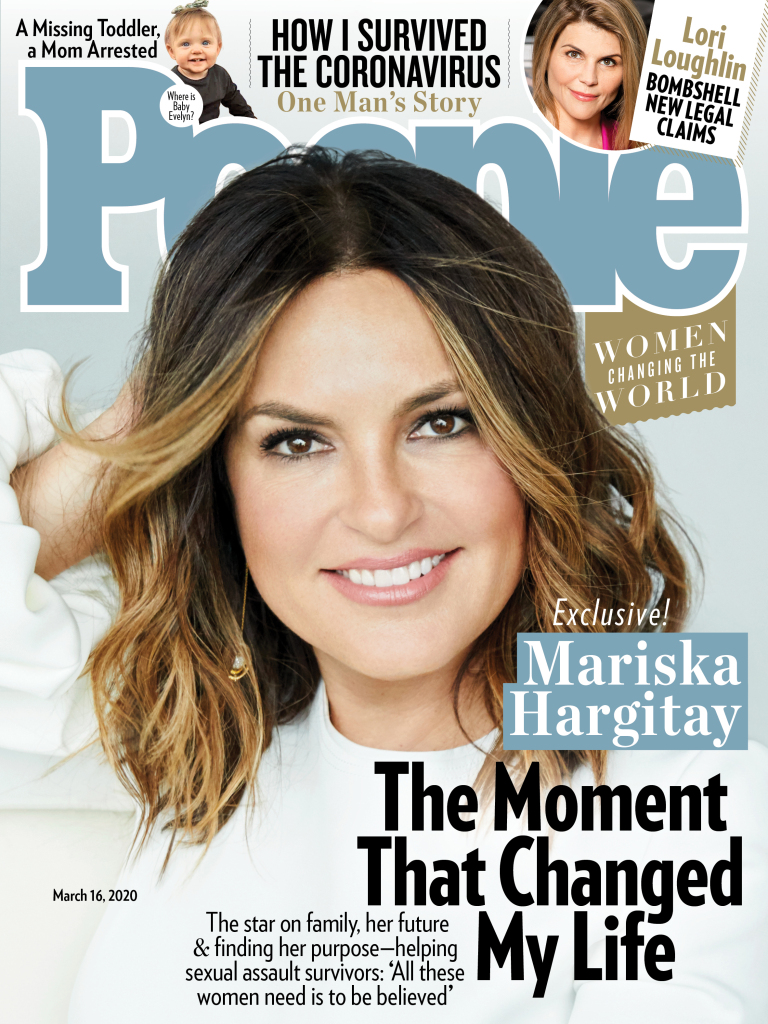
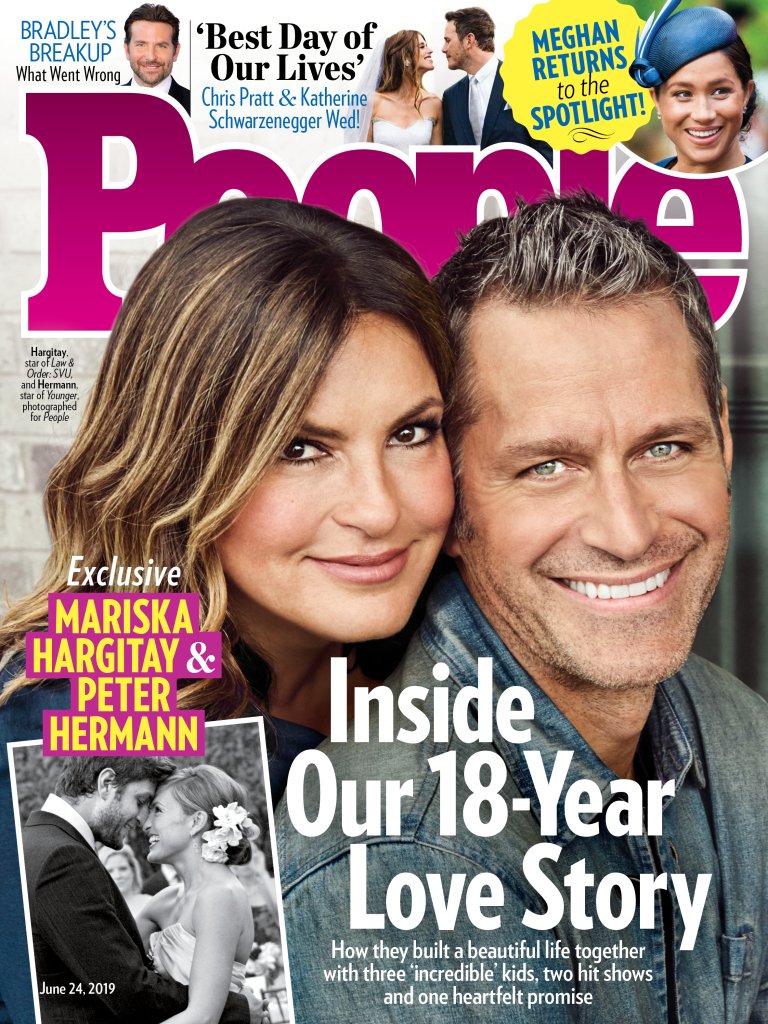
Update #4 on Wednesday morning. It's Mariska Hargitay, her third cover story in less than two years, this one tied to her work as an advocate for victims of sexual assault. The logo titled "Women Changing the World" looks new to me, and as of about 9.30 Wednesday morning, I don't see any other articles at People.com that appear to be tied to the theme. Maybe we'll see more going forward. Nothing on this cover was on the Guessing Game list, and for the second week in a row, there are no headlines about the royal family. Next week's cover should feature Bachelor Peter Weber and one, both or neither of his final two women, Madison and Hannah Ann. 

Issue dated March 16, 2020: Mariska Hargitay
Image

Mariska's previous covers:

Issue dated June 24, 2019


Issue dated April 9, 2018


Last year at this time: Issue dated March 18, 2019


Tuesday, October 9, 2018

On To Bigger Things? - Updated


Is it just that she's resigning, which has been announced (or at least, leaked,) or is there something else afoot? For what it's worth, Axios has a quote saying she's not running for president in 2020. (Read it here.)

Update: Why did Nikki Haley resign? So far, no one knows for sure, but as the saying goes, there's got to be a reason.

From Josh Marshall at Talking Points Memo:

The most repeated explanations of Nikki Haley's departure today are that she wanted to make money in the private sector or she wanted a "breather." I just wanted to reiterate that this makes absolutely no sense. People do sometimes leave high profile positions for those reasons. But not without warning and not four weeks before an election. President Trump claims she gave him a heads up six months. But he's a notorious liar. Various reports claim that neither John Bolton nor Secretary of State Pompeo knew anything about it. Apparently nobody did.

I'm not saying there's some big scandal lurking here. But these explanations do not hold up. There's certainly some as yet unknown driver of this decision.  (Nothing to link to, this is the whole post.)

From the Washington Post:

"Resignations in national politics are highly calculated maneuvers -- it's not just like, 'Uh, I think I'll have chili for lunch,' [Republican strategist/Trump critic Mike] Murphy said. "This was so abrupt and the timing so politically weird that it sure reads like it's preempting something... If it's the political masterstroke, where's the landing pad? Where's the ooh and ahh?" (Read the story here.)

From Bill Kristol via Twitter:


And Mike Murphy again, also via Twitter:

Stay tuned...

Wednesday morning, update #2: Who will replace Haley at the U.N.? Not Ivanka:

Saturday, June 6, 2015

The Duck And Some Friends


I love this picture! Partly because, you know, The Duck. But also because of his friends. That's Oregon governor Kate Brown on the left and former governor Barbara Roberts on the right.

Wednesday, November 14, 2012

How Many Stalls Do The Men Get?

From U.S. Senator Amy Klobuchar:

“For the first time, there was a traffic jam in the Senate women’s bathroom,” she said. “There were five of us in there, and there are only two stalls.”

For the record, the next Congress will have 20 female senators, which is not even close to parity with our percentage of the overall population, but definitely on the right track.