Showing posts with label Chicago. Show all posts

Tuesday, February 11, 2020

Another Bad Day For Jussie Smollett - Updated

Wow. Jussie Smollett has been indicted (again) by the special prosecutor looking into how his case was handled by the State's Attorney's office.

Here's how Page Six is covering it:

Jussie Smollett was indicted on Tuesday in Chicago, according to a new report.

The indictment, brought by special prosecutor Dan Webb, stems from the alleged January 2019 hoax attack against the former “Empire” star, Fox32 reported, citing sources.

Smollett has been accused of hiring two brothers to stage an attack on himself that included tales of a noose and bigots screaming racist, homophobic slurs.

Cops in Chicago, where Smollett lives and alleged the attack occurred, have said the actor made up the whole thing. He’s denied the allegations.

He is due in court Feb. 24, Fox32 said.


In an article just posted, the Sun-Times hedges a bit:

Attorneys for Jussie Smollett have been told that they should expect their client to be indicted Tuesday, a source familiar with the matter said.

Investigators in the case have gone to California to interview people connected to Smollett, the source said.

The indictment comes just under a year after Smollet was charged in 2019 for allegedly staging a hoax hate crime attack near his Streeterville home.

Special Prosecutor Dan Webb, a former U.S. Attorney in Chicago, was appointed by Judge Michael Toomin six months ago and charged with reviewing both the evidence against Smollett for with the possibility of filing new charges, and investigating how the case was handled by Cook County State’s Attorney Kim Foxx and her subordinates.

Toomin declined to answer any questions earlier Tuesday about a possible indictment.

Smollett in February 2019 was charged with multiple, low-level felony counts for allegedly providing false information about the attack, claiming that he was jumped by two white men who called out racist, homophobic slurs as they punched the actor and draped a noose over his head.

Detectives determined that Smollett had paid two acquaintances, who had previously served as extras on “Empire” and as Smollett’s personal trainers, to attack him.

Foxx had recused herself from the case the day before those charges were announced, delegating decision-making in the case to her top deputy, Joseph Magats. Just over a month after Smollett turned himself in to police, the State’s Attorney’s Office dropped all charges against Smollett.


The Chicago Tribune has more details:

Smollett was indicted by a special Cook County grand jury on six counts of disorderly conduct for allegedly making four separate false reports regarding what police said was a faked attack. Special Prosecutor Dan Webb announced the charges in a press release Tuesday, saying that “further prosecution of Jussie Smollett is ‘in the interest of justice’."

... In announcing his decision to charge Smollett, Webb pointed to several factors including “the extensive nature of Mr. Smollett’s false police reports, and the resources expended by the Chicago Police Department to investigate these false reports.”

Further, Webb said that the Cook County State’s Attorney’s office was unable to provide examples of how other cases were disposed of in a similar fashion.
(Read more here.)

Wednesday morning update. Last night, the Chicago Tribune Editorial Board published a blistering editorial:

Tuesday brought fresh criticism for Kim Foxx, state’s attorney of Cook County.

Tuesday also brought fresh challenges for Kim Foxx, candidate for renomination in the Illinois primary.

With legal action and comments that undercut Foxx in both roles, special prosecutor Dan Webb complicated life for the prosecutor and the candidate.

Kim Foxx’s reaction? In a peculiar statement she cast herself as the victim of an unfair attack of the sort former FBI Director James Comey might wage in the era of President Donald Trump.

This shows why the Smollett case matters

Taken together, Tuesday’s developments underscored why the case of actor Jussie Smollett matters less because of him than because of what all of us are learning about Foxx’s judgment: She mishandled a case and now has citizens asking about equality under the law: whether some defendants in Cook County’s criminal justice system have to bear the brunt of the law while others get sweet deals from her prosecutors.

Webb’s announcement of a six-count criminal indictment of Smollett says to the people of Cook County that it takes a special prosecutor to pursue a case that their elected prosecutor inexplicably dropped.

And with early voters preparing to decide Foxx’s fate, a statement from Webb, a former U.S. attorney here, opens the candidate to fresh accusations of incompetence if not deceit: Foxx has maintained that her office treated Smollett the way it treats other defendants every day. She has made much of that claim.

Yet Webb says her state’s attorney’s office couldn’t point to those comparable cases.

Webb’s conclusion contradicts Foxx’s statement to WBEZ on March 27, 2019, that “every single day ... there are people who get similar arrangements, people who get diversion, people who get sentences that are probably not what some people would want. Every single day.”

Webb is saying Foxx’s office had no precedent or consistent policy to justify letting Smollett off the hook — but did it anyway.

Dan Webb’s harsh verdict on Foxx


In a prepared statement, Webb came down hard on Foxx — politely, he didn’t name her while critiquing her — and lambasted her office for botching the Smollett case and misleading the public.

Webb said he disagrees with the way the state’s attorney’s office handled the Smollet prosecution, but actually he went quite a bit further. Webb’s team investigated Foxx’s claim that her office treated Smollett as it does other defendants. But in the end, his statement suggests that her office gave Smollett special treatment. Webb wrote that Foxx’s office “was unable to provide this documentary evidence.”

Webb also pointed out that Foxx’s office, at the time of the original indictment in March 2019, believed it had strong evidence against Smollett — yet three weeks later decided to dismiss the charges, with 15 hours of community service as Smollett’s punishment.

Between the lines of Webb’s statement is a special prosecutor shaking his head in disbelief at Foxx’s management of the case. And perhaps he’s not done. In his statement he said he hasn’t yet determined whether anyone involved in the case engaged in wrongdoing, including the state’s attorney’s office or individuals in that office.

Those hate crime allegations


Webb’s six counts of disorderly conduct essentially reassert last year’s allegations against Smollett: that in January 2019 he faked being the victim of a hate crime and assault.

According to Tuesday’s fresh indictment, Smollett invented the story of being attacked at 2 a.m. in Streeterville by two men who used racial and homophobic slurs, punched Smollett in the face, put a noose around his neck and poured a bleachlike substance on him.

Smollett made this report to police knowing “there was no reasonable ground for believing that such an offense had been committed,” the indictment states.

Foxx evokes Comey and Trump

Foxx’s statement in response to the new indictment questioned its timing, implying that Webb is playing a dirty political trick on her: “The Cook County State’s Attorney’s office charged Jussie Smollett with multiple counts, and today the Special Prosecutor did the same. What’s questionable here is the James Comey-like timing of that charging decision, just 35 days before an election, which can only be interpreted as the further politicization of the justice system, something voters in the era of Donald Trump should consider offensive,” Foxx’s office said.

That’s a misdirection play from Foxx, who’s reading the indictment through her own political prism: The allusions to Comey and Trump have an air of desperation.

Webb, by contrast, is focusing on Smollett’s actions, Foxx’s prosecutorial judgment and her office’s dubious conduct.

Foxx said almost a year ago that she welcomed an independent review of her office’s handling of the Smollett case, remember?

Now the results are coming in, and they don’t look good for prosecutor Foxx. Voters will render their own verdict on candidate Foxx.
(This is the editorial in its entirety.) 

Click here to read the press release from special prosecutor Dan Webb. 

Update #2: This is the statement from Jussie's attorney, issued last night. Note that nowhere does she say "Jussie is innocent and we have the evidence to prove it."

This indictment raises serious questions about the integrity of the investigation that led to the renewed charges against Mr. Smollett, not the least of which is the use of the same CPD detectives who were part of the original investigation into the attack on Mr. Smollett to conduct the current investigation, despite Mr. Smollett's pending civil claims against the City of Chicago and CPD officers for malicious prosecution. And one of the two witnesses who testified before the grand jury is the very same detective Mr. Smollett is currently suing for his role in the initial prosecution of him.

After more than five months of investigation, the Office of the Special Prosecutor has not found any evidence of wrongdoing whatsoever related to the dismissal of the charges against Mr. Smollett. Rather, the charges were appropriately dismissed the first time because they were not supported by the evidence. The attempt to re-prosecute Mr. Smollett one year later on the eve of the Cook County State's Attorney election is clearly all about politics not justice.
(From the Hollywood Reporter, read more here.) 

This is interesting: 


Update #3 on Friday, February 14: Jussie Smollett has had many bad days in the one year and change since he sent his hate crime hoax out into the world. Is he having a bad day today? No way to know. He may or may not remember, and it doesn't rise to the level of a "This Day In History" post, but it was one year ago today, on Valentine's Day, 2019, that his infamous interview with Robin Roberts aired on Good Morning, America. I read at the time that Jussie had really, really wanted to do that interview, which makes sense, given that publicity and fame were the whole point of the hoax. Unfortunately for Jussie, bad luck, bad planning and just plain bad karma combined to make the interview a very big mistake. (Watching it now, it's both pathetic and hilarious.)

The interview was taped Tuesday night, February 12, at the Chicago studio where Empire is filmed. What no-one, including Jussie, knew at the time was that the police had already identified the two "persons of interest" shown in this picture, taken from a surveillance camera:
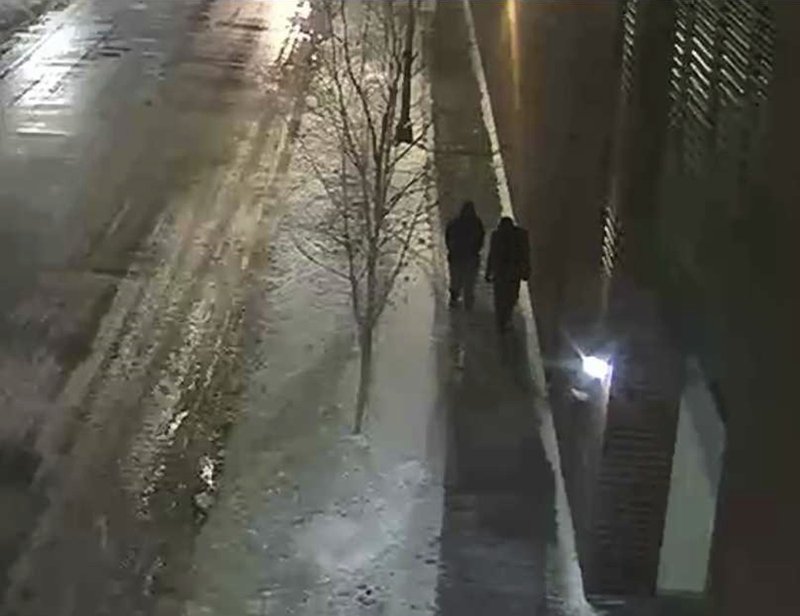


The police knew their names, that they were brothers and that they were black, not white. They knew they had worked on Empire, making them professional colleagues of Jussie Smollett. They knew Jussie had spoken to them by phone within an hour before the incident, as well as while they were conveniently out of the country in Nigeria. And the police knew they were returning from Nigeria the very next day. Between the time the interview was taped Tuesday night and when it aired Thursday morning, the police met the brothers upon their arrival at O'Hare and took them into custody on Wednesday, February 13. During the GMA interview, Jussie told Robin Roberts that he had no doubts that the two men in the picture were his attackers, a statement I'm guessing he came to regret. (During his press conference a few days later, the police Superintendent threw some shade at Jussie by "thanking" him for confirming the identification of his two black, not white, colleagues.)

Is there anything else Jussie regrets? Publicly he continues to profess his innocence. Deep in his heart, where he knows what really happened, does he feel any regret? The whole wretched mess is an example of unintended consequences, having spiraled wildly out of control and now, a year later, putting Jussie back in the news and back in legal jeopardy. It's clear that no-one, not the lawyers in the State's Attorney's office, not Jussie's lawyers and not Jussie himself, anticipated how negative the reaction to the charges being dropped would be.

And what about his lawyers? If we stipulate that they're not stupid, they can't possibly believe he's innocent. The police investigators have a virtual tsunami of evidence that does not, as the police Superintendent said, support Jussie's version of events. (Do his lawyers have any evidence that does support Jussie's version? Presumably if they did, they would have made it public before now.) Speaking as the non-lawyer I am, I'm guessing they're not thrilled at the notion of going into court and trying to defend Jussie's actions. (The billable hours? That's another story. A celebrity with legal troubles is manna from heaven to a defense lawyer.)

So what do the lawyers do now? Are they trying to convince Jussie to plead guilty and accept some kind of a deal, or are they really going to go to court? Let's watch and see.

Click here to watch Jussie's interview with Robin Roberts.

Saturday, November 2, 2019

Sunday, August 11, 2019

Is Rod Blagojevich Getting Out Of Jail Soon? No One Knows - Updated

Our jailed ex-governor Rod Blagojevich is back in the news because Donald has again teased him with a sentence commutation. The prospect is controversial around here, of course; both the Chicago Tribune and the Sun-Times had a lot to say about it Friday night. All five articles/columns below are posted in their entirety.

From Chicago Tribune reporter Jeff Coen: Sorting truth from myth in former Illinois Gov. Rod Blagojevich's conviction: 5 things to know:

Flying high above the country on Air Force One late Wednesday, President Donald Trump again teased that he might commute the sentence of former Illinois Gov. Rod Blagojevich, ending his time in a federal prison in Colorado. Even the possibility of Blagojevich coming back to Chicago more than four years before his sentence was expected to end sent reporters here scrambling for their laptops. Amateur legal experts around the water cooler also were weighing in Thursday about what the fate of the city’s most famous head of hair should be. On Friday evening, Blagojevich’s wife Patti was seen tying a “WELCOME BACK” balloon to a railing outside the family’s home, but declined to say whether it signified her husband’s return.

Here is a rundown of five frequent questions raised about whether Blagojevich should see his sentence commuted and be released from prison:

Was Rod Blagojevich’s 14-year sentence unusually long?

Yes and no. It was longer than most recent public corruption sentences here, but the sentence is within federal guidelines for Blagojevich’s crimes and is actually less than what prosecutors told U.S. District Judge James Zagel they wanted as his punishment, which was 15 to 20 years behind bars. Part of a judge’s job in sentencing is to factor in deterrence to keep others from committing the same offense. The governor immediately preceding Blagojevich was George Ryan, who fell to his own corruption case in the licenses-for-bribes scandal. He was sentenced to six and a half years. The judge noted that apparently was not enough of a deterrent for Blagojevich and other Illinois and Chicago politicians who have followed in Ryan’s footsteps. Some critics, however, pointed out that two years before handing down Blagojevich’s sentence, Zagel sentenced cooperating Chicago Outfit hitman Nicholas Calabrese to 12 years in prison — after he admitted on the witness stand to having a hand in the killings of 14 people.

Did federal prosecutors build a case around ‘only talk’?

This is mostly true. When many politicians get a whiff of federal crime investigators’ interest in their activities, one of the first things their lawyers tell them is to be careful what they say on the phone. You never know who could be listening. Blagojevich seemed to take the opposite track in 2008, when news reports of a federal probe of his administration were swirling around him. Federal investigators captured scores of phone calls he made allegedly plotting to have people shaken down for campaign contributions and attempting to get something for himself in exchange for an appointment to Barack Obama’s Senate seat, which he gave up after being elected president in 2008. The case was in fact built on all of that talking, but prosecutors said in Blagojevich’s case, the talking was the crime. They famously argued that if a police officer pulls you over and then asks you for money to tear up a ticket, it’s a crime for them to ask, even if you say no. It’s an attempt to use government power for personal benefit, which is what Blagojevich was convicted of.

Is it true he never personally pocketed any money?

This is also true. Prosecutors presented no evidence that Blagojevich ever stuffed a mattress with cash from his schemes. His defense lawyers were quick to point out to jurors that no one ever saw Blagojevich scooting around town in a Mercedes Benz bought with giant bribes. But prosecutors did suggest that was partially because the governor’s plans were cut short. One key witness against him was his longtime friend and former chief of staff, Lon Monk. Monk testified that after Blagojevich was elected, the two of them, along with close Blagojevich confidants Antoin “Tony” Rezko and Chris Kelly, agreed that they would use the levers of government inside the Blagojevich administration to make money. The plan, Monk said, was that the money would be kept secret by the group until after Blagojevich left office, and then split among them. It was Rezko (who was convicted in 2008) who at one point dipped into the pot early, and was told to put it back. Other elements of Blagojevich’s alleged self-dealing included trying to get Obama to give him a government post or ambassadorship in exchange for appointing someone Obama wanted to his old Senate seat. That also would have been a thing of value for Blagojevich, the government said, but Obama rebuffed him.

Was Blagojevich really just ‘playing politics,’ as he has claimed?

Blagojevich’s defense lawyers spent much of their time making this argument. Their efforts to convince Judge Zagel to let them “play all the (secretly recorded) tapes” of the governor was on this point: They wanted jurors to hear as many instances as possible where Blagojevich made it sound like he wanted to appoint then-Illinois Attorney General Lisa Madigan to the Senate seat, hoping that Democratic Party leaders would then go through her powerful father, Illinois Speaker Michael Madigan, to push Blagojevich’s platform through Springfield. Blagojevich’s team argued that he was not trying to collect $1.5 million in campaign contributions from supporters of Jesse Jackson Jr., whom Blagojevich was also considering for the seat. As the argument went, Democrats in Washington did not want Jackson, then an Illinois representative in the House, joining the Senate. Blagojevich argued his discussion of Jackson on the tapes was him floating that threat, in his mind boosting the chances for what came to be known as “the Madigan deal.” Prosecutors, however, pointed out that as Blagojevich was running out of string, just before his arrest, he directed his brother and chief fundraiser, Robert Blagojevich, to meet with the Jackson representatives and talk out the campaign contribution. It was at this time that investigators captured Blagojevich on tape urging his brother to be careful with his messaging on the matter and assume “the whole world is listening,” which prosecutors said showed his real intent.

Should he be let out to spend time with his family?

Blagojevich at this point has missed dozens of holidays and birthdays as he sits in prison. His two daughters, Amy and Annie, were in grade school when he was convicted, and Amy, the oldest, has now graduated from Northwestern University. His wife Patti has consistently pointed out this part of the former governor’s pain, and many courtroom observers felt sympathy for the couple’s children whenever they would appear in court. Zagel also considered the impact on Blagojevich’s family when he was sentenced but pointed out that Blagojevich had his family when he committed his crimes, and if anything should have stopped him, it should have been the thought of being separated from his children. But that was not to be the case. "Why did devotion as a father not deter him from engaging in such reckless conduct? ... Now it is too late,” Zagel said at the hearing. “If it’s any consolation to his children, he does not stand convicted of being a bad father.”

Also in the Trib, from columnist John Kass: Column: Mr. President, leave Rod Blagojevich where he belongs -- in prison:

If only Rod Blagojevich had been just another private sector weasel shaking down a children’s hospital — spineless and needy like the hapless Jerry from the “Rick and Morty” cartoons — we wouldn’t even be talking about him.

And though Blago clearly has the personality of a cartoon Jerry, constantly reciting Rudyard Kipling’s “If” during his corruption trial, yukking it up on “The View” and Donald Trump’s “The Apprentice,” letting his wife eat jungle bugs on yet another reality show in a play for cheap sympathy, let’s stipulate to one thing:

The man was once governor of Illinois.

He shook down a children’s hospital. He tried to sell a U.S. Senate seat. He had this thing that was bleeping golden. He’s no victim. The people of Illinois are his victims.

Now he’s in prison, where he belongs, despite President Donald Trump’s hinting that he’d like to spring Blago to revenge himself against former FBI Director James Comey and his friends. It was Trump’s firing of Comey that kicked off that special counsel investigation that bedeviled Trump for more than two years.

If the president of the United States wants to be a cartoon, I can’t stop him.

But Illinois is the most corrupt state in the union, with boss Democrats and Republicans working together against the people in an infamously corrupt bipartisan Combine that has bankrupted the state.

In Washington, it’s called “The Swamp.” In Illinois, it’s the Combine. Each has its media biscuit eaters, and institutional lines of defense, with gatekeepers and spinners running interference and moderates wetting their beaks.

When you were in school, you studied such relationships in biology class. There were the parasites and the host. And now the hosts are fleeing by the tens of thousands each year, in the infamous Illinois Exodus, a race to determine who will be the last taxpayer to turn out the lights.

As we head to 2020 and the elections, it’s clear that constant outrage and constant tears rule our politics now, like the tears from that little girl sobbing for her father, who was nabbed in an ICE illegal immigration raid the other day.

It’s that sort of thing that bothers the Republican White House. And with Democrats using those tears to play on the guilt of white women suburban voters, Trump reaches for his compassion play.

On top of it all, he just hates Comey and, apparently, also Comey’s friend and lawyer Patrick Fitzgerald, the former corruption-busting U.S. attorney in Chicago whose office convicted Blagojevich.

So determined is Trump to vex them while demonstrating his kindness that the other day he teased out that he was “very strongly” considering commuting Blagojevich’s 14-year prison term on corruption charges.

Our former Gov. Dead Meat has served seven years so far.

“I think he was treated unbelievably unfairly. And he’s a Democrat; he’s not a Republican,” the president told reporters. “And we’re thinking about commuting his sentence so he can go back home to his wife and children.

“And a lot of people thought it (the Blagojevich prosecution) was unfair, like a lot of other things. And it was the same gang — the Comey gang and the — all these sleazebags — that did it.”

Bingo.

The Comey gang. Sleazebags. Get it?

That set off a media stampede, until Trump issued a tweet later saying the White House would review the matter. That later tweet had a different tone, a different voice. There was none of the president’s meatiness. Rather, it was the tweet of a lawyer, dry and thin, practiced in the cool art of the skin-back.

Predictably, Illinois Republicans took great umbrage with Trump’s trial balloon, knowing it would cost them in congressional elections. They signed petitions. They made angry statements.

I get it. But I have a bad habit. I remember things.

I remember that when the last politico snared in the Blago investigation was sent to prison — the supreme Republican Combine boss William Cellini — Illinois Republican leaders had little to say.

They shut their mouths. Cellini, boss of the road builders and investor of millions in state pension funds, who made and housebroke a series of governors, was treated with great respect by politicians and journalists who called him “Mr. Cellini.” He was de facto Republican boss for decades.

And the feds taped him saying he just loved “flying under the radar” as he mocked a target of a shakedown. The jury could hear Cellini giggling.

When he went away, not for 14 years but for a baseball season, U.S. District Court Judge James Zagel said “three prominent journalists” had written letters of mercy on Cellini’s behalf. Zagel has never released the names of the journalists.

If Trump foolishly commutes Blagojevich’s sentence, Blago will become a celebrity. He’ll recite “If” right on cue and star in his own cheap redemption saga. His wife and kids will hug him and cry on the morning shows about Trump’s kindness.

But few will mention Chris Kelly, Blago’s friend and fundraiser who was also indicted during that period. Kelly committed suicide in a filthy shack he’d rented behind a lumberyard in the far south suburbs.

I stopped by afterward. The shack was a place of flies. Kelly had a family too.

Illinois corruption isn’t scenery for a Trump campaign stunt. It’s not a movie. It’s not a cartoon, with hapless Jerry Smiths playing the weasel straight man to Rick Sanchez’s merciless sarcasm.

Illinois is a place of political corruption. Taxpayers bear the true cost of it. And they’re leaving in droves.


Leave Blago where he belongs, Mr. President. In prison.


From the Sun-Times staff: Patti Blagojevich leaves up 'Welcome Home' balloons even though husband's clemency bid appears stalled

Some of Rod Blagojevich’s neighbors, not to mention a Chicago Tribune photographer, took notice Friday when Patti Blagojevich had “Welcome Home” balloons on her porch in the wake of President Donald Trump’s latest remarks about possibly releasing her husband from prison.

Despite the message on the balloons, it remained unclear Friday night if a grant of clemency for the former governor by Trump was any closer to becoming reality, sources told the Chicago Sun-Times. It also was unclear who put the balloons up: CBS2 Chicago reported Patti Blagojevich found them on the porch and didn’t purchase them.

Blagojevich, however, was spotted on her porch Friday evening with the balloons, an image captured by Chris Sweda of the Chicago Tribune.

The balloons remained on the Blagojevich family porch late Friday night.

Patti Blagojevich hasn’t commented publicly about the latest remarks by Trump, but she’s been her husband’s No. 1 advocate that he’s been treated unfairly.

She talked at length to WBEZ reporter Dave McKinney for a podcast chronicling her husband’s rise and fall, called “Public Official A,” and also reacted to former Chicago police Officer Jason Van Dyke getting a shorter prison sentence than her husband after Van Dyke was convicted of killing Laquan McDonald.

“I am speechless,” Patti Blagojevich tweeted in January after Van Dyke’s 81-month sentence was handed down. Rod Blagojevich was sentenced to 14 years in prison.

“A 17 year old is dead and the sentence is less than half of my husbands sentence for discussions with his staff and attorney about political fundraising,” Patti Blagojevich added in her tweet.

Though an appellate court tossed five of Rod Blagojevich’s convictions in 2015, federal prosecutors say he remains convicted “of the same three charged shakedowns” for which he was first sentenced in 2011.

Those include his attempt to sell then-President-elect Barack Obama’s U.S. Senate seat, to shake down the CEO of Children’s Memorial Hospital for $25,000 in campaign contributions and to hold up a bill to benefit the racetrack industry for $100,000 in campaign contributions. A jury also convicted Blagojevich of lying to the FBI.

After raising the possibility that Blagojevich could be free right away — on Thursday afternoon a commutation seemed hours from coming to fruition — by Thursday night Trump sudddenly decided to put on the brakes.

Trump said in a tweet, “White House staff” is still reviewing the former governor’s case.


From Sun-Times reporter Lynn Sweet: The inside story on Trump and Blagojevich's stalled bid for clemency: Kushner the key player:

WASHINGTON — On Wednesday, President Donald Trump said he was poised to cut short the sentence of imprisoned former Illinois Gov. Rod Blagojevich, but the quick emergence of critics after Trump signaled his move means clemency for now is up in the air.

“A lot of people are against it,” a senior administration official told the Chicago Sun-Times on Friday, with one big exception, the source said.

That’s Blagojevich’s main advocate in the White House, Jared Kushner, Trump’s son-in-law and senior adviser.

Trump first raised the possibility of giving Blagojevich a break from his 14-year sentence on May 31, 2018, with critics in and out of the White House able to block any action.

Giving Blagojevich a presidential break roared publicly back to life when Trump on Wednesday told reporters on Air Force One, “I’m thinking about commuting his sentence very strongly. I think he was — I think it’s enough: seven years.”

How did Blagojevich’s clemency prospects get resurrected in 2019?

“It was Jared,” I was told.

Kushner has no known personal connections to Blagojevich, though Trump does. Blagojevich got to know the former reality show star when he was a contestant on “Celebrity Apprentice.”

After raising the possibility that Blagojevich could be free right away — on Thursday afternoon a commutation seemed only hours away — by Thursday night Trump suddenly decided to put on the brakes.

Trump said in a tweet, “White House staff” is still reviewing his case.

What happened?

Trump dangling the likely Blagojevich commutation in advance provided opponents in and out of the White House time to act, with the same critics from 2018 quickly resurfacing, including the five Illinois Republicans who serve in the House.

In 2018, the Illinois GOP members — then numbering seven — banded together to ask Trump to keep Blagojevich’s punishment untouched.

The Illinois House members alone were not significant factors in stalling Trump. Their protests were “not going to be compelling enough for Donald Trump. It’s just not. There is always going to be somebody who thinks you should not be doing what you are doing,” the source said.

Moreover — and this argument may have had more impact — “It’s hardly draining the swamp to commute the sentence of someone who was selling his Senate seat and a lot of people are against it, which is how it got knocked down in the first place,” the senior administration official said.

Trump “has gotten pushback about Blagojevich before. He’s going to get it again” with the question put to Trump, “why are you rewarding this guy?”

Kushner, for all his pushing to get a break for Blagojevich, also did not have everything lined up before Trump on Wednesday all but announced the commutation — that is, getting all the paperwork signed off in the White House counsel’s office.

And on Thursday, no one seemed in a hurry as “the normal channels for examining possible pardons and commutation fired back up,” the source said. Even though Blagojevich’s file was submitted to the White House in 2018, it was only “discussed,” and “ultimately not reviewed.”

That slow walking in terms of getting the legal paperwork together — my phrase here — made it relatively easy, I was told, to get Trump to agree to slow things down.

Though the Blagojevich crime is often referred to as the attempted “selling” of the Illinois Senate seat vacated when then Sen. Barack Obama was elected president, there was more to the case.

Blagojevich was also convicted of trying to shake down the CEO of Children’s Memorial Hospital for $25,000 in campaign contributions and threatening to hold up a bill to benefit the racetrack industry for $100,000 in campaign contributions.

But it is also true that Blagojevich never ended up personally profiting from his schemes, a point his attorney, Leonard Goodman, underscored in an interview on Friday.

Goodman, an investor in Sun-Times Media, said, “there is a lot of misinformation going around about Blagojevich. The fact is he never took a bribe, never took a kickback, never took a penny from his campaign fund, never promised anyone anything in exchange for a campaign contribution, period.”

Blagojevich, 62, reported to prison on March 15, 2012. According to the federal Bureau of Prisons, his release date is March 13, 2024, meaning with good conduct time already calculated, Blagojevich is on track to serve 12 years.

Will Blagojevich get a break? I’m told, “it could go either way.”

Connecting the dots

On May 31, 2018, Trump first raised the possibility of clemency for Blagojevich and Martha Stewart while taking questions about a pardon he gave that day to conservative commentator Dinesh D’Souza.

There were a few threads tying the three together besides all being high-profile public personalities. Blagojevich was the only one still in prison.

Preet Bharara, who became a Trump critic after the president fired him as the U.S. attorney for the Southern District of New York, prosecuted D’Souza.

Stewart was prosecuted by James Comey, who years later Trump would fire as FBI director, the action triggering the Mueller probe.

Blagojevich’s prosecution was done under the direction of Chicago based former U.S. Attorney Patrick Fitzgerald, a longtime Comey friend. The news broke April 24, 2018 — just days before Trump mentioned clemency for Blagojevich — that Fitzgerald had been representing Comey since he was fired.

The Sun-Times editorial board gets the last word, at least for now: Regardless of your take on Blagojevich's sentence, what Trump is doing to him is wrong

Why would President Donald Trump think of setting Rod Blagojevich free?

a) Trump has always felt bad about firing the former Illinois governor on “The Apprentice.”

b) Trump can relate. Like Blagojevich, the president is an ethics-adverse puff of artfully arranged hair.

c) Trump wants to change the narrative. This past week was a bad one for the president, what with all kinds of mean people accusing him of being a spiritual accomplice to at least one mass murder, given the way he eggs on haters.

d) Trump has carefully considered the merits of Blagojevich’s case, weighing the seriousness of the former governor’s crimes against the length of his sentence. The president is concerned about proportionality of punishment in our criminal justice system. And he is taking into account any evidence that Blagojevich has grown from his mistakes or expressed contrition.

We’re just kidding on that last one. You know that.

If Donald Trump ever commutes Blagojevich’s sentence, it will be because Trump sees something in it for himself and nothing more.

That’s who Trump is, and that’s the tragedy of it.

Blagojevich sits in a federal prison in Colorado, seven years into a 14-year sentence that we believe is too long, and his chances of getting sprung early depend not at all on the merits of his case.

They depend on the whim of a president who’s perfectly happy to dangle out hope and then whip it away.

Trump is jerking Blagojevich around, and the ex-governor’s family, too.

Blagojevich deserved to be locked up. He had it coming. He tried to sell a vacant Senate seat and extort big campaign donations from a hospital and a racetrack owner. Even in Illinois, those are no-nos.

But we have long argued that Blagojevich’s 14-year sentence was too severe. A more appropriate sentence would have been in line with the 61⁄2 years given former Gov. George Ryan for equally — if not more — serious betrayals of the public trust.

We don’t agree with Trump that Blagojevich’s only crime was to say things “many other politicians say,” but we have always felt he is more ridiculous than venal.

Trump began the week by hinting he might commute Blagojevich’s sentence. Our best guess is that the president thought this might give him rhetorical ammunition in his attacks against the Justice Department, whose supposed “deep state” operatives he despises for pursuing an investigation into his presidential campaign’s ties to Russia.

The federal prosecutors who charged Blagojevich were “sleazebags,” said Trump, who treated the former governor “unbelievably unfairly.” He said “many people” had asked him to commute Blagojevich’s sentence.

By Thursday evening, though, Trump was in retreat. This one wasn’t playing out as expected.

Those “many people” were not to be found, and nobody was cheering him on. On the contrary, elected officials across Illinois were calling on Trump to reconsider. Republicans and Democrats alike, from Winthrop Harbor to Cairo, were of a like mind that Blagojevich should remain right where he is — prison.

Chicago Mayor Lori Lightfoot, a Democrat, said Blagojevich had “disgraced his office” and never expressed contrition.

Illinois House Republican leader Jim Durkin said commuting Blagojevich’s sentence would “send a message that if you’re a kind of character and you’ve been turned into a folk hero by the president . . . you have a good shot at not serving your sentence and paying your debt to society.”

By Thursday night, Trump seemed to get it. Setting Blagojevich free would not add to the narrative of a Justice Department out of control. It would add to the narrative of a president who has a soft spot for fellow conmen.

So he backed down. He tweeted that the matter would simply be “reviewed.”

And by Friday morning, the president was back to railing about “racist” Hollywood “elites,” the “failing NYT” and other bugaboos.

Rod Blagojevich doesn’t look to be going anywhere soon.

And given how Trump has completely politicized the commutation process, tainting any decision he might make, the former governor may be going nowhere for a long time.

Which is not right.


Monday morning update: 


Update #2, on Thursday, August 15. In a story posted yesterday, CNN says Trump appears to have backed off the idea of commuting Blagojevich's sentence after speaking with a couple of Illinois Republican congressmen. "I wish I had the perspective before," said Donald:

President Donald Trump was on the cusp of commuting former Illinois Gov. Rod Blagojevich's sentence late last week, multiple sources said. But then Republican members of Illinois' congressional delegation began flooding the White House with calls.

Now, Trump appears to have backed off his plans to commute Blagojevich's sentence.

Several Republican lawmakers called acting White House chief of staff Mick Mulvaney and White House counsel Pat Cipollone, the sources told CNN, and the Republican members of Illinois congressional delegation issued a joint statement opposing the move.

At least two of them, Reps. Darin LaHood and Mike Bost, made their case directly to the President on Thursday night, urging him not to go forward. They laid out the litany of crimes Blagojevich committed while in office and argued it would send the wrong message to voters about corruption by public officials.

Trump's response: "I wish I had the perspective before," according to Bost, who served on the Illinois House's impeachment committee to remove Blagojevich from office in 2009.

"Those charges were so outrageously bad," Bost said.

That same evening, LaHood -- a former federal and state prosecutor -- called Trump as well and laid out in detail the brazen charges against Blagojevich, including allegations he threatened to cancel millions in state dollars for a children's hospital if its CEO did not write him a $25,000 campaign check. Among the charges was that Blagojevich attempted to sell former President Barack Obama's Senate seat that he resigned in order to become president.

And Trump was informed on the call that Blagojevich -- whom Trump knew from his role on "Celebrity Apprentice" -- didn't offer any remorse for his crimes, sources said.

"I think this would have real ramifications," said LaHood, who also spoke with Cipollone about the matter. "We're trying to send a message that this type of public corruption is terrible for Illinois."
(Read more here.)

Thursday, April 4, 2019

Jussie's Very Bad Day - Updated

Will Jussie Smollett pay the city of Chicago $130,000 and change to cover the costs of investigating his hate crime hoax? My guess is no, but today's the deadline. If he doesn't pay, will the city sue? My guess? Yes. Mayor Rahm Emanuel isn't a marshmallow and he isn't a pushover. (When the letter was sent, Rahm suggested Jussie write "I'm accountable for the hoax" in the memo section of the check.) He's also leaving office in May, which makes him possibly less worried about the political repercussions of a lawsuit than if he was going to continue to be the mayor. This is from CNN:

In a letter sent to the "Empire" actor on March 28, the city's corporation counsel said that if he didn't pay in the next seven days, he might be prosecuted using Chicago's municipal code or other legal remedies.

"The city feels this is a reasonable and legally justifiable amount to collect to help offset the costs of the investigation," city spokesman Bill McCaffrey said.


The letter was sent after a prosecutor unexpectedly dropped 16 felony disorderly conduct charges against Smollett, who was accused of staging the attack on himself.
(Read more here.) 

NBC News in Chicago says a lawsuit is "likely" if Jussie doesn't pay up:

Nonpayment will likely prompt the city to sue Smollett, prompting a civil trial where standards for proving he staged the incident will be lower than in criminal court. (Read more here.) 

Chicago's mayor-elect Lori Lightfoot, who like Mr. Smollett is black and gay, appeared on MSNBC last night: 

Chicago’s new mayor-elect Lori Lightfoot still has questions about why the charges against Jussie Smollett were dropped and has called on the office of Cook County State’s Attorney Kim Foxx to provide more information about why the case against the actor was abandoned.

“The State’s Attorney’s office here which made the decision unilaterally to drop the charges has to give a much more fulsome explanation,” Lightfoot said during an interview with Craig Melvin on MSNBC Wednesday. “We cannot create the perception that if you’re rich or famous or both that you got one set of justice — and for everybody else it’s something much harsher. That won’t do and we need to make sure that we have a criminal justice system that has integrity.”

When asked point blank by Melvin about whether she thought Smollett was innocent, Lightfoot hedged but said the evidence did not suggest that conclusion.

“I believe that everybody is entitled to a presumption of innocence,” she said. “But I saw — as I’m sure you and your listeners saw — a very compelling case, with video tapes, witness statement and other information that looked like he had staged a hoax, and if that happened he’s got to be held accountable.”

Reps for Smollett declined to comment. Reps for Foxx did not immediately respond to a request for comment.

The remarks from Lightfoot, who will become the first black woman and first openly gay woman to serve as Chicago’s mayor suggest, that focus will not let up on the Smollett case even after Rahm Emanuel leaves office. In his final days on the job, Emanuel railed against the decision by Foxx to drop all charges against Smollett. In an angry press conference last month, Emanuel called the move a “whitewash of justice.”

“Do I think justice was served? No,” he said. “I’ve heard that they wanted their day in court with TV cameras so America could know the truth. But no, they chose to hide behind secrecy and broker a deal to circumvent the judicial system … I stand behind the detectives’ investigation.”
(From Yahoo News, read more here.)

Will Jussie cave and cough up the money, in effect acknowledging that he staged the attack, or will he call Rahm's bluff and gamble that he won't get sued? Either way, I feel safe in saying that once again, Jussie Smollett is not having a good day.

Thursday night update. Jussie didn't pay:


Saturday, March 30, 2019

A Message From The Cook County State's Attorney - Updated

On Wednesday night the Chicago Tribune published an editorial titled "The Jussie Smollett Fiasco: Kim Foxx Digs A Deeper Hole." (I linked to it below.) Last night Ms. Foxx, the Cook County State's Attorney, fired back. Note that she does not address the fact that early on, she had direct contact with a member of the Smollett family and at their request, tried to persuade the Police Superintendent to give the case to the FBI. She has subsequently acknowledged that that was a mistake, but still. That action is one of the things that's making the decision to drop the charges look fishy and politically motivated. Note also that earlier in the week she claimed her office would indeed get a conviction: "I believe, based on the facts and the evidence presented in the charging decision made by this office, this office believes that they could prove him guilty." This is her commentary, in its entirety:

Let’s talk about the Jussie Smollett case. Let’s talk about his alleged actions, the decision about how best to prosecute and resolve the case, and the implications for our Chicagoland community.

There was considerable evidence, uncovered in large part due to the investigative work of the Chicago Police Department, suggesting that portions of Smollett’s claims may have been untrue and that he had direct contact with his so-called attackers. Claims by Smollett or others that the outcome of this case has “exonerated” him or that he has been found innocent are simply wrong. He has not been exonerated; he has not been found innocent.

Falsely reporting any crime is itself a crime; falsely reporting a hate crime is so much worse, and I condemn in the strongest possible way anyone who does that. Falsely reporting a hate crime causes immeasurable harm to the victims of actual crimes, whether because they are less likely to be believed or, worse, because they are afraid to report their crimes in the first place for fear of not being believed.

So, why isn’t Smollett in prison or at least on trial? There are two different answers to this, both equally important.

First, the law. There were specific aspects of the evidence and testimony presented to the office that would have made securing a conviction against Smollett uncertain. In determining whether or not to pursue charges, prosecutors are required to balance the severity of the crime against the likelihood of securing a conviction. For a variety of reasons, including public statements made about the evidence in this case, my office believed the likelihood of securing a conviction was not certain.

In the interest of full transparency, I would prefer these records be made public. However, in this case, Illinois law allows defendants in certain circumstances to request that public records remain sealed. Smollett chose to pursue that avenue, and so my office is barred from releasing those records without his approval.

Another key factor is that the crime here was a Class 4 felony, the least serious category, which also covers things like falsely pulling a fire alarm in school and “draft card mutilation.” These felonies are routinely resolved, particularly in cases involving suspects with no prior criminal record, long before a case ever nears a courtroom and often without either jail time or monetary penalties. Any prosecutor, law-enforcement leader or elected official not grandstanding or clouded by political expediency understands the purpose of sentencing guidelines.

But more important than the dispassionate legal justification, there was another reason that I believe our decision not to prosecute the case was the right one.

Yes, falsely reporting a hate crime makes me angry, and anyone who does that deserves the community’s outrage. But, as I’ve said since before I was elected, we must separate the people at whom we are angry from the people of whom we are afraid. I am angry at anyone who falsely reports a crime. I am afraid when I see a little girl shot dead while sitting on her mother’s lap. I am afraid when I see a CPD commander slain by a four-time felon who was walking the streets. I am also afraid when I see CPD resources used to initially cover up the shooting death of Laquan McDonald.

I was elected on a promise to rethink the justice system, to keep people out of prison who do not pose a danger to the community. I promised to spend my office’s finite resources on the most serious crimes in order to create communities that are both safer and fairer.

Our community is safer in every sense of the word when murderers and rapists are locked away. But we can’t allow fearmongers to devalue the tremendous progress we’ve made in the last year. Since taking office, I’ve sought to employ alternative prosecutions, diversions, alternate outcomes and other forms of smart justice, and it has been working — violent crime in Chicago is down overall. In addition to the benefits of smart justice on recidivism and keeping families together, it also creates bandwidth for my office to dedicate more resources to combating not only truly violent crimes but also the opioid crisis, holding big banks accountable for their actions, protecting consumers from data breaches and other critical work.

Since it seems politically expedient right now to question my motives and actions, and those of my office, let me state publicly and clearly that I welcome an outside, nonpolitical review of how we handled this matter. I am not perfect, nor is any other prosecutor out there, but ensuring that I and my office have our community’s trust is paramount.

As a public figure, Smollett’s alleged unstable actions have probably caused him more harm than any court-ordered penance could. None of that, though, should detract from two facts that must be able to coexist: First, falsely reporting a hate crime is a dangerous and unlawful act, and Smollett was not exonerated of that in this case. Second, our criminal justice system is at its best when jails are used to protect us from the people we rightly fear, while alternative outcomes are reserved for the people who make us angry but need to learn the error of their ways without seeing their lives irrevocably destroyed.


Previous posts about Jussie Smollett:

March 27: An Editorial From The Chicago Tribune

Jussie didn't win an NAACP award last night, which is probably a good thing. In an earlier post I wrote that the award would be given out during the live show tonight, but it turns out that was wrong. Some of the awards were given out at a dinner last night:

"Empire" actor Jussie Smollett skipped the NAACP Image Awards Dinner on Friday night as controversy continued to swirl around the dismissal of felony charges against him for false reporting of a hate crime.

... Smollett, who stars as Jamal Lyon on the Fox series, had flown to Los Angeles on Wednesday, sparking rumors he might be in attendance at the awards show. Smollett was nominated for best supporting actor in a television drama for his role on "Empire" -- an award he has been nominated for four years in a row and won in 2017.

Jesse Williams, of "Grey's Anatomy," won the award on Friday night as part of the untelevised awards portion of the show. The rest of the awards will be given away live on TV One [tonight.]
(From ABC News, read more here.)

Will Jussie attend tonight's event? Stay tuned. 

Saturday afternoon update. More about how State's Attorney Kim Foxx came to be talking to a member of the Smollett family; as you read, keep in mind that at the time of these events, the Osundairo brothers were still in Nigeria and Jussie was considered to be the victim of a hate crime: 

Tina Tchen's longtime friend wasn't surprised the former Obama administration aide helped connect Jussie Smollett's family with a top Illinois prosecutor.

Weeks before a grand jury indicted Smollett on the theory he falsely reported being the victim of a hate crime, relatives of the actor, who is black and gay, had expressed to Tchen "concerns about the investigation" by Chicago police.

Getting the right person to take those sort of concerns seriously has been a hallmark of Tchen's career, highlighted by a stint as then-first lady Michelle Obama's chief of staff and now by her work leading a probe of workplace culture at the Southern Poverty Law Center.

"Long before Black Lives Matter, long before Time's Up, long before #MeToo, we were aware of how difficult it is to be believed as a woman, as a gay, as a black," Tchen's friend, Marilyn Katz, said. "Our whole lives have taught us that lesson."

But the involvement of Tchen, a Harvard graduate who earned her law degree from Northwestern University, in the Smollett case has sparked accusations of favoritism, particularly after the office of Cook County State's Attorney Kim Foxx this week dropped 16 felony charges of disorderly conduct against Smollett. In exchange, he agreed to forfeit his $10,000 bail and complete community service.

Tchen, 63, said her contact with Foxx on behalf of Smollett's family was not intended to influence the case's outcome.

"I know members of the Smollett family based on prior work together," she said this week in a statement.

"Shortly after Mr. Smollett reported he was attacked, as a family friend, I contacted Cook County State's Attorney Kim Foxx, who I also know from prior work together. My sole activity was to put the chief prosecutor in the case in touch with an alleged victim's family who had concerns about how the investigation was being characterized in public."

That explanation, however, hasn't quieted calls for investigations into whether Smollett got off easy because of his fame and well-placed connections, perhaps including Tchen.

Smollett's camp denies the claims. Tchen did not respond beyond her statement to CNN's request for comment.

Smollett told police two men attacked him on January 29, yelling racist and homophobic slurs while striking him. He said the assault ended with a noose placed around his neck and a chemical poured on him.

Tchen reached out to Foxx just three days after the attack report, according to text and email messages obtained by CNN through a public records request. She wrote that the family had "concerns about the investigation."

Foxx emailed Tchen later that day, saying in part, "Spoke to the (Police) Superintendent (Eddie) Johnson. I convinced him to Reach out to FBI to ask that they take over the investigation. He is reaching out now and will get back to me shortly."

On that same day, another person, identified by Foxx's office as a Smollett family friend, texted the prosecutor to ask whether they could talk by phone, the records show. "Tina Tchen gave me your number," the friend wrote.

Hours later, Foxx responded by text to the family friend, whose identity is redacted in the public records.

"Spoke to the superintendent earlier, he made the ask. Trying to figure out the logistics. I'll keep you posted," the prosecutor wrote.

"Omg this would be a huge victory," the family friend responded.

"I make no guarantees, but I'm trying," Foxx replied.

Chicago police have said the FBI "has been involved since Day One ... providing technical assistance to our officers" in the Smollett case. Johnson has said he was "amenable" to talking about having the FBI lead the Smollett investigation but police and federal officials decided it would be most appropriate for Chicago police to stay at the helm, he told USA Today. (From CNN, read more here.)

The irony here is that if Foxx really was giving Jussie special treatment by dropping the charges, either because of his celebrity or because of his political connections, it sure backfired. The resulting outrage has put him and his actions under an even brighter spotlight, and not to his benefit. As I said in an earlier post (read it here,) if his attorneys have any kind of credible evidence to offset the narrative that Jussie was not exonerated and is not innocent, the time to make it public is now.

Update #2, late Saturday afternoon. Chicago Police Superintendent Eddie Johnson has issued a statement in response to State's Attorney Foxx's commentary:


Update #3 on Sunday morning. Apparently Jussie did not attend the NAACP Awards event last night; it's interesting that producers felt compelled to issue instructions that there be no Jussie Smollett jokes:

Despite support from Anthony Anderson, Jussie Smollett was a no-show at Saturday night's NAACP Image Awards in Hollywood.

The "Empire" actor was nominated for Outstanding Supporting Actor in a Drama Series, but lost out to “Grey’s Anatomy” star Jesse Williams. Williams won the award during the untelevised portion of the show at the awards dinner Friday, which USA TODAY confirmed Smollett also did not attend.

But that didn't stop Chris Rock from taking aim.

"They said 'No Jussie Smollett jokes,' " said Rock, who was there to present Outstanding Comedy Series. But that didn't stop him. "What a waste of light skin," Rock cracked. "Do you know what I could do with that light skin? That curly hair? My career would be out of here! I'd be running Hollywood."


"What the hell was he thinking? You're 'Jessie' from now on," Rock continued, as cameras showed Trevor Noah cracking up in the crowd. "You don't get the 'u' no more. That 'u' was respect. You ain't getting no respect from me!" (From USA Today, read more here.)

TMZ has the video, see it here

And one more thing: When you've lost Saturday Night Live...


Between Chris Rock and SNL, I think it's safe to say, once again, that Jussie Smollett is not having a good day.

Wednesday, March 27, 2019

An Editorial From The Chicago Tribune - Updated

At 6.10 p.m. this evening, the Chicago Tribune posted the following editorial about the Jussie Smollett case, titled "The Jussie Smollett Fiasco: Kim Foxx Digs A Deeper Hole":

Mayor Rahm Emanuel and Chicago police Superintendent Eddie Johnson welled up with outrage over the decision by the Cook County state’s attorney’s office to drop felony charges against TV actor Jussie Smollett, who had been facing trial for concocting a hate crime to benefit his career. Smollett’s penalty: two days of community service and forfeiture of the $10,000 in bond money he’d put up. And then there was Smollett himself, hands shaking as he insisted he was innocent, that he really was a victim.

But in the first-day tumult, one voice wasn’t heard. State’s Attorney Kim Foxx, step up. Try to explain the indefensible.

On Wednesday, Foxx tried to explain the indefensible, and failed. Instead she dug herself a deeper hole.

In essence, she said there’s public confusion about all this because the public just doesn’t understand the intricacies of the legal system.

“Every single day,” Foxx told WBEZ, “… there are people who get similar arrangements … people who get sentences that are probably not what some people would want. Every single day.” As if to say: Trust us. You critics don’t understand.

That doesn’t come close to explaining why Foxx’s office brought the case this far, then let a celebrity walk, even though his alleged crimes consumed thousands of police man-hours in a city pummeled by violent crime. Foxx may think she has calmed the storm, but she hasn’t.

Three urgent questions remain for the state’s attorney:

  • First, do Chicagoans have the full story of Foxx’s conduct in this case? Foxx’s office disclosed that she’d had contact with Smollett’s representatives during the early stages of the investigation. That contact included an email from a politically connected lawyer acting on behalf of Smollett and his family. The Tribune has reported that the lawyer told Foxx the family had “concerns about the investigation” and wanted Superintendent Johnson to turn over the investigation to the FBI. Foxx asked Johnson to do exactly that, the Tribune reported. Johnson refused. Foxx also had exchanged texts with a Smollett relative. Foxx’s office said that, “out of an abundance of caution … State’s Attorney Foxx decided to remove herself from the decision-making.” Is that everything there is to know about these communications between Foxx and Smollett’s allies?

  • Second, what’s the rationale for cutting a secret deal without making Smollett reimburse the city for the costs his alleged actions inflicted on taxpayers? Without making him take responsibility for those alleged actions? To Chicagoans, to the rest of the country for that matter, it appears there was more to the decision to drop the charges and sandblast Smollett’s record than what Foxx’s office has disclosed so far.

  • Third, why the sealed case file? Specifically, is there any linkage between the answers to the first two questions — between Foxx’s stumbles at the start of the case and her office’s decision to abandon it? Sealing this file deprives Chicagoans of any insight into what may have led to this bizarre outcome. There occasionally are good reasons to expunge records and seal case files, but shielding prosecutors’ actions from public scrutiny isn’t one of them.
On Wednesday, the Chicago Police Department released its investigative file in the Smollett case. We appreciate that transparency, and if police have records of all their contacts with prosecutors in the early days of this case — including any efforts by Foxx or her prosecutors to influence the trajectory of the investigation — we hope CPD will release those records too.

Ms. Foxx, CPD’s actions should inspire you to be just as transparent — now.


In other (related) news, ABC News says the FBI is investigating why the charges against Smollett were dropped: 

Fuming from the stunning decision by prosecutors to drop charges in the "hoax" attack case against "Empire" actor Jussie Smollett, Chicago Mayor Rahm Emanuel blasted the move Wednesday, saying all the evidence police collected against the TV star should be unsealed as the FBI opened a review of the disposition of the case.

The Federal Bureau of Investigation (FBI) is reviewing the circumstances surrounding the dismissal of the criminal charges against Smollett, two law enforcement sources briefed on the matter told ABC News on Wednesday. The sources insisted it is not an investigation, but a "review."

"He's saying he's innocent and his words aren't true," Emanuel told ABC News chief anchor George Stephanopoulos on "Good Morning America." "They better get their story straight. This is actually making a fool of all of us."

But Cook County State Attorney Kimberly Foxx, whose office dismissed the charges against Smollett, insisted that the actor did not receive any special treatment. She said Smollett was allowed to dispose of his case through an alternative prosecution program, just like 5,700 other people her office has charged with low-level felonies over the past two years.

In an interview with ABC News, Foxx said Smollett qualified for alternative prosecution because he doesn't have a history of violence, lacks a criminal record and was charged with a class four felony, which is one step above a misdemeanor. She said her office would rather put resources towards prosecuting violent criminals.

Foxx said in a separate interview with ABC station WLS-TV that while Smollett was not found guilty in a court of law, "I believe, based on the facts and the evidence presented in the charging decision made by this office, this office believes that they could prove him guilty." "I think this office, based on the charging decision, believes he is culpable of doing that," Foxx said.
(Read more here.) 

As I'm writing late on Wednesday night, I'd say this story is a long way from being over. 

Thursday morning update: Jussie and his case are still in the news and honestly I'm almost beginning to feel sorry for the man. (Almost...) As I've said here before, he's not a rocket scientist and he had no idea what he was setting in motion when he decided he needed to be more famous. He now finds himself in the land of unintended consequences, only partly because of his own choices. He's caught in the "This is Chicago" political crossfire as the various stakeholders point their fingers, deflect blame and jockey for advantage. Even Jussie's lawyers may have served him badly. Yes, it's great (for Jussie) that they got the charges against him dismissed but they clearly didn't anticipate how controversial that decision would be. When they put Jussie in front of the microphones to say, once again, that he's innocent, they didn't anticipate how loudly the Mayor, the Police Superintendent and the Assistant State's Attorney would holler back: "No, you're not." 

Back when it still appeared that there would in fact be a trial, Jussie's lawyers insisted they wanted cameras in the courtroom so all of America could see the evidence that proves Jussie is innocent. If they really have such evidence, they should make it public, sooner rather than later. Jussie's career hangs in the balance.   

This story has taken on a life of its own and you bet I'll be watching to how it all plays out. 


Toni Preckwinkle is one of the two candidates in the run-off election for Mayor of Chicago. This case came up in a debate last night:


"... causes minimum harm to the defendant in the long term." Is that what's driving all this:


Update #2. The first time I ever mentioned Jussie Smollett in this blog, in a Guessing Game post dated February 18 (read it here,) I said that the story was spiraling out control. It's still true. Ponder this, from ABC Legal Reporter Dan Abrams' website Law And Crime:

An Illinois lawmaker said he wants to introduce a bill that would punish film productions that hire actor Jussie Smollett. Currently, the state provides tax breaks to movies and television shows that film there, but State Rep. Michael McAuliffe (R-Chicago) is looking to pass a law that would strip such benefits from any production that includes Smollett. The actor is currently a cast member of the show Empire, which films in Chicago.

“Smollett should not be able to get anything more from the City of Chicago or Illinois,” McCauliffe said in a statement, adding that “a lot of valuable Chicago Police Department man hours and resources were wasted chasing down a bogus crime arranged by Smollett.” Smollett forfeited $10,000 in bond money as part of the arrangement that led to his case being dismissed, but McCauliffe does not believe that’s enough. After the Empire actor’s case was dismissed with little explanation, McCauliffe wants a stronger message to be sent against Smollett, who had been accused of staging what he claimed was a racist, homophobic assault.

McCauliffe said the alleged hoax cost the city of Chicago “a lot more than a $10,000 bond.”

Nine television shows currently shoot in Chicago, according to the Chicago Sun-Times. Tax benefits include a 30 percent credit for in-state purchases and for hiring Illinois residents (those hired who live in areas with high unemployment can yield an addition 15 percent credit for the production). If a film or TV show uses a hotel room for at least 30 days for someone involved in the production, they won’t have to pay the hotel occupancy tax either.

McCauliffe, who has served as an Illinois State Representative since 1997, reportedly plans on introducing the bill this week.
(Check out the website here.)

I would say it's unlikely a bill like this would ever become law. I would also say that in spite of the charges against him being dropped, Jussie Smollett is having another bad day. As I said above, unintended consequences. 

Update #3. ABC7 Chicago reporter Ross Weidner provides a Twitter "explainer" about what happened in court this morning:


Meanwhile, back at City Hall:


From the Chicago Tribune article:

The mayor said Police Department brass are compiling the costs of the investigation into Smollett’s claim. City lawyers will then send Smollett a letter calling on him to pay the full amount, Emanuel said.

“The police are right now finalizing the cost that was used, police resources to come to the understanding this was a hoax and not a real hate crime,” Emanuel said. “What we spent. The corporation counsel, once they have the finalized and feel good about the numbers, will then send a letter to Jussie Smollett and his attorneys, trying to recoup those costs for the city.”

“It is a small way of both acknowledging, one, guilt, two, that we spent these resources and the taxpayers deserve, at minimum — because I think there’s a whole other level of ethical costs, because he’s still walking around, ‘Hey, I’m innocent, everything I said from day one is true’ — that actually we’re going to get the resources back. But come with those resources is, implicitly, if you pay it, that the city spent money to uncover what the grand jury discovered.”
(Read more here.)

A little political grandstanding from the outgoing mayor? Possibly.

Update #4. The National District Attorneys Association released a statement on prosecutorial best practices in high profile cases:

The handling of cases by prosecutors nationwide has garnered national media attention and a greater focus on the role of the prosecutor in the criminal justice system. In each instance, the local prosecutors involved in the case must weigh all the facts and determine the best path forward to ensure justice is served. Prosecutors don’t always get it right, nor does the public necessarily get to see all the information available to prosecutors, particularly during an ongoing investigation. In these types of circumstances, it is easy for emotions to run high and finger pointing to ensue, but it is important not to allow investigations and charging decisions to be swayed by public sentiment and to follow best practices and guidelines in whatever situation may arise. 

The recent incident in Chicago involving actor Jussie Smollett is no different and has garnered national attention as the case has made its way through various phases of the investigation and prosecution process. While details of the case remain sealed, several observations must be made in order to increase, not diminish, the public’s confidence in the criminal justice system. 

First, when a chief prosecutor recuses him or herself, the recusal must apply to the entire office, not just the elected or appointed prosecutor. This is consistent with best practices for prosecutors’ offices around the country. 

Second, prosecutors should not take advice from politically connected friends of the accused. Each case should be approached with the goal of justice for victims while protecting the rights of the defendant. 

Third, when a prosecutor seeks to resolve a case through diversion or some other alternative to prosecution, it should be done so with an acknowledgement of culpability on the part of the defendant. A case with the consequential effects of Mr. Smollett’s should not be resolved without a finding of guilt or innocence.

Fourth, expunging Mr. Smollett’s record at this immediate stage is counter to transparency. Law enforcement will now not be able to acknowledge that Mr. Smollett was indicted and charged with these horrible crimes and the full record of what occurred will be forever hidden from public view. 

Finally, we believe strongly that hate crimes should be prosecuted vigorously but the burden of proof should not be artificially increased due to the misguided decisions of others. (Read the entire statement here.)

Finally, at least for now, could Jussie Smollett win an NAACP award Saturday night? He's nominated for Outstanding Supporting Actor in a Drama Series and TMZ says he flew to LA last night to attend Saturday night's awards ceremony. (Read about it here.) Jussie's fellow nominees are Jesse Williams for Grey's Anatomy, Joe Morton for Scandal, Romany Malco for A Million Little Things and Wendell Pierce for Tom Clancy's Jack Ryan. Will Jussie win? It probably depends on when the voting took place.

Thursday afternoon, update #5. Mayor Emanuel has followed through on his threat:


And here's the letter: