Showing posts with label coronavirus. Show all posts

Friday, October 2, 2020

Donald Is Sick - Updated

This is a developing story this morning and who knows what twists and turns lie ahead. I'll post interesting things as I see them, starting with this: 

At about 9:15 this morning, the CNN bottom-of-screen crawler said this: 

National Security Council ordered masks for White House grounds back in February, but was met with sharp directive that masks were not "a good look," multiple officials tell CNN. "If you have the whole west wing running around wearing masks, it wasn't a good look," one admin official recalls of [the] directive that came down after some NSC staffers were told to wear masks. [The] west wing wanted to "portray confidence and make the public believe there was absolutely nothing to worry about," the official says, revealing for [the] first time the image-conscious reason for early opposition to masks within [the] White House. In late January when [the] U.S. confirmed several coronavirus cases, west wing staff often told others in the administration that this was nothing to worry about, one former official says; staffers were repeatedly told in internal White House meetings that the virus had been "contained" because there were only 15 cases at the time. One former admin official laments setbacks the early masks opposition dealt U.S. coronavirus response, telling CNN "we lost so much time... this could have been so different."

Several minutes later, there was this: 

Trump has several risk factors for more severe Covid-19 symptoms. He is 74, falling in [the] age range that faces five times greater risk of hospitalization and 90 times greater risk of death from the virus compared to young adults, [the] CDC says. Men are also more likely to die from coronavirus, and Trump is considered obese, which triples risk of hospitalization from Covid-19, CDC says. In 2018, one test indicated Trump had moderate heart disease. Not everything about Trump's health is known: [the] president made [a] relatively secret visit to Walter Reed National Military Medical Center last November, though [the] White House press secretary said the unannounced trip was to begin portions of his routine annual physical exam.

It's going to be an interesting day.

Update: Speaking of twists and turns, several people in my Twitter timeline were pointing out that Donald's illness is a distraction from the "Kimberly" situation. I assumed that meant Kimberly Guilfoyle, a.k.a. Don Jr.'s girlfriend, but I hadn't heard anything specific about her since her weird speech at the Republican convention a few weeks ago. A quick Google search turned up this, from Jane Meyer, writing at The New Yorker: 

As President Donald Trump heads into the 2020 elections, he faces a daunting gender gap: according to a recent Washington Post/ABC News poll, he trails Joe Biden by thirty percentage points among female voters. As part of his campaign, Trump has been doing all he can to showcase female stars in the Republican Party, from nominating Amy Coney Barrett for the Supreme Court to naming Kimberly Guilfoyle, the former Fox News host and legal analyst, his campaign’s finance chair. Guilfoyle, however, may not be an ideal emissary. In November, 2018, a young woman who had been one of Guilfoyle’s assistants at Fox News sent company executives a confidential, forty-two-page draft complaint that accused Guilfoyle of repeated sexual harassment, and demanded monetary relief. The document, which resulted in a multimillion-dollar out-of-court settlement, raises serious questions about Guilfoyle’s fitness as a character witness for Trump, let alone as a top campaign official.

In the 2020 campaign, Trump has spotlighted no woman more brightly than Guilfoyle. She was given an opening-night speaking slot at the Republican National Convention. And this fall Guilfoyle, who is Donald Trump, Jr.,’s girlfriend, has been crisscrossing the country as a Trump surrogate, on what is billed as the “Four More Tour.” At a recent “Women for Trump” rally in Pennsylvania, Guilfoyle claimed that the President was creating “eighteen hundred new female-owned businesses in the United States a day,” and praised Trump for promoting school choice, which, she said, was supported by “single mothers like myself.”

Guilfoyle has maintained that her decision to move from television news to a political campaign was entirely voluntary. In fact, Fox News forced her out in July, 2018—several years before her contract’s expiration date. At the time, she was a co-host of the political chat show “The Five.” Media reports suggested that she had been accused of workplace impropriety, including displaying lewd pictures of male genitalia to colleagues, but few additional details of misbehavior emerged. Guilfoyle publicly denied any wrongdoing, and last year a lawyer representing her told The New Yorker that “any suggestion” she had “engaged in misconduct at Fox is patently false.” But, as I reported at the time, shortly after Guilfoyle left her job, Fox secretly paid an undisclosed sum to the assistant, who no longer works at the company. Recently, two well-informed sources told me that Fox, in order to avoid going to trial, had agreed to pay the woman upward of four million dollars.

Until now, the specific accusations against Guilfoyle have remained largely hidden. The draft complaint, which was never filed in court, is covered by a nondisclosure agreement. The former assistant has not been publicly identified, and, out of respect for the rights of alleged victims of sexual harassment, The New Yorker is honoring her confidentiality. Reached for comment, she said, “I wish you well. But I have nothing to say.”

and last year a lawyer representing her told The New Yorker that “any suggestion” she had “engaged in misconduct at Fox is patently false.” But, as I reported at the time, shortly after Guilfoyle left her job, Fox secretly paid an undisclosed sum to the assistant, who no longer works at the company. Recently, two well-informed sources told me that Fox, in order to avoid going to trial, had agreed to pay the woman upward of four million dollars.

Until now, the specific accusations against Guilfoyle have remained largely hidden. The draft complaint, which was never filed in court, is covered by a nondisclosure agreement. The former assistant has not been publicly identified, and, out of respect for the rights of alleged victims of sexual harassment, The New Yorker is honoring her confidentiality. Reached for comment, she said, “I wish you well. But I have nothing to say.”

As serious as the draft complaint’s sexual-harassment allegations were, equally disturbing was what the assistant described as a coverup attempt by Guilfoyle, whose conduct was about to come under investigation by a team of outside lawyers. In July, 2016, the network had hired the New York-based law firm Paul, Weiss to investigate sexual misconduct at the company, which, under the leadership of Roger Ailes, had a long history of flagrant harassment and gender discrimination. According to those familiar with the assistant’s draft complaint, during a phone call on August 6, 2017, she alleged that Guilfoyle tried to buy her silence, offering to arrange a payment to her if she agreed to lie to the Paul, Weiss lawyers about her experiences. The alleged offering of hush money brings to mind Trump’s payments to the porn star Stormy Daniels, in order to cover up his sexual impropriety.
(Read the entire article here.)

Update #2: Josh Marshall, writing at Talking Points Memo, ponders the timeline of events:

The timeline of events leading up to the disclosure of President Trump’s diagnosis point overwhelmingly to some mix of a coverup and gross negligence and likely both.

Let’s review some key facts, as far as we presently know them.

The New Jersey Trip

Yesterday morning Hope Hicks received test results showing she was COVID positive. It’s not clear when the test was administered (we’ll get to that in a moment). But she received the confirmed positive test yesterday morning before Trump left for a campaign/fundraiser trip to New Jersey. On that trip Trump was frequently observed unmasked, including in an indoor roundtable meeting. He appears to have exposed dozens of people during that trip.

It is clear that the President’s medical staff and top staff (and almost certainly the President himself) knew before leaving on that trip that he had been exposed to COVID. But he went anyway and exposed dozens more.

That was at a minimum an act of gross irresponsibility.

As I’ll note in a moment it also suggests the strong possibility that the White House tried to keep the whole situation secret.

Who Infected Who and When?

Most people are assuming that Hicks infected President Trump. But based on what we know that’s not the only or even the most likely scenario. Indeed, their infections being discovered so close in time makes it probably more likely that some other person or persons infected both of them. But there are details here that don’t add up.

We’ve been led to believe that the President and the people around him are tested either daily or close to daily. The White House medical staff have both the rapid saliva tests which take on the order of 15 minutes or so and the PCR tests which a dedicated lab can turn around in something like an hour and a half. If these tests are being done that frequently there should never been more than hours between someone becoming virus positive (and thus infectious) and tripping off a test.

We know that you can be infectious before becoming symptomatic. Indeed there’s significant evidence that you’re more infectious before developing symptoms. But your infectiousness is about your viral load. A significant viral load should trip off a test.

But here’s the problem. We don’t just know Trump, Melania Trump and Hicks are COVID-positive. They all appear to be actively symptomatic, sick. Presumably their symptoms are currently mild. But it is unlikely that all three people reached viral levels capable of testing positive and became actively sick on the same day.

This throws into some question whether the top people at the White House, including the President, are actually being tested on a daily basis. It also suggests that these three and likely others have been infectious and possibly actively sick for a significant period of time. There’s some mix of failed surveillance and/or secrecy about what the surveillance has found.

Were They Keeping It a Secret?

A critical part of this equation is that the White House didn’t come forward with any of this. Jennifer Jacobs of Bloomberg News learned that Hicks had tested positive and reported that last night. That immediately focused attention on the President’s exposure and forced the overnight disclosure of his illness. Were they planning on disclosing that Hicks had tested positive? That is at best unclear. They hadn’t disclosed that Ronna McDaniel, the head of the RNC who met with Trump last week, tested positive. We just found that out this morning. And what about Trump himself? Trump had repeatedly traveled with Hicks. Her diagnosis Thursday morning should have led to President Trump’s being immediately tested and possibly diagnosed yesterday morning or at the latest in the afternoon. But news reports last night suggested – though without saying so directly – that they were being tested and waiting on results last night.

This timeline has serious holes in it.

This is a crisis situation. Things can get confused. And because it is a crisis situation we can’t assume that all the reporting we have is complete or entirely accurate. We can’t point with total confidence to the contradiction between two apparent facts. Because none of them are that certain. But there are lots of indications that the White House was trying to keep this information under wraps and possibly endangered the lives of numerous people in doing so, including that of the President himself and possibly his challenger Vice President Biden
. (This is the article in its entirety.) 

Some good news: It has now been announced that Joe and Jill Biden have both tested negative. 

Update #3: This is from Vanity Fair; apparently Hope Hicks is "frustrated" with Donald for his cavalier approach to the virus:  

Trumpworld is gripped by fear and panic this morning as the country absorbs the news that Donald Trump, Melania, and Hope Hicks tested positive for COVID-19. “There are so many threads to pull. No one knows where this is going to go,” a stunned former West Wing official told me.

The biggest unknown is the state of the president’s health. This morning the New York Times reported that Trump is exhibiting “coldlike symptoms.” Two Republicans in close contact with the White House told me that Trump’s symptoms have included a cough and fever. Melania is said to be asymptomatic. “They are worried about the president because of his age,” one of the sources said. Sources said Trump will likely want to be seen in public as soon as possible to blunt the narrative that he is sidelined by the virus he’s spent the last six months downplaying. “He’s going to want to get out there a lot sooner than people think,” the former official said. “But it will be hard to hide if he’s sick. Also, who will want to be in a room with him?” The White House did not respond to a request for comment.

Campaign advisers are also gaming out how Trump’s COVID diagnosis will play out with only 32 days left until the election. Sources I spoke with are doubtful the next two debates will happen. “There really can be nothing for 14 days. It’s as if the campaign ended yesterday,” a second former West Wing official told me. Republicans close to Trump are discussing what kind of message Trump should put out that might limit the political damage. “He could come out and say, ‘Look, I had COVID and it wasn’t that bad. It just shows that I’m strong and we should open up the country,’” the former West Wing official said. “He could make a mockery of it.”

Meanwhile, Hicks has experienced more pronounced symptoms than the president. Two sources said she has had a high fever and a cough, with one source adding she lost her sense of smell. Hicks is said to be frustrated with Trump for taking such a cavalier approach to the virus. She was one of the few West Wing staffers to wear a mask in meetings, which her colleagues chided her for. “She was made fun of because she wore a mask,” a friend said. Sources told me Hicks is also upset that news coverage has made it appear that she gave Trump the virus, when in fact no one knows where he got it. “It’s so unfair she’s sort of being blamed,” the friend told me.

Hicks did not respond to a request for comment.
(This is the article in its entirety.)

Note: Apparently the fundraising message I posted was not authentic. Apologies, I've deleted it. 

Thursday, August 27, 2020

The Trump National Celebration? Unimpressive. - Updated

Political scientist Jonathan Bernstein, writing at Bloomberg, weighs in on the first three days of the Republican National Convention:

Way back in March, President Donald Trump gave an Oval Office speech about the coronavirus, which was immediately rendered irrelevant by the breaking news that Tom Hanks had contracted it and that the National Basketball Association was shutting down.

The Republican convention has had a similar feel all week, but on Wednesday the impression was overwhelming. Republicans went through a series of (mostly taped) speeches that felt entirely out of touch with current events, as the NBA once again shut down, along with the WNBA and three Major League Baseball games, this time to protest the police shooting of Jacob Blake. And of course those NBA games were supposed to take place in a “bubble,” a brand-new term that for most people evokes the ongoing pandemic — except for Republicans, who continue to pretend that the coronavirus is something that Trump solved long ago.

Even when they’re not explicitly talking about the crisis in the past tense, they’re effectively doing so. Vice President Mike Pence proclaimed that “we’re re-opening America’s schools” even as many districts are staying remote and dealing with impossible choices — and without the extra funds that even Trump concedes they need but hasn’t been able to deliver. Pence at least addressed the pandemic, which most other speakers have ignored. But he gave no hint that there are still tens of thousands of new cases a day, or that the toll in the U.S. is among the worst in the world.

And while it’s probably true that Democrats last week underplayed the violence and looting that have broken out in some cities in the wake of protests, Republicans have exaggerated the discord out of all proportion — and blamed it all on Democrats, who (as Joe Biden just did) have mostly condemned the violence while supporting peaceful protests. Again, that was true on the first two nights of the convention, but it seems increasingly out of touch.

The second notable thing Wednesday, and really throughout the convention, is just how hollowed out this Republican Party is. I counted four administration officials and two candidate family members among the speakers, and there have been several other relatives featured so far. It’s unusual (and potentially illegal) for White House staff and other administration officials to speak at political events. But it’s also, well, unimpressive. Senators, governors, community leaders and ordinary citizens all presumably speak on behalf of the presidential candidate out of genuine support. Staff … well, sure, they wouldn’t be working for the president if they didn’t support him, but the bottom line is that they’re praising the boss, and the only folks apt to be impressed by that are those who already support the candidate.

Regardless of how effective those speeches are, they suggest that the party is atrophying rapidly (at the level of party actors, that is, not of voters, where there’s been little change). It’s not clear whether other politicians just don’t want to be associated with the convention or if Trump doesn’t want them there, but either way the whole week has seemed more like a Trump National Celebration (and airing of grievances) than a Republican National Convention. And that’s all the more true because the Trump family members are for the most part giving standard political speeches, not talking personally about the president in a way that others could not. In that se
nse, it’s hard to see the logic of why they’re speaking at all. (This is the column in its entirety.)

Why, exactly, didn't Don Jr., Eric, Lara, Tiffany, Melania and quasi-family member Kimberly Guilfoyle tell heartwarming personal stories about Donald as a person, a father, a husband? Why didn't they tell lovely stories about those times when he supported them, encouraged them, inspired them? Why didn't they talk about those times when he helped someone? Times when he was inspirational? Heroic? Courageous? Why didn't they tell those stories? That's easy. They can't, because there aren't any.

In the interest of fairness I'll note that daughter-in-law Lara Trump did tell a nice story about when when she first met husband Eric's family, saying that she liked them because they were "down to earth." She was quickly laughed out of the room:


And one more thing. The Lincoln Project is out with a new video that points out the hypocrisy behind Mike Pence's slobbering, sycophantic adoration of Donald:


Update: Eugene Robinson's thoughts about Mike Pence's speech last night:

What 176,000-plus deaths from covid-19? What devastating shutdown and recession? What double-digit unemployment? What mass uncertainty over whether and how to open the schools? What shocking police killings of African Americans? What long-overdue reckoning with systemic racism?

Let me put it another way: What country does Vice President Pence live in?

During his acceptance speech at the Republican National Convention on Wednesday, Pence sounded as though he lived in some kind of fantasyland that perhaps had encountered a few tiny little bumps in the road. His party has spent the week claiming to represent “the common man,” but Pence spoke as though he knew next to nothing about the daunting challenges that Americans are having to deal with every day. The most he could muster was an acknowledgement that “we’re passing through a time of testing,” as though he were consoling a motorist after a fender bender.

He did offer “our prayers” for victims of Hurricane Laura, and he acknowledged there had been deaths from the coronavirus pandemic, though not how many. But his only pointed and specific words were his attacks against the Democratic nominee — “You won’t be safe in Joe Biden’s America” — and his full-throated endorsement of President Trump’s “law and order” rhetoric.

The vice president rejected the idea of systemic racism, instead focusing on the protest and demanding its end. He blasted “violence and chaos . . . rioting and looting . . . tearing down statues” — with no mention of why those things might be happening.

Pence spoke from an iconic American setting, the site of the War of 1812 battle whose “rocket’s red glare” and “bombs bursting in air” inspired Francis Scott Key to write “The Star-Spangled Banner.” Fort McHenry is meant to symbolize national unity. It was an act of defilement to use such a place for partisan political rhetoric intended to provoke division and fear.

But as far as this Republican convention is concerned, what else is new?

So far, the GOP has misused the White House — the people’s house — to have President Trump and his acting secretary of homeland security stage a naturalization ceremony, crassly reducing five newly minted U.S. citizens to photogenic props; have Trump pardon an African American ex-convict, as part of an all-out attempt to whitewash the administration’s shocking racism; and have first lady Melania Trump deliver her convention address, standing before Republican partisans in the Rose Garden she recently renovated.

The party also had Secretary of State Mike Pompeo speak to the convention from Jerusalem, playing an active partisan role in a way no sitting secretary of state has done in living memory — in the middle of an overseas diplomatic trip, no less. He is supposed to represent the entire nation, but apparently he represents only the loyal Trump base.

Trump and his campaign aides see this ostentatious disregard for hallowed norms as an element of the Trump brand. Despite having been in office for 3½ years, Trump still wants to cast himself as some kind of rough-hewn outsider willing to smash all the china, if necessary, to “get things done.” It’s pure razzle-dazzle, designed to create the illusion of blunt effectiveness — and distract from the administration’s dismal, tragic failures.

Pence is supposedly leading the nation’s response to the coronavirus emergency. One might have expected that he, of all speakers, would at least try to deal with that crisis substantively. But one would have been wrong.

As Pence spoke, a potentially catastrophic Category 4 storm was grinding toward landfall along the Gulf Coast. Many thousands of people were trying to evacuate their homes near the Texas-Louisiana border — and, because the Trump administration so bungled its response to covid-19, had to scramble for shelter and safety in the middle of a raging pandemic.

Meanwhile, Kenosha, Wis., was under a tense dusk-to-dawn curfew following angry protests that were sparked by the shocking police shooting Sunday of yet another Black man, Jacob Blake. Pence apparently hadn’t noticed the reason for the Kenosha protests. And he apparently really didn’t notice the killing Tuesday of two protesters, allegedly by a young White vigilante and Trump supporter.

I wasn’t surprised. Earlier in the evening, the convention brought out Michael McHale, president of the National Association of Police Organizations, to describe Biden (who wrote the 1994 crime bill) and vice-presidential nominee Kamala D. Harris (a former prosecutor) as somehow anti-police — and call Trump “the most pro-law-enforcement president we’ve ever had.” Be afraid, America, be very afraid.

But what all of this actually reveals is Trump’s own naked fear.

He and the Republicans are pulling these stunts because they know that right now, according to polls, they are losing this election. Badly. And deep down, I hope, at least some of them realize that defeat is what they richly deserve. (This is the column in its entirety.)  

Tuesday, August 11, 2020

The Guessing Game - Updated: Kelly Ripa & Her Family

What will be on the cover of People this week? My guesses:

Pete Hamill: The legendary journalist died at age 85
Michelle Obama: Talking about depression during the shutdown; she'll also be a featured speaker at the Democratic (virtual) convention next week
Becca and Garrett: The Bachelorette couple appears to have broken up, although neither has confirmed it
Jennifer Grey: Will star in a Dirty Dancing sequel
Linda Collins: An Arkansas state senator, she was killed by a close friend (read more here)
Kanye West: His so-called presidential campaign is apparently designed to draw voters away from Joe Biden. Several Republicans are helping him get on the ballot in various states.
Maureen Dowd: A dumb mistake in her New York Times column, I wrote about it here
Katherine Schwarzenegger and Chris Pratt: Their daughter was born
Rachael Ray: A big fire at her house, she, her husband and their dog are reported to be safe
Simon Cowell: Broke his back in an e-bike accident
Antonio Banderas: Tested positive for Covid-19
Princess Anne: Turning 70 this Saturday

Stories that appear on the new cover will be highlighted in green.

Update on Tuesday evening. Madeleine Westerhout: A former executive assistant to Donald, her book, titled Off The Record, comes out today (August 11)

Update #2 on Wednesday morning:

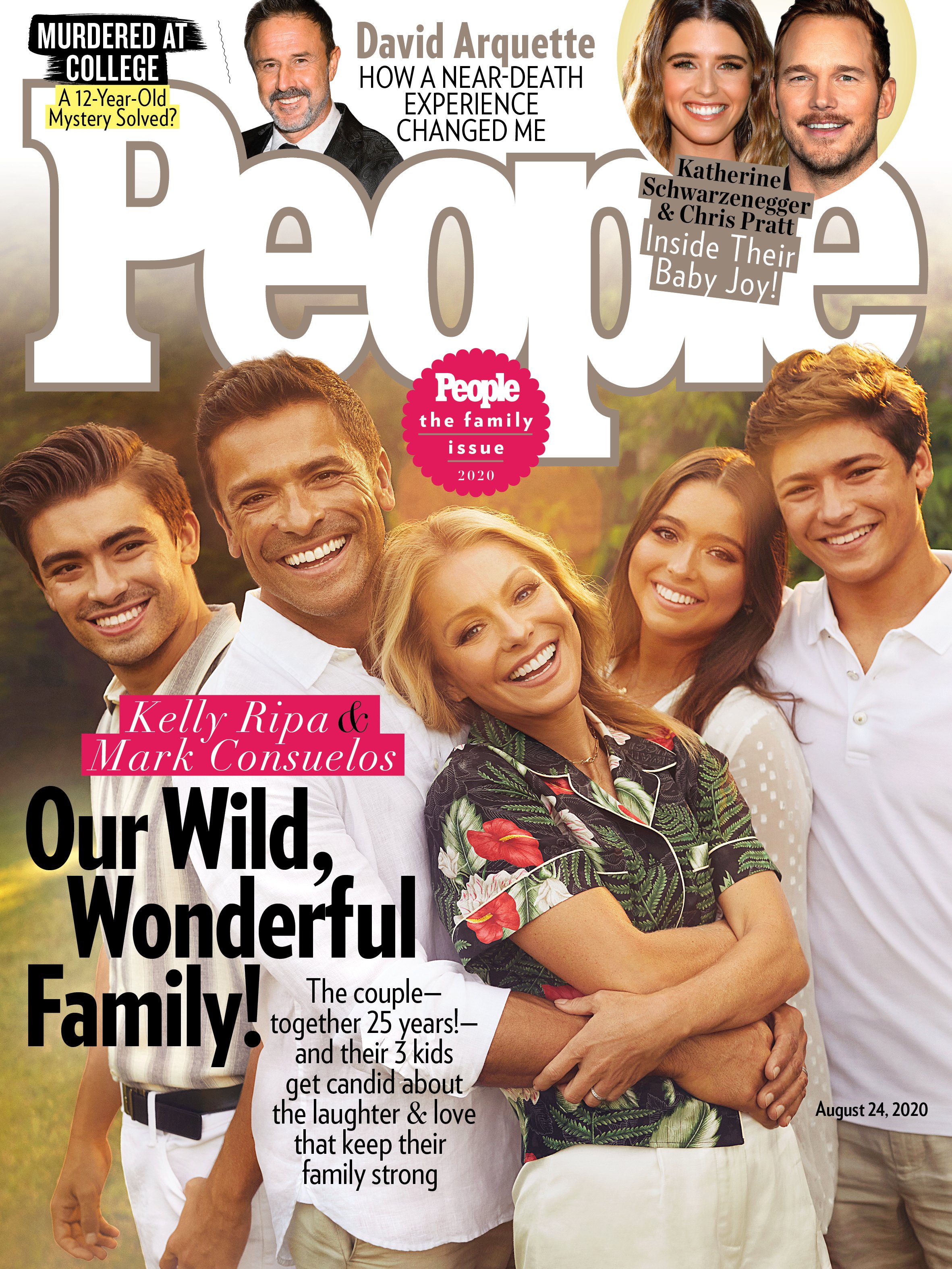
Issue dated August 24, 2020: Kelly Ripa and her Family
Image


Last year at this time: Issue dated August 26, 2019

Thursday, July 30, 2020

Herman Cain Dies Of Coronavirus

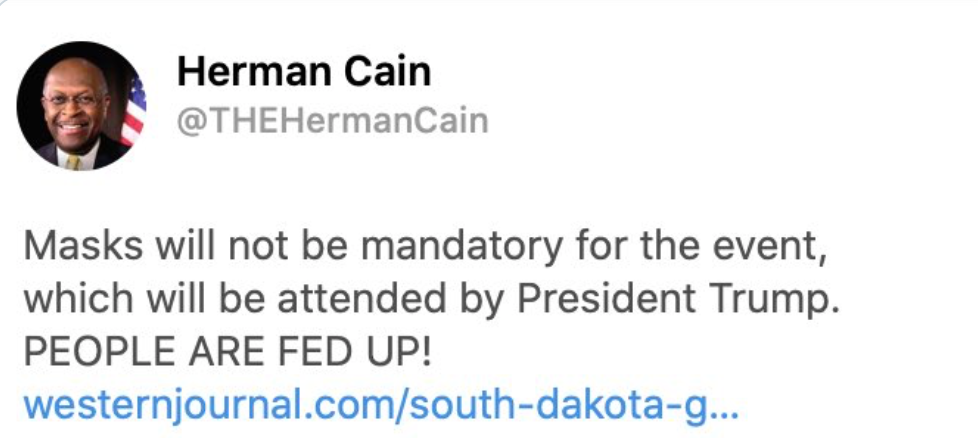
Former presidential candidate Herman Cain boasted about attending the Tulsa rally in June. You know, the one with no masks and no social distancing:

Image


Now Mr. Cain has died from COVID-19:


Tuesday, July 28, 2020

A View From The Other Side

Tony Green is a conservative and a Trump supporter. He believed the coronavirus was a big hoax from the libs trying to damage Donald Trump. He made fun of people wearing masks. He ignored social distancing guidelines and threw a big party for his family. It was his God-given right. Here's how he describes what happened next:

Imagine the sound and vibration of an old-fashioned electric heater going through your whole body. Imagine gasping for air with every step you take. Imagine rubbing Icy Hot all over your head to soothe a painful headache. Imagine your eyes in a bowl of water while you’re still seeing through them. Imagine collapsing and waking up in the ER only to find out COVID-19 attacked your central nervous system, and the doctor had just saved you from a stroke.

If that were the worst of it, it would be bad enough. But that’s not the worst of it. This is the story of one family’s harrowing fight with COVID-19.

Full disclosure: I am a gay conservative, someone that often juggles persecution for my sexuality while being true to my values. Such a combination requires a lot of tenacity to earn respect from either group.

I admit I voted for Donald Trump in 2016. I admit traveling deep into the conspiracy trap over COVID-19. All the defiant behavior of Trump’s more radical and rowdy cult followers, I participated in it. I was a hard-ass that stood up for my “God-given rights.”

In great haste, I began prognosticating the alphabet soup about this “scamdemic.” I believed the virus to be a hoax. I believed the mainstream media and the Democrats were using it to create panic, crash the economy and destroy Trump’s chances at re-election.

And so, believing the pandemic to be a hoax, my partner and I hosted family members on Saturday, June 13. On Sunday, June 14, I woke up sick.

By Monday, June 15, my partner and my parents were all sick. That same Monday, my in-laws traveled to witness the birth of their first grandchild. They took with them my father-in-law’s mother and one of my partner’s sisters. That night my father-in-law became ill. Then my mother-in-law and their daughter began feeling sick. So they cut their trip short.

Two days later, my father-in-law’s mother got sick. The new mommy and daddy got sick, too. We all tested positive for COVID-19. Only the newborn was spared.

My father-in-law and I both went to the hospital on June 24. The virus had attacked my central nervous system, and the staff stopped me from having a stroke.

My father-in-law’s mother was admitted a day later. On July 1, she died of COVID-19/pneumonia. The chaplain wanted the family to break the news to my father-in-law, and he learned how his mother lay on her deathbed and then drifted off without any family by her side, even though he was in the room next to hers.

On the day of her funeral, which was July 14, five more of our family members tested positive for the virus. That evening, my father-in-law was put on a ventilator.

You cannot imagine the guilt I feel, knowing that I hosted the gathering that led to so much suffering. You cannot imagine my guilt at having been a denier, carelessly shuffling through this pandemic, making fun of those wearing masks and social distancing. You cannot imagine my guilt at knowing that my actions convinced both our families it was safe when it wasn’t.
(Read the rest of the column here.)

Monday, July 27, 2020

100 Days To Go

Jonathan Bernstein looks at the state of the race at the 100-days-out mark:

Sunday marked 100 days until the election, so I’ll break my general rule of thumb — which is to ignore the horse-race polls until after the conventions — for a day. And what those polls say is pretty simple: Former Vice President Joe Biden has opened up a solid lead over President Donald Trump.

How solid? Checking the averages: FiveThirtyEight estimates an 8 percentage point lead, RealClearPolitics says 9.1 percentage points and the Economist puts it at 8.4 percentage points. How big is that lead? Big enough. Even if the polls are a bit off and Trump is actually doing better, and even if he still has an Electoral College advantage and everything breaks in his favor, there’s no way he wins if the polls look this way in November.

But of course it’s July, not November. The good news for Trump is that despite everything that’s gone wrong, even a modest rally would put him close enough that a normal polling error and an Electoral College edge could be enough to win a second term.

The bad news for him is that it seems unlikely he can do that. Trump has trailed Biden in head-to-head polling throughout the campaign, long before the pandemic and ensuing recession. It’s anybody’s guess what will happen with the virus by November, but it’s hard to believe that it will no longer be a dominant issue — and Trump’s polling on the pandemic is bad and getting worse.

The economy is a bit more complicated, but public opinion has trended against Trump there, too. I still think that a president could have sold high unemployment as an unavoidable consequence of the successful fight against the virus, but that would’ve required showing a lot more success, and a president who had built trust with the electorate and knew how to show empathy. At this point, it seems more likely that Trump will be punished for his handling of the economy.

In fact, the polls so far may even be understating Biden’s lead. Biden gets about 50% of the vote in head-to-head polls, but Trump’s disapproval rating has been at or above 55% for a while, and has almost always been higher than 52%. It’s true that some people voted for Trump in 2016 despite not liking him, but it’s a lot tougher to win votes from people who think you’re currently doing a bad job as president. And don’t forget: Polling errors could go in either direction, and there’s no guarantee that Trump will wind up having an Electoral College advantage.

There are enough unusual things going on this year that it’s worth being skeptical of anyone making confident predictions. Still, everything in the polling right now looks grim for Trump. And he’s running out of time to do anything about it.
(This is the column in its entirety.) 

Friday, July 24, 2020

The Death Toll Of 47 September 11's

Writing at The Bulwark in an article titled "Why Can't Trump Land A Punch?," Molly Jong-Fast ponders Donald's campaign and why it's not
going so well:

In 2015, Trump crushed an entire political dynasty with two words: “low energy.” But Jeb wasn’t the only recipient of a truly destructive nickname. Trump was the king of the takedown. In the Republican primary, Trump eviscerated his enemies with a single tweet or a mean nickname, impaling the other two heavyweight contenders with one adjective each—“Liddle Marco” and “Lyin’ Ted.”

What a difference four years makes.

Trump’s nicknames no longer shape the news cycle. Trump’s Twitter account no longer drives the narrative. And Trump’s lies are no longer reported as fact, even on Fox News. (Well, with some obvious exceptions.)

What happened?

In 2015, the American political world had never been confronted by a politician so deeply untethered to the truth. Trump lied the same way normal people breathe. Whether it was about his finances, or his health, or “watching Shark Week” with a porn star. (Best euphemism ever?)

Trump literally paid actors to come to his announcement that he was running for president and pretend to be supporters!

Can you imagine what would have happened to any other Republican presidential candidate in the history of Republican presidential candidates if they had gotten caught paying a crowd to show up for their launch?

John [sic] Huntsman: Dead.

Bob Dole: Dead.

Phil Gramm: Triple dog dead.

And Trump’s super power wasn’t just his shamelessness in lying about himself—he was willing to lie about what he wanted to do as president.

Presidential candidates are always promising crazy stuff that has no way of passing into law.

But there has always been a line. Like, if you were running for president you could promise that you would “end poverty” or “fit your entire tax return on a postcard.” And sure, everyone knew that you weren’t going to really do those things because the problems were complex and legislating is hard and blah, blah, blah. But at least, in a perfect world, these goals were theoretically possible.

No one was ever willing to say, “Vote for me and we’ll change the universal gravitational constant.” Or, “I pledge that together, we can make alicorns real.”

But Trump kind of was. He promised not only to build an unbroken physical wall stretching across America’s entire southern border—itself an exercise in magical thinking—but that Mexico would pay for this contraption.

He would have had a better chance with the alicorns. I hear InGen is doing amazing work these days.

Democrats didn’t know what to do with someone who lied like Trump. And the media found themselves totally at sea because there was no handbook in America for a free press covering an aspiring autocrat.

But things change. And people and institutions change, too. Donald Trump is no longer an outsider promising to blow things up. He’s the guy in charge and he blew things up real good. Promises made, promises kept!

Because of Trump’s administration, the United States has endured (so far) the equivalent death toll of 47 September 11’s. The unemployment rate is double digits, and many of us cannot safely leave our homes. Weirdly enough, people now seem to view “blowing it all up” as more bug than feature. Go figure.

Trump has other problems, too.

For instance, everything Trump accuses Biden of doing, he does himself, only worse. So when Trump World tried to shop the idea that Biden was creepy with women, all it really did was remind people that Trump has more than two dozen sexual assault allegations on his rap sheet.

When Trump World pushed the idea that Hunter Biden was somehow corrupt, you couldn’t help but think about Jivanka and DJTJ and all the ways the Trump family has been siphoning cash out of the public coffers.

Trump World tried painting Joe as doddering and old at the same time that the president was rambling through daily press conferences and struggling to walk down a ramp.

This is the problem with projection: Once people get wise to the pathology, then every boomerang you throw at your opponent comes back and pops you in the nose.

But ultimately, Trump’s biggest problem is himself.

Donald Trump has been president for 3 years and 186 days. He is no longer an outsider and the country is not better off than it was in 2016.

Unemployment is at 11 percent. Numerous countries have closed their borders to America (including, this past weekend, the Bahamas). And Trump still has no plan to slow the spread of coronavirus.

In 2015 Trump was able to make the case that he was a changemaker. He could say, as he did to African Americans, “what do you have to lose?”

But in mid-2020, the problem is that Americans can see exactly how much they’ve lost and are keenly aware of how much they still could lose.

And it’s a lot.
 (This is the article in its entirety.)
Tuesday, July 21, 2020

How It's Supposed To Work - Updated

Donald is coming back to the podium this afternoon, with a so-called press conference at 5.00 Eastern time. Jonathan Bernstein has some thoughts:

Here we go again.

President Donald Trump has announced that he’s resuming regular pandemic briefings. Quick recap: Trump did these briefings on a daily basis back in the spring when the virus was spreading for the first time; his staff, Republicans in Congress, and virtually everybody else thought that his long, rambling statements and frequent public disagreements with his own experts weren’t helping him; the White House tried retooling the briefings to make them better sales pitches for the president; then Trump mused about injecting bleach. End of regular briefings.

Now the president claims he’s going to revive them, at least for a while. The bottom line is that, for a normal president, such press conferences are a highly useful procedure. They begin with an opening statement, which means that the White House has to prepare something for the president to say. Knowing that they need to produce news in that statement, and preferably good news, staffers will push all the relevant agencies and departments to come up with achievements they can talk about. Yes, the process can be superficial and even counterproductive. But overall, it’s one of the ways that presidents focus the White House and the bureaucracy on getting things done.

After that the president takes questions. On the surface, this is good because it forces the president to speak about the important policy questions of the day. Perhaps even more important, the White House has to prepare answers to all the questions that are likely to be asked. Just as with the opening statement, this pushes staffers to come up with good answers — answers that make the president look good — which in turn helps them to make decisions, push policies forward and confront issues that have been avoided. It’s not just an inside game; outside groups, knowing the president is likely to speak on various topics, will understand that it’s time to apply whatever pressure they have. In short: Governing happens.

Of course, any good politician will have the skills to duck questions from even the most tenacious reporter. So a press conference never exactly forces a decision. But generally, they’ll tend to create a set of positive incentives.

It’s not clear how much those incentives apply to this administration. Normal presidents will spin, enhancing small accomplishments to make them seem important, but the truth acts as a constraint. They won’t just make something up. Trump doesn’t treat the truth as a constraint. Nor does he seem to prep the way normal presidents do. It’s possible that briefing books are prepared anyway, but with the president unlikely to read them, no one in the executive branch is likely to feel pressured to take any relevant actions, and I doubt that the White House staff puts serious effort into it.

Another problem for Trump is that he's likely to spread misinformation. But he tends to do that even without the briefings. What I wouldn’t worry much about is any electoral effect. Regardless of who the president is, the audiences are relatively small for such things, and they’re likely to be dominated by strong supporters. Of course, former Vice President Joe Biden’s campaign is also watching. The president has the opportunity to look good; the out-party has the opportunity to take advantage of anything he says that can be used against him.

On balance, I think it’s still better for the president to regularly face questions from the press. Realistically, though, it’s not apt to make much difference in November.
(This is the column in its entirety.)

Update: It's not really a coronavirus briefing and it's not really even a press conference. It's a political rally:


Friday, July 10, 2020

Two Disastrous Numbers

From Jonathan Bernstein, published this morning:

There are only two numbers from this week you need to know if you want to understand the presidential election: 1.3 million and 59,886.

That’s the number of new applications for unemployment insurance last week and (by one estimate) the number of new coronavirus cases from Thursday. They’re both disastrous figures for the nation — and for President Donald Trump, who has no apparent plan to deal with either.

New infections hit yet another daily record on July 9, according to the New York Times. Cases are rising in 36 states plus Puerto Rico, the Virgin Islands and Washington, DC. Hospitals are filling up in Houston, Phoenix and more. Supplies of personal protective equipment are running low. Testing, while considerably better than a few months ago, is still struggling to keep up. As a result, several states (including California, Florida and Texas) have partially reversed their reopenings and many more have paused.

As for the labor market? Despite better-than-expected numbers in April and May, the overwhelming story is that weekly job losses are at what would’ve been a record pace before 2020. As my Bloomberg Opinion colleague Noah Smith puts it:

"The U.S. is in a very odd situation. Even as the official unemployment rate falls, the health of the underlying labor market is deteriorating as the coronavirus pandemic drags on. The country is in the middle of two simultaneous downturns — a short-term seizure caused by fear of coronavirus and a longer-term slump that will look more like a traditional recession. Unfortunately, the latter is just beginning."

There’s no way to predict the direct effects of the pandemic on the election; there simply isn’t a precedent for it. But if there's one relationship that is reliable, it's that hard economic times are terrible for incumbent presidents. It’s possible that voters would give Trump a mulligan on a recession directly tied to something beyond his control. The problem is that the longer the pandemic drags on, the less likely it is that they’ll consider either the public-health disaster or the economic fallout inevitable — especially since the damage has receded in other rich nations.

And especially since Trump has so little to offer. Since mid-April, he has basically abandoned any attempt to control the virus. His only consistent message has been to ask everyone to resume normal life. He's recently been repeating the preposterous claim that the spike in cases is simply an artifact of more testing, which hardly accounts for the hospital beds filling up in state after state. Trump's task force established guidelines for reopening businesses, but the president has urged governors to ignore them; now that his focus is on getting schools to open, he's pushing the Centers for Disease Control and Prevention to gut their recommendations.

As for the economy, Trump seems far more willing to provide continued relief and stimulus than the “wait and see" Senate Republicans. But his specific proposals aren't particularly well thought-out or suited for the job (he really wants to restore the deductibility of business-entertainment expenses, which seems more like a long-term benefit for people in the hospitality business than a way to immediately boost the economy). And he hasn't put together a sustained push for new legislation; he's been willing to let Senator Mitch McConnell set the pace, which has meant months of delay. At any rate, as both public-health professionals and economists have been screaming since March, the economy will never be healthy as long as the virus is out of control.

The truth is that, in a crisis like this, there just isn’t a substitute for sustained, serious presidential action, and Trump has been more of a passive spectator than anything else. And while there is still theoretically time for him to rebound from his desperate standing in the election, it's hard to see how that happens if he doesn't change the way he runs his presidency.
 (This is the article in its entirety.)

Tuesday, June 23, 2020

He Wasn't Joking

This is devastating:


And no, he wasn't joking, this tweet is from this morning:


And one more thing. I haven't published a "tweet with a typo" in a while, but this one is pretty funny:


Saturday, May 30, 2020

Bad At Presidenting

Jonathan Bernstein points out another way Donald is bad at being president:

It’s amazing how quickly the CDC has squandered its reputation for straight-shooting and scientific excellence during Donald Trump’s presidency (the latest embarrassments are here and here). There’s a lot to say about this and similar failures across the federal government, but what strikes me is what they reveal about healthy incentives — and how Trump manages to ignore them.

First, having an agency with a gold-standard reputation is a terrific resource for leaders who care about getting their way and also care about re-election. It allows them to speak with the authority of experts even if they themselves are relatively ignorant. It also gives them an opportunity to have most of the nation, and not just their supporters, at least potentially support their policies.

That matters. It matters desperately for Trump right now. His obvious goals are to reduce the spread of the virus while rebooting the economy as quickly as possible; for that, he needs citizens to follow best practices for safety and also to trust that it is safe to return to activities they gave up in March. And he needs strong supporters, strong opponents and everyone in between to do both of those things, or else it won’t work. No politician is ever able to do that on his or her own. But trusted experts make it possible for the president to get it done.

To be sure, there’s a cost. For a president to get the seal of approval from experts, he or she has to listen seriously to them. This may mean compromising the president’s preferred approach. If the president simply ignores the experts but tries to use their reputation anyway, the agency’s bureaucrats may refuse to endorse the policy, or undermine it through such strategies as press leaks or testimony to Congress. Or, if the president succeeds in undermining the agency’s integrity enough that it will slavishly grant his every whim, its reputation — and thus its political usefulness — will be destroyed.

Notice that healthy incentives are built into the system. Agencies care about their reputations for reasons of professional pride, but also because it benefits them at budget time and helps them do their jobs without outside interference. And presidents have good self-interested reason to listen to those agencies. That’s a way to force politicians who care mainly about elections to seek expert input into policy.

Now, I should be clear that good presidents should listen seriously to experts in the executive branch — not necessarily do whatever they say. Experts can be wrong! That’s why presidents beginning with Harry Truman have built up a White House staff with parallel teams of experts who don’t have the same bureaucratic practices as those inside executive-branch agencies, and who are more naturally attuned to the president’s political interests. And beyond that, good presidents apply their own political judgment to the subject-matter expertise that they have access to in order to make good decisions.

Trump, unfortunately, is so bad at presidenting that he fails to follow those clear healthy incentives. To be fair, he did seem to take some expert advice seriously for two or three weeks in April. But he rapidly lost interest, and either he or others in the White House seem to have pressured agencies to go along with him even as he ignores their counsel. Now he wants the economy to reopen safely, but he has no idea how to get there from here, and he doesn’t have the assets the presidency once had. It’s not apt to work very well for the nation, or for him.
(This is the column in its entirety.)

Days until the election: 157

Friday, May 22, 2020

Wearing A Mask

Jonathan Bernstein wonders why Donald won't just put on the damn mask:

President Donald Trump had another opportunity to wear a mask in public on Thursday, on his tour of a Ford Motor Co. plant in Michigan. He didn’t do so — according to him, mainly to spite the media — although he evidently did put one on afterward. It’s bizarre behavior, and very likely self-defeating for the president politically.

Public-health experts have said, and have told Trump, that masks are crucial to safely reopening businesses and returning to something resembling normal while minimizing the risk of new coronavirus outbreaks. Trump’s re-election surely depends on successfully controlling the virus and rebooting the economy. And yet the president has consistently downplayed the idea, including refusing to cover his face in front of the cameras. In fact, as Greg Sargent points out, Trump is doing this despite the public being overwhelmingly in favor of him wearing a mask.

I can think of three possible explanations, none of them flattering.

One is, well, vanity, or some other personal stubbornness. Trump doesn’t like the way the masks look, or doesn’t like having to wear them or really does consider it a point of honor to contradict the media’s expectations.

A second is that the president doesn’t want to violate the wishes of his strongest supporters, and he has concluded that the armed demonstrators opposing masks and distancing restrictions are in his corner. It’s possible he doesn’t understand that he’s putting himself on the wrong side of public opinion in doing so. It’s also possible that he’s using a con-artist’s logic: Find the easiest marks and you can make a lot of money, even if they’re a tiny fraction of the overall population. That’s a logic, by the way, that can also work for party-aligned media, and one way that party-aligned media can undermine the party as a whole, which needs broad support from majorities (or at least very large pluralities) to win elections.

The third possibility? Trump, like certain cable-news pundits, really thinks that elections are all about image, and so avoiding a Michael-Dukakis-in-the-tank moment is a first-order priority. In fact, that kind of image campaigning tends not to be important at all in presidential general elections. The condition of the economy is important; so may be, in this cycle, progress against the virus.

Perhaps the most unfortunate aspect of Trump’s decision is that this is a case where a president’s enthusiastic endorsement for wearing masks and otherwise following best practices might really make a difference. After all, the economy simply will not rev up if people are afraid to go out of their houses, and a lot of people are going to be afraid if they see more and more folks — including the president himself — refusing to wear a mask.
(This is the article in its entirety.)  
In actual fact, Donald did put on a mask yesterday. He said he didn't want the press to see him wearing it, but someone got a picture: 


Days until the election: 165

Saturday, May 16, 2020

It's Just Not Fun Anymore

In yesterday's column, titled "Does Donald Trump Want to Be Re-Elected?" and sub-titled "The president's inattention to the coronavirus doesn't suggest someone desperate to win in November," Jonathan Bernstein ponders Donald's inept handling of the crisis. This is the column in its entirety:

It’s becoming more and more obvious that President Donald Trump has simply stopped dealing with the coronavirus pandemic, and has no particular plan for confronting its economic fallout, either. In both cases, he’s pretty much substituted wishful thinking for action. The Atlantic’s David Graham had a good item about this disengagement earlier in the week, followed by one from Ezra Klein arguing that “the White House does not have a plan, it does not have a framework, it does not have a philosophy, and it does not have a goal.”

What surprised me was political scientist Lee Drutman’s conclusion, based on Klein’s article, that “the debate over what to do has polarized with depressing haste, because ‘winning’ in Washington is not defeating the virus, but winning the next election.” I argued a bit with Drutman on Twitter about this, but it’s worth a longer discussion. My basic sense is that Trump isn’t nearly concerned enough with winning re-election, and that the current catastrophe is in part a consequence of that.

There’s no way to know what’s really in the president’s mind. But we can compare his actions with what a president determined to be re-elected would probably do. A lot of Trump’s critics have claimed that he’s deliberately risking American lives by boosting the economy to improve his chances in November. And it’s true that he seems concerned mainly with re-opening businesses these days. But there are at least two reasons to doubt that this preference is due to the election. For one, public-health experts and economists broadly agree that opening too soon will be a disaster. For another, even if there is a trade-off, there’s no particular reason to think that restoring jobs at the cost of more illness and death will be a good electoral deal for Trump.

At any rate, the evidence that Trump has an economic plan is just as weak as the evidence that he’s engaged in dealing with the coronavirus.

What I think is more likely is that Trump simply isn’t finding this aspect of the presidency very much fun. You might remember when President George H.W. Bush declared that he didn’t like broccoli: “And I haven’t liked it since I was a little kid and my mother made me eat it. And I’m president of the United States, and I’m not going to eat any more broccoli!” Trump acts this way about doing most of the mundane jobs of the presidency. Thus his newly invented scandal, “Obamagate.” As the New Yorker’s Susan Glasser points out: “For Trump, spending the week attacking Obama, no matter what the subject, is the political equivalent of retreating to his bedroom and hiding under the blanket. It’s his safe space, his comfort zone.” Except it’s not so much a political equivalent as it is a retreat from politics altogether, along with the duties and responsibilities of his office.

A politician who desperately wanted re-election would’ve been hard at work, from the moment he or she was alerted to the danger, attempting to contain the pandemic and limit the economic damage, and would persevere no matter what the setbacks, never wavering in an effort to produce the policy results that might lead to a big win in November. Such presidents might sacrifice the long term for the short term, as Lyndon Johnson did in goosing the economy in 1964, or Richard Nixon did in 1972. But they would never just give up when things went wrong.

That’s not this president. That’s not Donald Trump.


Mr. Bernstein may be indulging in a little reverse psychology because in actual fact, of course Donald wants to be re-elected. I'd say he cares about winning in November more that life itself, if only to avoid being branded a LOSER. Why hasn't he been hard at work from the start, attempting to contain the pandemic and limit the economic damage, persevering no matter what the setbacks, etc? That's easy. He's just not capable of it.

What does surprise me is that there is apparently no one in the administration who has the smarts to handle a crisis. In truth, it doesn't surprise me, it's been clear all along. It's just that this is the biggest crisis the Trump administration had faced and it's happening within sight of the election. You would think that Ivanka, Jared and the vice president, in particular, would have a vested interest in helping Donald to succeed at this, but nope. The slobbering, ass-kissing sycophantic-ness of Mike Pence continues to astonish (and disgust) me, but it's not just him. There's mind-boggling incompetence from one end of the White House to the other.

And one more thing: In November, Steve Schmidt, a former Republican political operative and one of the Never Trumpers behind the Lincoln Project (read more here,) said that he thinks Donald will dump Mike Pence for Nikki Haley as his running mate this year. (I wrote about it here.) This was before the coronavirus crisis started but it occurs to me now that with Pence in charge of the response, doesn't that make him a convenient scapegoat for the whole bungled mess? Maybe Donald really will give him the boot. 

Sunday, April 19, 2020

The Guessing Game - Updated/Beautiful Issue

What will be on the cover of People this week? Last year at this time it was the "Beautiful" issue (below,) but in the midst of the pandemic People might put that on hold for a while. Other possibilities, in no particular order:

Princess Beatrice: Her wedding has now been officially postponed due to the coronavirus
Harry and Meghan: Settling into their new life in Los Angeles; they've been seen delivering food to people in need. Update on Tuesday, 4/21: Private texts to Meghan's father have become public, part of their lawsuit again some of the British tabloids.
Brian Dennehy: Died at age 81
Michael Jordan: A new documentary titled "The Last Dance"
Chris Soules: Is the former Bachelor dating Victoria Fuller, a so-called villain from Peter's season?
Princess Anne: She's on the cover of the May issue of Vanity Fair to mark her upcoming 70th birthday, read the VF article here
James Patterson: A new book about the Kennedys, titled The House of Kennedy
Covid-19: Stories about the virus have been on the last five covers. Will this week be different? 
Melania Trump: Turning 50 on April 26, the First Lady has mostly been AWOL during the Covid-19 emergency. (Read more here.) As I've pointed out before, since the day Donald was elected, People has not put one single word about Melania on the cover of the magazine, which is a change from past practice and has to be a deliberate omission. Will the magazine mark this milestone birthday? Probably not. In contrast to Melania, the two most recent First Ladies joined together to send out a message of hope:


Will & Grace: The series finale airs April 23
Nick Cordero: A Broadway star, he had his right leg amputated due to the coronavirus
Dr. Phil. Dr. Drew and/or Dr. Oz: They all got themselves in hot water for saying stupid things on television, followed by apologies, more or less, for "misspeaking." A Washington Post article about the good doctors starts with this:

Dr. Phil had much to say about the coronavirus lockdown the other night on Fox News.

“Look, the fact of the matter is we have people dying — 45,000 people a year die from automobile accidents, 480,000 from cigarettes,” the talk-show host said Thursday, “but we don’t shut the country down for that. But yet we’re doing it for this?”

Social media quickly erupted with fury and derision as viewers pointed out the hopeless apples-to-orangeness of his argument: Cars and tobacco aren’t exactly communicable diseases; and both, in fact, have inspired extensive government regulations to limit injuries and death. (The TV shrink was also widely mocked for making a comparison to swimming-pool deaths using a bogus statistic inflated by a factor of nearly 100.)

But the interview raised deeper concerns: Why was Dr. Phil — not a medical doctor but a clinical psychologist with no special knowledge about the politics, science or economics of the shutdown — on a TV news channel talking about the topic in the first place?

Like Drs. Drew [Pinsky] and Oz before him, Phil McGraw was on TV, it seems, largely because he’s a articulate, charismatic and well-known TV personality. But none of that amounts to expertise on this particular topic. In fact, in recent TV appearances to discuss the pandemic, fellow celebrity doctors Drew Pinsky and Mehmet Oz have offered commentary based on a loose or seemingly wobbly understanding of the crisis — arguably doing more to undermine public understanding than enhance it.

All three have since walked back their statements.
(Read the entire article here.)

CNN piled on with an article titled "Fox News keeps inviting TV doctors on air who say crazy things," read that here. 

Stories that appear on the new cover will be highlighted in green. 

Last year at this time: The Beautiful Issue, dated May 6, 2019
Image result for Jennifer Garner People cover Beautiful

This is the final version of last year's Beautiful issue: 
Nate Berkus | PEOPLE.com

Update: Val Kilmer. His memoir, titled I'm Your Huckleberry, is out today; he reprises his role as Iceman in the upcoming Top Gun sequel, which is now scheduled to open in December

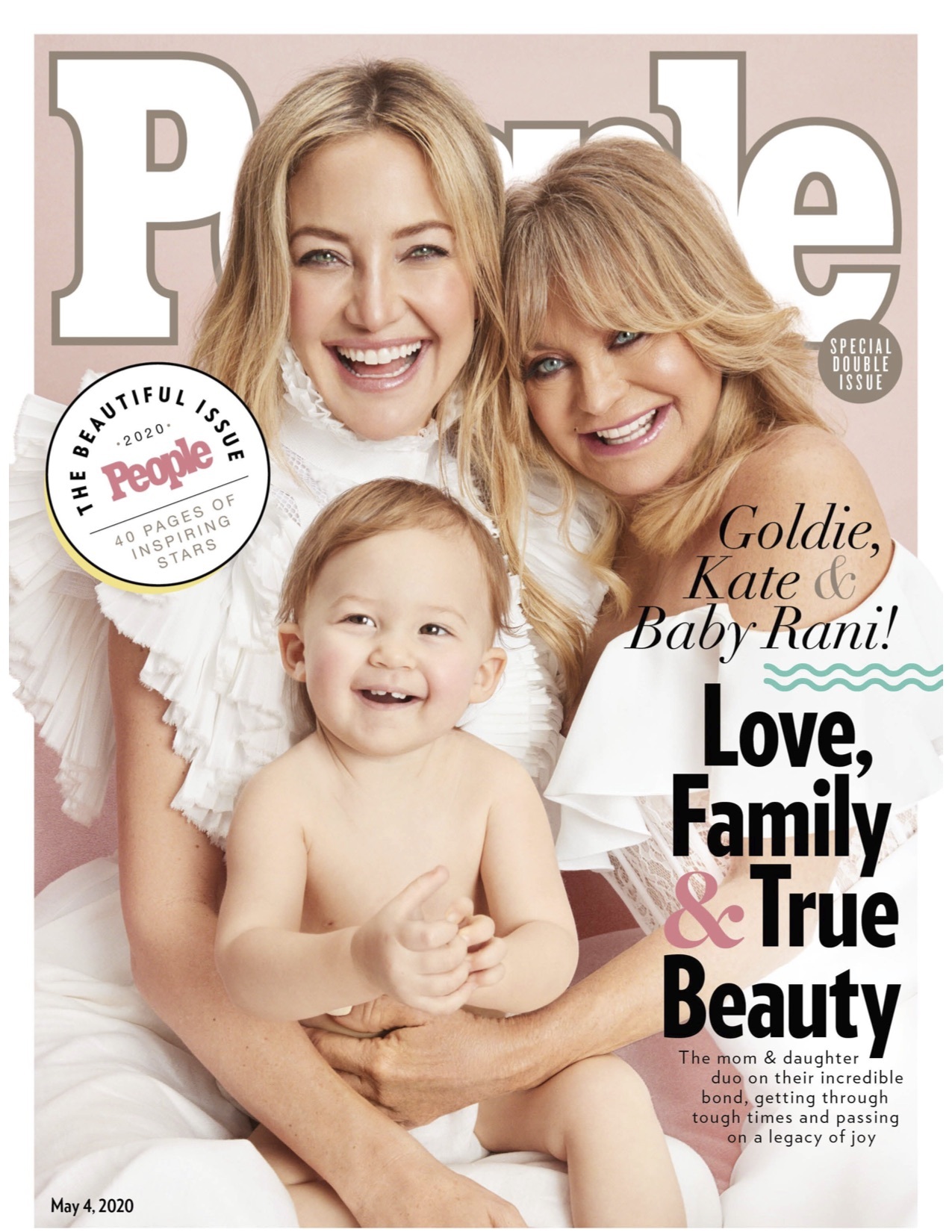
Update #2. It is the Beautiful issue, featuring Goldie Hawn, Kate Hudson and her daughter Rani: 

Issue dated May 4, 2020: The Beautiful Issue
Image


This is the final version of the cover, with secondary headlines featuring Harry & Meghan and a story about a nurse treating coronavirus patients:  


People MAGAZINE May 4 2020 Goldie HAWN  - Kate HUDSON & Baby Rani. Mint!