Writing at Rolling Stone, Rick Wilson has some fun with words as he ponders Roger Stone's future. Apologies for the NSFW language, I cut-and-pasted exactly as written:
It’s not every day that a degenerate former swinger and serial scumbag who built a career based on a single line of bullshit and self-fellation so constant and vigorous that it is practically a yogic art form stands before the bar of justice, but here we are. Roger Stone is, as he loves to be, in the center of a national political scandal, and with his sentencing approaching in just days, Stone hoped the Trump “Justice” Department would save him from a well-deserved sentence of seven to nine years in prison.
Stone earned the recommended sentence not because he is a Trump ally, but because he threatened witnesses, lied to the court and to the House of Representatives, and got caught. Worst of all, he threatened Judge Amy Berman-Jackson online, defied various gag orders, and engaged in his usual rat-fuckery. He made the mistake of thinking that Judge Berman-Jackson is as gullible as the claque of hangers-on, wanna-be catamites, and scumbag errand boys with whom Stone usually surrounds himself.
The Trump media has been bleating for two days now that the original sentence recommended by the career Justice Department officials that Stone serve his twilight years breaking rocks, stamping out license plates, and working in a prison call center was a massive miscarriage of justice, a horror beyond words and reason, and a grim penalty for a wee, decrepit old dandy barely able to totter to the stand in his own defense.
Horseshit. The sentence Stone faced was appropriate because his actions weren’t simply a criminal — and criminally stupid — defense of the president. They were just one part of a wider assault from the transparently corrupt Trump-Barr kleptocracy on the entire administration of justice in the United States. William Barr, who has taken on the role of Trump’s family attorney, put his greasy thumb on the scale this week, demanding the U.S. attorneys in the case reduce Stone’s recommended sentence.
It led to the withdrawal of all four of the prosecutors, and the resignation of one. Barr’s bull-in-a-china-shop efforts on Stone’s behalf were comically absurd, driven by a Trump tweet, and will no doubt land him in front of congressional committees for a full political rectal exam in the immediate future.
But they were also par for the course in his role as the chief enabler and defender of this president. Barr has been systematically choking out every investigation of the Trump administration since he killed off Bob Mueller, and has no intention of stopping.
Like Trump, Barr is unbound, uncontrolled, and has no fear of congressional power. He doesn’t care about the scummy appearance of his actions; it’s a feature of Trumpism that anyone engaging in any action defending this president will be praised for it on the presidential Twitter feed and on the Presidential News Channel. The shamelessness is a feature, not a bug.
As Trump seeks to settle scores, terrify future witnesses, and generally act out all the fantasies in his authoritarian spank bank, Barr is his chief fluffer. Trump’s fantasy of having another Roy Cohn has come to life, with all of Cohn’s mendacity and amorality, but in a size 54 stout from Men’s Wearhouse.
Stone deserved everything in the first sentencing memo. Every minute. He deserves to be dragged from the courtroom in shackles and issued his itchy, federal-prison poly-cotton orange scrubs. Karmically, he deserves it because he was one of Trump’s lifelong enablers, and because once Trump was elected, Stone trafficked in the most lunatic and corrosive conspiracy theories under the sun. Stone’s gift for sleaze-bag political tactics was always that — tactical. He was great at piling on a wounded victim (see Elliot Spitzer), but it was Trump who kept Stone afloat for decades.
Of course, Stone likely won’t serve his full hitch, because Trump and Barr know that without a pardon Stone will squeal like a rat in a blender, proving that Trump lied to Mueller and about the details of the Trump-Stone-WikiLeaks connections. Stone sure as hell deserves his time in the graybar hotel for reasons of both ordinary and moral justice, and Judge Berman-Jackson has also likely had enough of Stone’s weapons-grade bullshit and may treat the revised DOJ sentencing letter as the political trash it is.
In some ways there’s a terrible and largely unremarked symmetry to the role Barr has played as Trump’s Roy Cohn. In the early days of his career, Stone was a bagman and dogsbody for the infamous Cohn, who served as an early Trump attorney and fixer in New York. Cohn, one of the most repellent and degenerate stains on America’s political landscape, was a perfect role model for both Trump and Stone.
In the late 1990s, I once asked the famous (or infamous, depending on your perspective) New York political operator Ray Harding about Stone. Harding was a man who knew where all the bodies — literal and metaphorical — were buried. He looked across his desk from behind a cloud of unfiltered-Camel smoke and said to me, “Roger parlayed one line of bullshit into a career. The only person who buys his bullshit is that moron Trump.”
At least some justice has come for Fort Lauderdale’s most prominent Penguin cosplayer and sleaze-ball boulevardier already. Trump left his former confidant hanging for two years, reducing Stone to penury in a one-bedroom apartment. Even if Trump pardons him, Stone will never work in politics again at any serious level — not that he did anyway.
He’ll never get out from under his legal bills. His speaking circuit appearances at local Republican clubs in Florida often bring in tens of dollars, and it’s gonna take longer than Stone has on this Earth to catch up. His days as a provocateur are over. He may get a hit or two on Infowars or OANN, but he’ll never be in the big green rooms again. His days without having the mark of “felon” — pardoned or not — branding him are over.
For Stone, one of the tragedies is that the world of campaigning has moved on from dumb, dirty tricksters like him; Trump will likely never allow him back into even his outer circle because Stone brings nothing of value to a modern campaign. He will never sit at the high table of the Orange King with his old status. Even a man of Stone’s unlimited chutzpah will never be able to wink and nod his way to convincing any but the most slack-jawed Trump fans he still has the confidence of the president.
The attention he craves will, on its best days, come as a form of pity. Stone’s last whisper of power and influence is gone, and no matter what happens next week, he’s going to bear the lifelong stain of a man who spent time in prison for crimes he gleefully committed.
Long sentence or short, everything Trump touches dies — even his most loyal henchman. (This is the article in its entirety.)
Showing posts with label impeachment. Show all posts
Showing posts with label impeachment. Show all posts
Friday, February 14, 2020

Monday, January 27, 2020
A Watergate Moment
The headline for Jonathan Bernstein's latest column, posted this morning (Here We Have It. The Trump Impeachment Smoking Gun,) doesn't precisely match the point he actually makes in the column. (Headlines are almost always written by an editor or someone else in the organization.) He only notes the "close parallels" to Nixon's Smoking Gun tape. He also points out that it wasn't the tape that doomed Nixon, it was what it revealed about his behavior, and that Donald has done something similar. This is the column in its entirety:
President Donald Trump’s team opened its impeachment-trial defense in the Senate on Saturday morning. I was wrong about how the president’s lawyers would go about the job. I had suspected that they would use a tantrum to rally Republicans to their side, but it turned out that Republican Senators had their tantrum late Friday night when they chose to be outraged that the lead House impeachment manager, Representative Adam Schiff of California, referred to a (somewhat thinly sourced) news report that someone at the White House had threatened that Trump would have the “head on a pike” of any Republican who opposed him.
Trump’s lawyers began with a misstep, rehashing their flimsy claim that there’s some kind of significance to the fact that Schiff paraphrased, instead of directly quoting, the words Trump used in the July 25 phone call in which he pressed Ukrainian President Volodymyr Zelenskiy to participate in a smear of a leading Democratic rival, former Vice President Joe Biden.
But they didn’t rely on emotion in their presentation. Instead, they did what defense attorneys do. They floated alternative interpretations of the evidence the House managers, serving as prosecutors in the Senate trial, had presented in support of the articles of impeachment accusing Trump of abusing his power by trying to coerce that country’s interference on his behalf in his 2020 re-election effort. They pointed out that some of the witnesses who testified on the House side were not entirely reliable on some questions. And they added a bunch of mostly irrelevant points, such as the administration’s overall support for Ukraine (which in fact only makes Trump’s decisions to pause congressionally approved military aid and refuse to schedule an Oval Office meeting with Zelenskiy harder to understand as anything but elements of a pressure campaign) and the fact that previous presidents had also put foreign aid on hold (which no one denies, but the question is why it happened this time).
I’m not sure I’d call the first few hours of their presentation strong, but then again if they are constrained by their client to pretend that the Zelenskiy call was “perfect,” they have a difficult hand to play. It could have been worse.
And then, Sunday night, it fell apart. The New York Times reported that former National Security Adviser John Bolton has written in his upcoming book that Trump made explicit the quid pro quo that his lawyers are denying: that Trump told him directly that he wanted to keep the military aid frozen until the Ukrainian government agreed to help with investigations of Democrats. Not only that, but apparently the White House has had Bolton’s manuscript all month. Trump’s team knew this was coming.
While I certainly don’t expect the president’s support in Congress to collapse, it’s impossible not to see close parallels to the “smoking gun” tape that ended Richard Nixon’s presidency in 1974. That tape, proving that Nixon ordered his staff to have the Central Intelligence Agency block the Federal Bureau of Investigation’s inquiry into the Watergate scandal and released to Congress and the public after the House Judiciary Committee had passed articles of impeachment, was so devastating for Nixon not so much because it was proof of his crimes; plenty of proof of plenty of crimes had long since been placed in the record. Instead, it became the moment when conservative Republicans realized that Nixon had deliberately set them up with false arguments even though Nixon knew that the evidence, if released, would undermine those arguments and make them look like liars and fools.
That is exactly what appears to have happened with the Bolton book. Trump knew that Bolton’s testimony and supporting notes, if they ever surfaced, would undermine the claims of his supporters. In some ways, it’s not quite as strong as Nixon’s smoking gun, since there’s no tape (as far as we know!) furnishing absolute proof of what Trump said to Bolton. But in some ways, it’s worse. Nixon knew what was on the tapes, but until the Supreme Court ruled against him he might at least have hoped that he could keep them secret. Apparently in the Trump case, at least some people in the White House have known for weeks that Bolton was going to release this book, and yet they still encouraged their allies to say things that were about to be shown to be false.
So far, it appears that Republican politicians would rather look like liars and fools — following ever-less-plausible White House lines, perhaps hoping that no one notices — than dare to oppose Trump and his still-loyal allies in the Republican-aligned media. Maybe they’ll all stay on message, even after this episode. Some of them, I’m sure, are either such blind partisans or so far inside the conservative information feedback loop that they may not even notice. But I have to believe that, whatever they do about it, a lot of Republican politicians are feeling more uncomfortable than ever.
Sunday, January 26, 2020
Lawlessness
A longer than usual post from political scientist Jonathan Bernstein, writing at Bloomberg. It was published yesterday morning at 7.00 a.m.:
Title: The Unspoken Charge That Should Doom Trump: Lawlessness
Subtitle: Senators are entitled to render their judgment based on more than the specific impeachment case that the House put before them.
For three days, the House managers serving as prosecutors in the Senate impeachment trial of President Donald Trump set out the details of his effort to strong-arm Ukraine into aiding his 2020 re-election, and then argued that those details constitute reason to remove him from office. They made a strong case. Using the power of the presidency to push a foreign power to smear a political opponent is an abuse of that power, a “high crime and misdemeanor” in the constitutional phrase setting forth the standard for removal.
What of the case made by law professor Josh Blackman in the New York Times on Thursday: that presidents often pursue policies in hopes of improving their political prospects? It is true, of course, that presidents consider domestic politics, including electoral politics, in everything they do. There’s nothing wrong with that. Presidents should act to increase their influence, and that includes taking actions with their professional reputation and personal popularity in mind.
So what’s different about Ukraine?
For one thing, as Representative Adam Schiff and the other House managers explained, Trump’s actions weren’t taken with politics as one consideration. They were taken, as Schiff said, with electoral concerns as the primary goal.
But that’s not enough to make it impeachable. Trump ordered a hold on congressionally approved military aid to Ukraine last summer, according to high-ranking officials who testified in the House impeachment investigation, as the president and his allies were ratcheting up the pressure on the Ukrainian government to announce a criminal investigation of a leading Democratic presidential candidate, former Vice President Joe Biden, along with another investigation into a bizarre, evidence-free theory about Ukraine and the 2016 election.
The aid freeze wasn’t part of a legitimate reconsideration of U.S. policy towards Ukraine, which Trump would have been free to initiate. Instead, it was an effort to undermine the consensus plan to support Ukraine as he squeezed that country’s government to help him get re-elected. The president certainly has the right to change his policies and to work to get the rest of the government to go along. It’s much less legitimate to attempt to subvert the official policy. And given that it appears the freeze on aid to Ukraine was illegal, Trump’s scheme wasn’t legitimate at all.
Blackman’s analysis is also wrong because it matters how a president uses policy for political advantage. Trump is accused of soliciting foreign election interference! Unlike maneuvering to get a Supreme Court justice to resign, or even deploying troops, Trump tried to get a foreign nation to influence an election. That’s not just a likely violation of U.S. law; it’s contrary to his oath to “preserve, protect and defend the Constitution of the United States.”
So: Could a president legitimately base Cuba policy in part to win the support of a key group of voters in a swing state? Absolutely. Even if national security experts think the resulting policy would be a bad one. But could a president base Ukraine policy on whether or not the Ukrainian government gets involved in U.S. domestic politics? No. Because that involves something which is itself both illegal and a violation of the president’s oath of office. It is, indeed, an abuse of power — the use of his formal powers to do something illegal and unconstitutional.
The truth is, however, that for all of the strength of the House managers’ case, what really clinches it is something they didn’t say, and which isn’t part of the two articles of impeachment that the Senate is considering: Trump’s overall lawlessness.
The articles make only a glancing mention of Trump’s obstruction of justice, as laid out in Special Counsel Robert Mueller’s report on Russian interference in the 2016 election. They don’t say that Trump is probably violating the Constitution’s emoluments clauses when foreign and domestic governments spend money at his hotels and resorts. They say nothing about his threats against the media or his threats to prosecute political opponents. If impeachment was purely a legal matter, those things would therefore be irrelevant and jurors would be directed to ignore them.
Impeachment isn’t a judicial procedure. U.S. senators are not mere jurors. Impeachment and removal or acquittal is a political act, even when expressed in judicial language. I don’t mean “political” here only in terms of elections and ordinary partisanship, although those are necessarily part of it, but as the broader idea of politics as the way a polity collectively governs itself. As political scientist Julia Azari has written: “There is no nonpartisan, apolitical mechanism to evaluate abuses of power and remove a president from office. Our Constitution places this responsibility with the people’s elected representatives (and senators, to be precise).” And that’s because the framers thought that politics at its best was very much a good thing — that neither elites who were not ultimately responsible to the people nor any kind of automatic formula was as good as purposeful self-government.
Therefore, it is appropriate that members of the House take into account what they know about the president’s fitness for office and his compliance with his oath of office when deciding whether to impeach or not. Senators can — and should — take all of that into account when deciding whether to vote to remove or acquit.
To be clear: That doesn’t mean that senators should vote based on whether they like the president or not. Nor should they vote to remove him based on ordinary policy differences, such as disagreements over taxation or abortion or gun control, or to leave him in office because they agree with his positions on such things. They should, indeed, resist their natural urge to vote based on their strongly held policy ideas.
If impeachment and conviction should not rest only on the specific articles, why bother having any specific articles of impeachment at all? One reason is that it’s traditional to do so, although note that in the case of the first presidential impeachment trial, of Andrew Johnson in 1868, the House impeached first and drew up the articles later. But it’s a good idea anyway, because it grounds the debate in specific actions. And the need for concrete articles based on particular episodes is a healthy practice in that it probably deters the House majority from simply impeaching presidents they don’t like or have merely ordinary differences with. Just as it is probably healthy that impeachment in practice has become a political procedure expressed in judicial language, by custom if not by constitutional mandate. That, too, deters removing the president merely for policy or partisan differences.
And so while Democrats did talk on the Senate floor about Trump’s threat to American democracy given his invitation to other nations to interfere with U.S. elections, they did not talk about Trump’s general lawlessness. The closest Democrats have gotten to that larger idea is to point out that Trump’s various public statements amount to claims that he will repeat this particular offense again — that he asked Russia for help during the 2016 campaign, pressured Ukraine for help in 2019, and publicly asked China for help when the Ukraine scheme went public.
But all the senators know that there is more to it than even that — that the president has repeatedly displayed his willingness to flout the law in a variety of serious ways. And they’re entitled to take that knowledge of his unfitness for office into account when deciding what to do about the two accusations before them. (This is the column in its entirety.)
Title: The Unspoken Charge That Should Doom Trump: Lawlessness
Subtitle: Senators are entitled to render their judgment based on more than the specific impeachment case that the House put before them.
What of the case made by law professor Josh Blackman in the New York Times on Thursday: that presidents often pursue policies in hopes of improving their political prospects? It is true, of course, that presidents consider domestic politics, including electoral politics, in everything they do. There’s nothing wrong with that. Presidents should act to increase their influence, and that includes taking actions with their professional reputation and personal popularity in mind.
So what’s different about Ukraine?
For one thing, as Representative Adam Schiff and the other House managers explained, Trump’s actions weren’t taken with politics as one consideration. They were taken, as Schiff said, with electoral concerns as the primary goal.
But that’s not enough to make it impeachable. Trump ordered a hold on congressionally approved military aid to Ukraine last summer, according to high-ranking officials who testified in the House impeachment investigation, as the president and his allies were ratcheting up the pressure on the Ukrainian government to announce a criminal investigation of a leading Democratic presidential candidate, former Vice President Joe Biden, along with another investigation into a bizarre, evidence-free theory about Ukraine and the 2016 election.
The aid freeze wasn’t part of a legitimate reconsideration of U.S. policy towards Ukraine, which Trump would have been free to initiate. Instead, it was an effort to undermine the consensus plan to support Ukraine as he squeezed that country’s government to help him get re-elected. The president certainly has the right to change his policies and to work to get the rest of the government to go along. It’s much less legitimate to attempt to subvert the official policy. And given that it appears the freeze on aid to Ukraine was illegal, Trump’s scheme wasn’t legitimate at all.
Blackman’s analysis is also wrong because it matters how a president uses policy for political advantage. Trump is accused of soliciting foreign election interference! Unlike maneuvering to get a Supreme Court justice to resign, or even deploying troops, Trump tried to get a foreign nation to influence an election. That’s not just a likely violation of U.S. law; it’s contrary to his oath to “preserve, protect and defend the Constitution of the United States.”
So: Could a president legitimately base Cuba policy in part to win the support of a key group of voters in a swing state? Absolutely. Even if national security experts think the resulting policy would be a bad one. But could a president base Ukraine policy on whether or not the Ukrainian government gets involved in U.S. domestic politics? No. Because that involves something which is itself both illegal and a violation of the president’s oath of office. It is, indeed, an abuse of power — the use of his formal powers to do something illegal and unconstitutional.
The truth is, however, that for all of the strength of the House managers’ case, what really clinches it is something they didn’t say, and which isn’t part of the two articles of impeachment that the Senate is considering: Trump’s overall lawlessness.
The articles make only a glancing mention of Trump’s obstruction of justice, as laid out in Special Counsel Robert Mueller’s report on Russian interference in the 2016 election. They don’t say that Trump is probably violating the Constitution’s emoluments clauses when foreign and domestic governments spend money at his hotels and resorts. They say nothing about his threats against the media or his threats to prosecute political opponents. If impeachment was purely a legal matter, those things would therefore be irrelevant and jurors would be directed to ignore them.
Impeachment isn’t a judicial procedure. U.S. senators are not mere jurors. Impeachment and removal or acquittal is a political act, even when expressed in judicial language. I don’t mean “political” here only in terms of elections and ordinary partisanship, although those are necessarily part of it, but as the broader idea of politics as the way a polity collectively governs itself. As political scientist Julia Azari has written: “There is no nonpartisan, apolitical mechanism to evaluate abuses of power and remove a president from office. Our Constitution places this responsibility with the people’s elected representatives (and senators, to be precise).” And that’s because the framers thought that politics at its best was very much a good thing — that neither elites who were not ultimately responsible to the people nor any kind of automatic formula was as good as purposeful self-government.
Therefore, it is appropriate that members of the House take into account what they know about the president’s fitness for office and his compliance with his oath of office when deciding whether to impeach or not. Senators can — and should — take all of that into account when deciding whether to vote to remove or acquit.
To be clear: That doesn’t mean that senators should vote based on whether they like the president or not. Nor should they vote to remove him based on ordinary policy differences, such as disagreements over taxation or abortion or gun control, or to leave him in office because they agree with his positions on such things. They should, indeed, resist their natural urge to vote based on their strongly held policy ideas.
If impeachment and conviction should not rest only on the specific articles, why bother having any specific articles of impeachment at all? One reason is that it’s traditional to do so, although note that in the case of the first presidential impeachment trial, of Andrew Johnson in 1868, the House impeached first and drew up the articles later. But it’s a good idea anyway, because it grounds the debate in specific actions. And the need for concrete articles based on particular episodes is a healthy practice in that it probably deters the House majority from simply impeaching presidents they don’t like or have merely ordinary differences with. Just as it is probably healthy that impeachment in practice has become a political procedure expressed in judicial language, by custom if not by constitutional mandate. That, too, deters removing the president merely for policy or partisan differences.
And so while Democrats did talk on the Senate floor about Trump’s threat to American democracy given his invitation to other nations to interfere with U.S. elections, they did not talk about Trump’s general lawlessness. The closest Democrats have gotten to that larger idea is to point out that Trump’s various public statements amount to claims that he will repeat this particular offense again — that he asked Russia for help during the 2016 campaign, pressured Ukraine for help in 2019, and publicly asked China for help when the Ukraine scheme went public.
But all the senators know that there is more to it than even that — that the president has repeatedly displayed his willingness to flout the law in a variety of serious ways. And they’re entitled to take that knowledge of his unfitness for office into account when deciding what to do about the two accusations before them. (This is the column in its entirety.)
Friday, January 24, 2020
presidentpence.com - Updated


Yes, the url in the title of this post is a real website. Is it somehow connected to Mike Pence? Possibly. (And possibly not. Slogans like "Pence, Well I Guess He'll Do," "Pence, It Could Be Worse," and "Pence, It's An Improvement," are not exactly ringing endorsements. They actually rhyme with what I've said here before, which is that while anyone, anyone, would be better than Donald, in the case of Mike Pence, not by much. Check out the website here.) I've said here before that Pence is publicly loyal to Donald while privately salivating over the possibility that he'll be removed from office. I've also noted that any vice president, no matter how loyal, has more to gain from a presidential removal than anybody else. Is Mike Pence, behind the scenes, pushing for Donald's removal by reminding people that if Donald is removed, it's not Hillary Clinton or Nancy Pelosi who moves up? It wouldn't surprise me.
Hey, Mr. @VP: You and your staff say it quietly, worried that @realDonaldTrump will hear. We proclaim it loudly:— Bill Kristol (@BillKristol) January 23, 2020
"It's time for President Pence."
A new video from your friends at Defending Democracy Together (@democracydefend).
More info at https://t.co/oAJfCNnBmN. pic.twitter.com/MjKcThOB0i
Pence effusively praises Trump on a “hot mic” in obvious attempt to distract Trump from Pence’s tacit endorsement of https://t.co/lAVuDcYJEg. https://t.co/pesxGxSTCB— Bill Kristol (@BillKristol) January 23, 2020
Wow. Worried about the spontaneous surge of excitement for Pence 2020. https://t.co/lAVuDcYJEg https://t.co/gAmeEaCRK1— Bill Kristol (@BillKristol) January 23, 2020
All it would take: 20 Republican senators quietly collude for the sake of the country. A snap vote of guilty as charged. President Pence.https://t.co/lAVuDcYJEg— Bill Kristol (@BillKristol) January 24, 2020
Click here to read my previous posts about Mike Pence.Trying VERY hard to reassure @realDonaldTrump of his total, unqualified, and absolute loyalty, @VP chooses to quote, to characterize the Holocaust, not a famous poet or philosopher or resistance fighter or soldier or survivor, but...@realDonaldTrump. Sad. https://t.co/9pMWiFScf2— Bill Kristol (@BillKristol) January 24, 2020
Update on Saturday afternoon:
This is the man to whom the Republican Party bends the knee and bows the head. https://t.co/uMyLXX2G5H— Bill Kristol (@BillKristol) January 25, 2020
Update #2 on Tuesday afternoon. Bill Kristol and his friends are still trying to get Mike Pence promoted (or possibly just trying to drive Donald crazy):
Today a mobile billboard truck promoting https://t.co/w1NlNjH9zL will be driving around DC stopping near the Capitol, White House, and Trump Hotel. Republicans for the Rule of Law want to remind Republicans that if Trump is removed, we'll have Pence. It could be worse. It is now. pic.twitter.com/4mCFzNQipS— Bill Kristol (@BillKristol) January 28, 2020
Sunday, December 22, 2019
The Guessing Game - Updated
With Christmas on Wednesday, the new issue of People will probably be published early. What will be on the cover? My guesses:
Donald Trump: The third president to be impeached. So far, the only cover story about Donald during his presidency was in July, 2017 when the Russia scandal started to heat up:
Issue dated July 31, 2017

Will the first issue of 2020 feature a picture of Donald and a big headline that says "Impeached!" Maybe.
Other possibilities:
Teresa and Joe Giudice: The reality couple has separated
JK Rowling: Controversy over her support for transphobic comments
Channing Tatum and Jessie J: They broke up
Prince Philip: Hospitalized on Friday Dec 20, he's still there as I'm writing on Sunday. In other royal news, Harry and Meghan are spending the holidays in Canada, and the Queen, Princes Charles, William and George posed for a cute picture. (See it here.)
Peter Weber: His season of The Bachelor starts January 6
Camille Schrier: The new Miss America is a scientist who is pursuing a Doctor of Pharmacy degree #SmartWomen
Hillary Duff: Married
Eddie Murphy: Returned to Saturday Night Live after 35 years
Emanuel Ungaro: The French fashion designed died at age 86
Stories that appear on the new cover will be highlighted in green.
Update: Click here to see the new cover, dated January 6, 2020 and featuring Jennifer Aniston, Courtney Cox and Lisa Kudrow. You'll also see the January 13 cover, which is the annual Half Their Size issue. I didn't do a Guessing Game post for that one.
Donald Trump: The third president to be impeached. So far, the only cover story about Donald during his presidency was in July, 2017 when the Russia scandal started to heat up:
Issue dated July 31, 2017
Will the first issue of 2020 feature a picture of Donald and a big headline that says "Impeached!" Maybe.
Other possibilities:
Teresa and Joe Giudice: The reality couple has separated
JK Rowling: Controversy over her support for transphobic comments
Channing Tatum and Jessie J: They broke up
Prince Philip: Hospitalized on Friday Dec 20, he's still there as I'm writing on Sunday. In other royal news, Harry and Meghan are spending the holidays in Canada, and the Queen, Princes Charles, William and George posed for a cute picture. (See it here.)
Peter Weber: His season of The Bachelor starts January 6
Camille Schrier: The new Miss America is a scientist who is pursuing a Doctor of Pharmacy degree #SmartWomen
Hillary Duff: Married
Eddie Murphy: Returned to Saturday Night Live after 35 years
Emanuel Ungaro: The French fashion designed died at age 86
Stories that appear on the new cover will be highlighted in green.
Update: Click here to see the new cover, dated January 6, 2020 and featuring Jennifer Aniston, Courtney Cox and Lisa Kudrow. You'll also see the January 13 cover, which is the annual Half Their Size issue. I didn't do a Guessing Game post for that one.
Thursday, December 19, 2019
"Trump Should Be Removed From Office"--Christianity Today - Updated
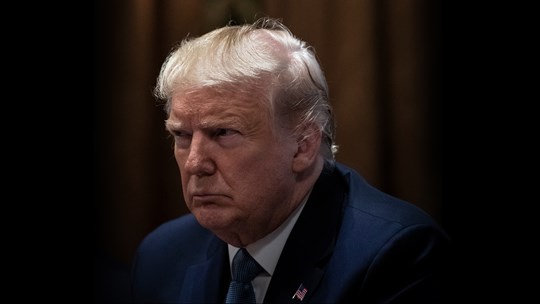
photo credit: Drew Angerer/[CT] Staff/Getty Images
Wow. Just wow. Christianity Today, described by the Washington Post as "evangelicalism's flagship magazine," has called for Donald Trump's removal from office, not as "a matter of partisan loyalties but as a matter of loyalty to the Creator of the Ten Commandments." Wow. This is the article in its entirety:
In our founding documents, Billy Graham explains that Christianity Today will help evangelical Christians interpret the news in a manner that reflects their faith. The impeachment of Donald Trump is a significant event in the story of our republic. It requires comment.
The typical CT approach is to stay above the fray and allow Christians with different political convictions to make their arguments in the public square, to encourage all to pursue justice according to their convictions and treat their political opposition as charitably as possible. We want CT to be a place that welcomes Christians from across the political spectrum, and reminds everyone that politics is not the end and purpose of our being. We take pride in the fact, for instance, that politics does not dominate our homepage.
That said, we do feel it necessary from time to time to make our own opinions on political matters clear—always, as Graham encouraged us, doing so with both conviction and love. We love and pray for our president, as we love and pray for leaders (as well as ordinary citizens) on both sides of the political aisle.
Let’s grant this to the president: The Democrats have had it out for him from day one, and therefore nearly everything they do is under a cloud of partisan suspicion. This has led many to suspect not only motives but facts in these recent impeachment hearings. And, no, Mr. Trump did not have a serious opportunity to offer his side of the story in the House hearings on impeachment.
But the facts in this instance are unambiguous: The president of the United States attempted to use his political power to coerce a foreign leader to harass and discredit one of the president’s political opponents. That is not only a violation of the Constitution; more importantly, it is profoundly immoral.
The reason many are not shocked about this is that this president has dumbed down the idea of morality in his administration. He has hired and fired a number of people who are now convicted criminals. He himself has admitted to immoral actions in business and his relationship with women, about which he remains proud. His Twitter feed alone—with its habitual string of mischaracterizations, lies, and slanders—is a near perfect example of a human being who is morally lost and confused.
Trump’s evangelical supporters have pointed to his Supreme Court nominees, his defense of religious liberty, and his stewardship of the economy, among other things, as achievements that justify their support of the president. We believe the impeachment hearings have made it absolutely clear, in a way the Mueller investigation did not, that President Trump has abused his authority for personal gain and betrayed his constitutional oath. The impeachment hearings have illuminated the president’s moral deficiencies for all to see. This damages the institution of the presidency, damages the reputation of our country, and damages both the spirit and the future of our people. None of the president’s positives can balance the moral and political danger we face under a leader of such grossly immoral character.
This concern for the character of our national leader is not new in CT. In 1998, we wrote this:
The President's failure to tell the truth—even when cornered—rips at the fabric of the nation. This is not a private affair. For above all, social intercourse is built on a presumption of trust: trust that the milk your grocer sells you is wholesome and pure; trust that the money you put in your bank can be taken out of the bank; trust that your babysitter, firefighters, clergy, and ambulance drivers will all do their best. And while politicians are notorious for breaking campaign promises, while in office they have a fundamental obligation to uphold our trust in them and to live by the law.
And this:
Unsavory dealings and immoral acts by the President and those close to him have rendered this administration morally unable to lead.
Unfortunately, the words that we applied to Mr. Clinton 20 years ago apply almost perfectly to our current president. Whether Mr. Trump should be removed from office by the Senate or by popular vote next election—that is a matter of prudential judgment. That he should be removed, we believe, is not a matter of partisan loyalties but loyalty to the Creator of the Ten Commandments.
To the many evangelicals who continue to support Mr. Trump in spite of his blackened moral record, we might say this: Remember who you are and whom you serve. Consider how your justification of Mr. Trump influences your witness to your Lord and Savior. Consider what an unbelieving world will say if you continue to brush off Mr. Trump’s immoral words and behavior in the cause of political expediency. If we don’t reverse course now, will anyone take anything we say about justice and righteousness with any seriousness for decades to come? Can we say with a straight face that abortion is a great evil that cannot be tolerated and, with the same straight face, say that the bent and broken character of our nation’s leader doesn’t really matter in the end?
We have reserved judgment on Mr. Trump for years now. Some have criticized us for our reserve. But when it comes to condemning the behavior of another, patient charity must come first. So we have done our best to give evangelical Trump supporters their due, to try to understand their point of view, to see the prudential nature of so many political decisions they have made regarding Mr. Trump. To use an old cliché, it’s time to call a spade a spade, to say that no matter how many hands we win in this political poker game, we are playing with a stacked deck of gross immorality and ethical incompetence. And just when we think it’s time to push all our chips to the center of the table, that’s when the whole game will come crashing down. It will crash down on the reputation of evangelical religion and on the world’s understanding of the gospel. And it will come crashing down on a nation of men and women whose welfare is also our concern.
Note: This editorial has gone viral in a big way, so much so that the Christianity Today website crashed from all the traffic and was offline for a couple of hours.
Update: The Washington Post spoke with the author of editorial, CT's editor-in-chief, Mark Galli:
Based in the suburbs of Chicago, Christianity Today aims to be the voice of evangelicals, providing news and commentary through its monthly magazine and website. Many evangelical leaders and high-profile pastors are among the magazine’s 80,000 print subscribers, and its advertisements regularly feature major evangelical institutions. In the hours after the editorial was published, “Christianity Today” was trending on Twitter.
Galli said that under his watch, the magazine has received criticism from some who wanted it to be more outspoken against the president. He said initially he thought criticisms of the president were “too panicky and fearful” and that it took him some time to decide to draw a line in the sand.
“I bend over backwards to be charitable and patient with people, including people who support Trump,” he said. “I probably went too far on that.” (Read more here.)
It turns out Christianity Today also published an editorial about Donald in October, 2016, shortly after the "grab 'em by the pussy" tape came out:
Indeed, there is hardly any public person in America today who has more exemplified the “earthly nature” (“flesh” in the King James and the literal Greek) that Paul urges the Colossians to shed: “sexual immorality, impurity, lust, evil desires, and greed, which is idolatry” (3:5). This is an incredibly apt summary of Trump’s life to date. Idolatry, greed, and sexual immorality are intertwined in individual lives and whole societies. Sexuality is designed to be properly ordered within marriage, a relationship marked by covenant faithfulness and profound self-giving and sacrifice. To indulge in sexual immorality is to make oneself and one’s desires an idol. That Trump has been, his whole adult life, an idolater of this sort, and a singularly unrepentant one, should have been clear to everyone.
And therefore it is completely consistent that Trump is an idolater in many other ways. He has given no evidence of humility or dependence on others, let alone on God his Maker and Judge. He wantonly celebrates strongmen and takes every opportunity to humiliate and demean the vulnerable. He shows no curiosity or capacity to learn. He is, in short, the very embodiment of what the Bible calls a fool. (Read more here.)
Update #2 on Monday, December 23. Yesterday, Timothy Dalrymple, president and CEO of Christianity Today, published a lengthy follow-up to Thursday's article. These are the ideas that stood out to me:
While the Trump administration may be well regarded in some countries, in many more the perception of wholesale evangelical support for the administration has made toxic the reputation of the Bride of Christ.
... Jesus said we should give to Caesar what is Caesar’s and to God what is God’s. With profound love and respect, we ask our brothers and sisters in Christ to consider whether they have given to Caesar what belongs only to God: their unconditional loyalty.
... The problem is that we as evangelicals are also associated with President Trump’s rampant immorality, greed, and corruption; his divisiveness and race-baiting; his cruelty and hostility to immigrants and refugees; and more. In other words, the problem is the wholeheartedness of the embrace. It is one thing to praise his accomplishments; it is another to excuse and deny his obvious misuses of power.
... Countless men and women we hold in the highest regard voted for President Trump, some wholeheartedly and some reluctantly. Friends we love and respect have also counseled and worked within the Trump administration. We believe they are doing their best to serve wisely in a fallen world.
We nevertheless believe the evangelical alliance with this presidency has done damage to our witness here and abroad. The cost has been too high.
... and this is the article, titled "The Flag in the Whirlwind: An Update from CT's President," in its entirety:
Reader responses to Mark Galli’s recent editorial have spanned the spectrum. We have received countless notes of encouragement from readers who were profoundly moved. They no longer feel alone. They have hope again. Many have told us of reading the editorial with tears in their eyes, sharing it with children who have wandered from the faith, rejoicing that at last someone was articulating what they felt in their hearts. They felt this was a watershed moment in the history of the American church—or they hoped it would prove to be. Stay strong, they told us, knowing we were about to reap the whirlwind.
On the other hand, we have heard from many readers who felt incensed and insulted. These readers felt the editorial engaged in character assassination, or maligned a broad swath of our fellow evangelicals, or revealed that we prefer the Democrats to a President who has done a lot of good for causes we all care about.
Of course, we appreciate the support and listen humbly to the criticisms. But at the end of the day, we write for a readership of One. God is our Tower. Let the whirlwind come.
President Donald Trump would have you believe we are “far left.” Others have said we are not Bible-believing Christians. Neither is true. Christianity Today is theologically conservative. We are pro-life and pro-family. We are firm supporters of religious liberties and economic opportunity for men and women to exercise their gifts and create value in the world. We believe in the authority of Scripture.
We are also a global ministry. We travel the world and see the breadth and depth of what God is doing through his people all around the planet. It is beautiful, and breathtaking, and immense. The global Body of Christ—and the community of evangelicals—is vastly larger than our domestic political squabbles. But partly on behalf of that global body, we can no longer stay silent.
American evangelicals have always been a loose coalition of tribes. We have fought one another as often as we have fought together. We at Christianity Today believe we need to relearn the art of balancing two things: having a firm opinion and inviting free discussion. We need, in other words, both a flag and a table.
First, then, the flag. Numerous reporters have asked whether the ministry supports what was stated in the editorial. Was Mark Galli speaking on behalf of the institution? CT does not have an editorial board. Editors publish under their own names. Yet Galli has stood in the trenches for men and women of faith for over three decades. He has been an outstanding editor in chief. While he does not speak for everyone in the ministry—our board and our staff hold a range of opinions—he carries the editorial voice of the magazine. We support CT’s editorial independence and believe it’s vital to our mission for the editor in chief to speak out on the issues of the day.
As an institution, Christianity Today has no interest in partisan politics. It does not endorse candidates. We aim to bring biblical wisdom and beautiful storytelling both to the church and from the church to the world. Politics matter, but they do not bring the dead back to life. We are far more committed to the glory of God, the witness of the church, and the life of the world than we care about the fortunes of any party. Political parties come and go, but the witness of the church is the hope of the world, and the integrity of that witness is paramount.
Out of love for Jesus and his church, not for political partisanship or intellectual elitism, this is why we feel compelled to say that the alliance of American evangelicalism with this presidency has wrought enormous damage to Christian witness. It has alienated many of our children and grandchildren. It has harmed African American, Hispanic American, and Asian American brothers and sisters. And it has undercut the efforts of countless missionaries who labor in the far fields of the Lord. While the Trump administration may be well regarded in some countries, in many more the perception of wholesale evangelical support for the administration has made toxic the reputation of the Bride of Christ.
Galli’s editorial focused on the impeachment, but it was clear the issues are deeper and broader. Reasonable people can differ when it comes to the flagrantly partisan impeachment process. But this is not merely about impeachment, or even merely about President Trump. He is not the sickness. He is a symptom of a sickness that began before him, which is the hyper-politicization of the American church. This is a danger for all of us, wherever we fall on the political spectrum. Jesus said we should give to Caesar what is Caesar’s and to God what is God’s. With profound love and respect, we ask our brothers and sisters in Christ to consider whether they have given to Caesar what belongs only to God: their unconditional loyalty.
Let me protect against two misunderstandings. The problem is not that we as evangelicals are associated with the Trump administration’s judicial appointments or its advocacy of life, family, and religious liberty. We are happy to celebrate the positive things the administration has accomplished. The problem is that we as evangelicals are also associated with President Trump’s rampant immorality, greed, and corruption; his divisiveness and race-baiting; his cruelty and hostility to immigrants and refugees; and more. In other words, the problem is the wholeheartedness of the embrace. It is one thing to praise his accomplishments; it is another to excuse and deny his obvious misuses of power.
Similarly, this is neither a criticism of the evangelical Trump voter nor an endorsement of the Democrats. The 2016 election confronted evangelical voters with an impossible dilemma: Vote for a pro-choice candidate whose policies would advance so much of what we oppose, or vote for an extravagantly immoral candidate who could well damage the standing of the republic and the witness of the church. Countless men and women we hold in the highest regard voted for President Trump, some wholeheartedly and some reluctantly. Friends we love and respect have also counseled and worked within the Trump administration. We believe they are doing their best to serve wisely in a fallen world.
We nevertheless believe the evangelical alliance with this presidency has done damage to our witness here and abroad. The cost has been too high. American evangelicalism is not a Republican PAC. We are a diverse movement that should collaborate with political parties when prudent but always standing apart, at a prophetic distance, to be what Martin Luther King, Jr. called “the conscience of the state.” That is what we believe. This is where we plant our flag. We know we are not alone.
Now, to the table. A table is a place of welcome, a place where bread is broken and friendships are forged. In a political landscape dominated by polarization, hostility, and misunderstanding, we believe it’s critical for Christians to model how to have a firm opinion and host free discussion at the same time. Evangelicals of different stripes cannot continue to shout one another down, bully those who disagree, or exclude one another and refuse to listen.
We hold fast to our view that the wholehearted evangelical embrace of Trump has been enormously costly—but we are committed to irenic conversation with men and women of good faith who believe otherwise. (And since an open letter was published even as we were preparing to publish this statement, let me simply say that I appreciate the thoughts it expresses, and I hope this statement too can be the beginning of a dialogue.)
In the words of Proverbs 27:6, “faithful are the wounds of a friend” (ESV). Deeply aware of our own sinfulness and limitations, we are going to invite supporters and critics alike to produce essays agreeing or disagreeing with our stated views. It is time for evangelicals to have a serious discussion about how our identity as Christians shapes our activity as citizens. We will invite authors who represent a variety of viewpoints in a thoughtful and charitable manner. We will publish those essays in mid-January. We hope we can come together in convicted humility and learn from one another.
Now it is time for Christmas. Christ is still the light that shines upon a people living in darkness. We look forward to resuming the conversation soon.
The flag is planted. The table is set. We invite you to join us at either one.
I'm still wondering what Mike Pence thinks about all this. So far, his silence is deafening.
This Day In History, 1998: Bill Clinton Is Impeached - Updated
It's just a coincidence, but Donald's impeachment last night came just one day short of the 21st anniversary of the impeachment of Bill Clinton.
Reporter Jamie Dupree flags the almost identical headlines at the Washington Post:
Photographer David Hume Kennerly was at the White House in 1998:
Reporter Jamie Dupree flags the almost identical headlines at the Washington Post:
Two front pages almost exactly 21 years apart pic.twitter.com/EVLJGRnX2n— Jamie Dupree (@jamiedupree) December 19, 2019
Photographer David Hume Kennerly was at the White House in 1998:
Update. From the Washington Post: [T]he scarlet "I" of impeachment will be permanent:
Yes, he is expected to be acquitted in the Republican-controlled Senate, if and when the House sends the charges over to the other chamber. Sure, 46 percent of people still oppose Trump’s impeachment — statistically similar to the 49 percent who support such action, according to a Washington Post-ABC poll released Tuesday. And of course, he may yet win reelection in 2020.
But for a man consumed with his legacy and legitimacy, the 230-to-197 vote on abuse of power and the 229-to-198 vote on obstruction of Congress are stains that undermine both.
It is impeachment, and it is for life. It’s historical and it’s constitutional. It’s not something Trump can squirm his way out of, or cut a hush-money check to make disappear.
“I do think that the reason the president is taking impeachment particularly hard is because he has absolutely no control over the process, at least not in the way he understands,” Jeff Flake, a former Republican senator from Arizona who was a frequent Trump critic, said in a text message. “Bullying doesn’t work in this situation.”
Trump can spin and obfuscate all he wants — he can dismiss it from the rally stage and decry it from his Twitter feed — but the scarlet “I” of impeachment will be, as Rep. Ted Lieu (D-Calif.) said, “permanent.”
“No president wants to be impeached,” Lieu said in his speech on the House floor Wednesday before the final vote. “Whether Donald Trump leaves in one month, one year or five years, this impeachment is permanent, it will follow him for the rest of his life, and it will be included in all future history books. And the people will know why we impeached.” (Read more here.)
Wednesday, December 18, 2019
Random Thoughts On Impeachment Day - Updated
I'll be posting interesting things periodically throughout the day. To start us off, how about an interview with Donald from 11 years ago. He says nice things about Nancy Pelosi then wonders why she didn't impeach George W. Bush for getting us into the war. (Apparently that wouldn't have been overturning an election.) Separate from that, the contrast between Donald's ability to speak clearly 11 years ago, and his ability to do so today, is striking:
This is how Morning Joe opened the show this morning:
George T. Conway III is an attorney in New York. Steve Schmidt is a political strategist who worked for President George W. Bush, Senator John McCain and Gov. Arnold Schwarzenegger. John Weaver is a Republican strategist who worked for President George H.W. Bush, Senator John McCain and Gov. John Kasich. Rick Wilson is a Republican media consultant and author of “Everything Trump Touches Dies” and the forthcoming “Running Against the Devil: A Plot to Save America From Trump and Democrats From Themselves.”
A striking picture of Donald. You know he's not having a good day:
A little karma for Don Jr.:
Update on Thursday afternoon:
Update #2 on Friday afternoon. A great story about Doug Mills, the New York Times photographer who took the black-and-white picture of Donald above:
Check out this exchange I had with then private citizen @realDonaldTrump on Oct. 15, 2008. We spoke about House Speaker Nancy Pelosi and he then offered his thoughts about impeachment. pic.twitter.com/mXlsG9SjbB— Wolf Blitzer (@wolfblitzer) December 18, 2019
How much must every @HouseGOP and @SenateGOP member hate Mike Pence @VP if they portray the impeachment of Trump as the end of the world?— Kurt Eichenwald (@kurteichenwald) December 18, 2019
If the Republic will end if @Mike_Pence is president, well, he shouldn't be vice president. At least that is the message from the @GOP.
This is how Morning Joe opened the show this morning:
.@Morning_Joe's 6am open, 12/18/19 pic.twitter.com/pUam98fZiR— Daniel Norwick (@danielnorwick) December 18, 2019
Joe Scarborough also said that a big reason why Donald is getting impeached today is that he listened to Rudy Giuliani:
"Isn't it fascinating that Donald Trump gets so angry when somebody works on his campaign and makes a few dollars here and a few dollars there off of his campaign or off of his name, it drives him crazy, it always has. And yet he is being impeached today in large part because Rudy sold him a bill of goods while Rudy was trying to get even richer off of inside deals in Ukraine. People all around the president, people in the White House didn't want the president to listen to Rudy but he bought it hook, line and sinker because Rudy said you know what, I can get at the one thing that exasperates him the most, that irritates him the most, the 2016 election. I'll sell him a bill of goods that this was about Ukraine and not Russia. He'll blow the entire country apart and I can go into the chaos and make millions of dollars off of these inside deals. Donald J Trump is getting impeached today in large part because he bought Rudy's nonsense, hook, line and sinker."
In an article titled "We Are Republicans, and We Want Trump Defeated," George T. Conway III, Steve Schmidt, John Weaver and Rick Wilson co-wrote the following in the NYT:
Patriotism and the survival of our nation in the face of the crimes, corruption and corrosive nature of Donald Trump are a higher calling than mere politics. As Americans, we must stem the damage he and his followers are doing to the rule of law, the Constitution and the American character.
That’s why we are announcing the Lincoln Project, an effort to highlight our country’s story and values, and its people’s sacrifices and obligations. This effort transcends partisanship and is dedicated to nothing less than preservation of the principles that so many have fought for, on battlefields far from home and within their own communities.
This effort asks all Americans of all places, creeds and ways of life to join in the seminal task of our generation: restoring to this nation leadership and governance that respects the rule of law, recognizes the dignity of all people and defends the Constitution and American values at home and abroad.
Over these next 11 months, our efforts will be dedicated to defeating President Trump and Trumpism at the ballot box and to elect those patriots who will hold the line. We do not undertake this task lightly, nor from ideological preference. We have been, and remain, broadly conservative (or classically liberal) in our politics and outlooks. Our many policy differences with national Democrats remain, but our shared fidelity to the Constitution dictates a common effort.
The 2020 general election, by every indication, will be about persuasion, with turnout expected to be at record highs. Our efforts are aimed at persuading enough disaffected conservatives, Republicans and Republican-leaning independents in swing states and districts to help ensure a victory in the Electoral College, and congressional majorities that don’t enable or abet Mr. Trump’s violations of the Constitution, even if that means Democratic control of the Senate and an expanded Democratic majority in the House.
The American presidency transcends the individuals who occupy the Oval Office. Their personality becomes part of our national character. Their actions become our actions, for which we all share responsibility. Their willingness to act in accordance with the law and our tradition dictate how current and future leaders will act. Their commitment to order, civility and decency are reflected in American society.
Mr. Trump fails to meet the bar for this commitment. He has neither the moral compass nor the temperament to serve. His vision is limited to what immediately faces him — the problems and risks he chronically brings upon himself and for which others, from countless contractors and companies to the American people, ultimately bear the heaviest burden.
But this president’s actions are possible only with the craven acquiescence of congressional Republicans. They have done no less than abdicate their Article I responsibilities.
Indeed, national Republicans have done far worse than simply march along to Mr. Trump’s beat. Their defense of him is imbued with an ugliness, a meanness and a willingness to attack and slander those who have shed blood for our country, who have dedicated their lives and careers to its defense and its security, and whose job is to preserve the nation’s status as a beacon of hope.
Congressional Republicans have embraced and copied Mr. Trump’s cruelty and defended and even adopted his corruption. Mr. Trump and his enablers have abandoned conservatism and longstanding Republican principles and replaced it with Trumpism, an empty faith led by a bogus prophet. In a recent survey, a majority of Republican voters reported that they consider Mr. Trump a better president than Lincoln.
Mr. Trump and his fellow travelers daily undermine the proposition we as a people have a responsibility and an obligation to continually bend the arc of history toward justice. They mock our belief in America as something more meaningful than lines on a map.
Our peril far outstrips any past differences: It has arrived at our collective doorstep, and we believe there is no other choice. We sincerely hope, but are not optimistic, that some of those Republicans charged with sitting as jurors in a likely Senate impeachment trial will do likewise.
American men and women stand ready around the globe to defend us and our way of life. We must do right by them and ensure that the country for which they daily don their uniform deserves their protection and their sacrifice.
We are reminded of Dan Sickles, an incompetent 19th-century New York politician. On July 2, 1863, his blundering nearly ended the United States.
(Sickles’s greatest previous achievement had been fatally shooting his wife’s lover across the street from the White House and getting himself elected to Congress. Even his most fervent admirers could not have imagined that one day, far in the future, another incompetent New York politician, a president, would lay claim to that legacy by saying he could shoot someone on Fifth Avenue and get away with it.)
On that day in Pennsylvania, Sickles was a major general commanding the Union Army’s III Corps at the Battle of Gettysburg, and his incompetence wrought chaos and danger. The Confederate Army took advantage, and turned the Union line. Had the rebel soldiers broken through, the continent might have been divided: free and slave, democratic and authoritarian.
Another Union general, Winfield Scott Hancock, had only minutes to reinforce the line. America, the nation, the ideal, hung in the balance. Amid the fury of battle, he found the First Minnesota Volunteers.
They charged, and many of them fell, suffering a staggeringly high casualty rate. They held the line. They saved the Union. Four months later, Lincoln stood on that field of slaughter and said, “It is for us, the living, rather, to be dedicated here to the unfinished work which they who fought here have thus far so nobly advanced.”
We look to Lincoln as our guide and inspiration. He understood the necessity of not just saving the Union, but also of knitting the nation back together spiritually as well as politically. But those wounds can be bound up only once the threat has been defeated. So, too, will our country have to knit itself back together after the scourge of Trumpism has been overcome. (This is the article in its entirety.)
Who, exactly, are these guys? This is the blurb that was attached to the article; it doesn't mention that George Conway is married to Kellyanne Conway, one of Donald's closest advisers:
A striking picture of Donald. You know he's not having a good day:
A little karma for Don Jr.:
— Donald Trump Jr. (@DonaldJTrumpJr) September 10, 2016
And finally, this is what Donald will see when he reads the papers tomorrow:
tomorrow's NYT front page pic.twitter.com/peoHULu6o2— Jesse Lehrich (@JesseLehrich) December 19, 2019
tomorrow's USA Today pic.twitter.com/kvdLwQjJTB— Jesse Lehrich (@JesseLehrich) December 19, 2019
tomorrow's Washington Post pic.twitter.com/rlczcHzmFB— Jesse Lehrich (@JesseLehrich) December 19, 2019
A newspaper i was proud to have delivered on a bike as an 11 year old in Detroit area even on cold winter days. pic.twitter.com/x0ueppqC1j— Matthew Dowd (@matthewjdowd) December 19, 2019
Thursday's front page of The Oregonian. pic.twitter.com/9abINaeTVv— The Oregonian (@Oregonian) December 19, 2019
Update on Thursday afternoon:
Update #2 on Friday afternoon. A great story about Doug Mills, the New York Times photographer who took the black-and-white picture of Donald above:
Pres. Trump has made insulting the media a centerpiece of his presidency. But at least one member of the press corps has earned universal praise for his work: Photographer @DougMillsNYT.@MajorCBS introduces us to the photographer who has caught the president's eye: pic.twitter.com/pN4TsMOys1— CBS This Morning (@CBSThisMorning) December 17, 2019
Subscribe to:
Posts (Atom)