This is Talking Points Memo's take on it:
It’s been an eventful week for the Trump clan.
To say nothing of the various antediluvian calamities battering the country, a potential bombshell is headed toward the family in the form of a book written by a former friend of Melania Trump’s, Stephanie Winston Wolkoff, due out next week.
Wolkoff isn’t only a friend of Melania’s, but also served as a chief organizer of President Trump’s 2017 inauguration. That event has been facing down federal investigations amid allegations of mass financial mismanagement, and of schemes in which foreign bigwigs were allowed to contribute to the committee in exchange for tickets — a practice banned by federal law.
That’s not to mention an ongoing mystery over why the inaugural raised $107 million — nearly twice as much as the next-most-expensive inauguration bash — but featured far fewer events and productions than any other presidential inauguration in recent memory.
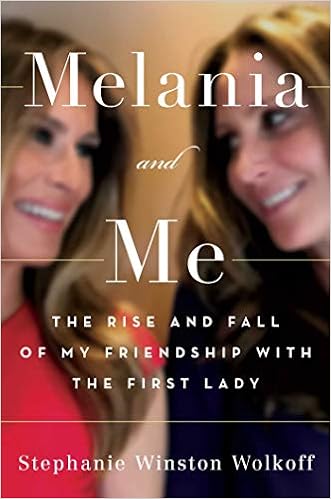
Wolkoff’s book — Melania and Me — has been billed as having an answer to that nagging question of where the $107 million went, while also offering details of Wolkoff’s relationship with Melania. Wolkoff reportedly taped her conversations with the first lady. (Read the entire article here.)
Now Olivia Nuzzi, writing at NY Mag, has published an excerpt, along with some dish about her conversations with Ms. Wolkoff. The dish first, in Nuzzi's voice:
I'd heard Melania Trump speak before. But I’d never heard her sound like this. I was sitting at the end of the dining-room table in the Park Avenue home of Stephanie Winston Wolkoff, who had been the First Lady’s best friend for years and, until a few months earlier, an informal member of her East Wing staff.
A former public-relations executive at Vogue who bears a vague resemblance to Stephanie Seymour, Wolkoff is 49 years old and over six feet tall. She is sweet and friendly and quick with a self-deprecating joke. She is scatterbrained but focused, if that makes any sense at all, like the personification of an “organized mess.” She’d been the producer of the Met Gala and the fashion director of Mercedes-Benz Fashion Week, so it made a certain amount of sense when she was enlisted to help produce Donald Trump’s inauguration — a multiday series of events across Washington, D.C., ending with the swearing-in of the new president. But reports about the inaugural committee’s finances suggested something might be amiss. Wolkoff’s company, WIS Media Partners, received $26 million, according to financial records — the highest amount paid to any single entity. Soon after the disclosure, the New York Times reported that Wolkoff’s White House contract had been terminated following the Trump family’s “displeasure” with how much Wolkoff had made, and the president himself was “enraged” when he learned about another contractor Wolkoff hired for the inaugural planning who billed the committee nearly $4 million.
The coverage of Wolkoff and the money she made left the impression that this was yet another example of Trumpworld grift: a close friend of the First Lady’s, a “party planner,” as she was sometimes dismissively described, emerging from the chaos of a Trump production with millions. Wolkoff was devastated.
By the time we met, in the spring of 2018, Wolkoff had come to believe that she’d been sacrificed to the media by others in the president’s orbit in order to deflect attention from their misdeeds. She believed financial records had been purposefully structured in such a way that she was listed as the inaugural committee’s greatest benefactor when, in fact, she’d kept a careful paper trail that showed she dispersed the bulk of her payment to a series of other vendors she’d hired to put on the events. She believed her life and reputation had been destroyed — that she now looked to the outside world like a scam artist, a glamorous petty criminal. Like one of them, in other words — one of the people of the campaign and inauguration and now the White House who she believed were up to no good.
She thought “they” — powerful forces at the committee, like Rick Gates and Tom Barrack and the members of the Trump family they were working on behalf of — were hiding something. She didn’t know, or didn’t feel comfortable saying what she thought that something might be. She thought that her questions about the spending, and the financial reports, and why things were being done the way they were made her too much of a problem to keep around. She thought she was fired because she wouldn’t go along with the narrative created by people more powerful than she was — people who, she believed, wanted to conceal the truth. When Wolkoff told Melania the White House had “cut her head off” when a spokesperson said her relationship had been “severed,” Melania coldly replied, “Don’t be so dramatic. You weren’t fired.”
She knew only that it didn’t feel right, didn’t sound right, and she believed she’s been selected to bear the brunt of the criticism of the committee’s finances because she was a wealthy society woman with no knowledge of politics — the perfect scapegoat, perfect media villain, and someone unlikely to fight back.
But most of all, Wolkoff had come to believe that she’d been abandoned and betrayed by the woman she thought was her best friend, the woman who was now First Lady of the United States and could not be bothered to intervene on her behalf.
Wolkoff’s home is sleek and pristine, decorated with works of modern art beyond my comprehension. So the mess in the corner was hard to ignore: dozens of stacks of documents, scattered across the table, falling out of binders, heaped on the floor. Tax records, email correspondence between powerful members of the Trump family and entertainment and Trump Organization executives, pages and pages of research, news articles, leads she was trying to follow to figure out what had happened to her own life. I watched in something like awe as Wolkoff sifted through it all, clearing papers out of the way, then frantically reaching for a paper at the bottom of a pile to point out to me a highlighted section of text, then gesturing as if to say, What does it mean? I sure as hell didn’t know either.
When she had begun to suspect something was wrong, she told me, she started collecting as many receipts as she could. She hired lawyers. She became paranoid, communicating exclusively on encrypted apps like Signal. She pulled out her phone and showed me her Signal messages with Melania, punctuated with emoji hearts and laughs and kisses and flowers. Melania uses emoji like my mom: often, without restraint, and in place of words or punctuation. Wolkoff seemed not to be able to understand how a person she thought she knew could turn out to be someone else entirely. She emphasized over and over just how close they were, what good friends they were. But she couldn’t explain what had happened. And then she asked me if I wanted to hear one of their conversations.
Melania’s voice was familiar, but she sounded softer, not quite as guarded and steely as she does in public. She was reassuring Wolkoff that things would be okay, that she didn’t do anything. It was a bit hard to follow, but it sounded like she cared. Like she was trying to be there for a friend. As Wolkoff emphasized what good friends she had been with Melania, she seemed unaware of the betrayal that she was engaging in herself: Do best friends show texts and play recordings of their conversations to reporters? (I wasn’t the only member of the press to make the pilgrimage to her home and to leaf through the documents alongside her, trying to knit the threads together.) But I also understood how Wolkoff had gotten to this point. She was hurt and confused and worried. She had thought, for a period, that she might be killed, though she acknowledged now that was probably not the case. She wanted to salvage her reputation, and she was aware of how little she grasped about the world she had found herself deep inside of because of her friendship with another mom a few blocks away.
Many of the characters in this chapter of Wolkoff’s life — what would become chapters in her new book, Melania & Me, an excerpt of which appears below — became a part of the various federal investigations that defined much of Trump’s first term in office. Wolkoff doesn’t say if or to what degree she participated in those investigations, but certain scenes in the book relate directly to what we know have been areas of interest for law enforcement. But the book isn’t a legal exposé focused on financial questions about the handling of the inauguration. It is much more personal than that. And while the story is built around her friendship, and then falling out, it delivers a vivid account of Melania’s strange relationship with her adult stepchildren — particularly Ivanka, to whom Wolkoff writes Melania referred, with almost joking bitterness, as “Princess.” This account is not written from a distance but from within Melania’s tightest orbit — literally, in that case, inside Melania’s living room. Wolkoff grants legitimacy to years of rumors about a rivalry between Ivanka and Melania, with the First Daughter angling for screen time and power and proximity at her stepmother’s expense. And it isn’t an unflattering portrait of the First Lady, up close as it is. Not completely, anyway. Even as Wolkoff details her Herculean efforts to keep Ivanka from being positioned too close to her father during the swearing-in, Melania comes across as sometimes amused and often annoyed — but never consumed — by any of this.
Perhaps without intending to, Wolkoff also reveals the shocking ignorance with which members of the administration deal with the media —and with each other. In one scene, she writes about her desire for the White House to release a statement to the press detailing her recent health crisis and hospital stay. When White House lawyers respond that it’s not a good idea to send the statement out, Wolkoff sees evidence of a coordinated plan. It doesn’t seem to occur to Wolkoff that it would be highly unusual for any White House to release a statement about the health of an East Wing employee with no public-facing responsibilities. And Wolkoff interprets negative press coverage of Melania and then of herself as evidence of conspiracy, too. But you have to forgive her: Seeing this through Wolkoff’s eyes, it’s easy to get why it probably felt at times like conspirators might be lurking everywhere.
Something you learn, while reporting on Melania, is how small her world is. While her husband keeps in touch with a vast network of friends and frenemies and associates and rivals and informal advisers and people he’s fired and rehired and fired again, the First Lady speaks to few people and trusts fewer. This is part of the reason why, despite performing the traditional tasks of a First Lady that might ordinarily contribute to a warm, feminine image — she visits hospitals, she wraps her arms around sick children — she projects only iciness and impenetrability. We hear from her little, and what we do hear is terse and shallow. We see her rarely, and what we do see is carefully presented, not a hair out of place, her face obscured by dark sunglasses, her mouth pressed into a now-iconic pouted scowl. To humanize a press-shy public figure, you need character witnesses. Sources who can reveal glimpses of a person beneath the artifice. But the size of Melania’s social circle has prevented that. There is her immediate family — by which I mean her teenage son, her parents, and her sister, which can be understood as a wholly separate offshoot of the Trump family — and there is a small group of friends from her life in New York. Survey the media coverage of the First Lady from the last five years, since her husband first entered politics. You will find a few people who actually know her being quoted, talking about the type of person she is. Wolkoff was one of them.
And then she wasn’t.
To her, Melania & Me, the book she’s written about the formation and collapse of her relationship with the First Lady, is an odd but compelling cross of two stories: a female friendship gone awry and a whodunit about some possibly shady behavior surrounding the swearing in of the president of the United States. Wolkoff writes about being let down by one of the most important women in the world — Melania is not who she thought she was during their years of weekly lunches at which they ate salmon and French fries — and a handful of society events a year. She drifts further and further from her connection with Wolkoff, a protracted break of the heart, told through the saga of Wolkoff’s personal health struggles during the first year of the administration. Her own decision to let her friend down receives little scrutiny. And perhaps it won’t — Melania is not exactly a sympathetic figure. As Wolkoff writes, she now knows that “a Trump is a Trump is a Trump.”
The dedication reads, “To Melania.”
And then the excerpt from the book, in Wolkoff's voice:
Fifty-one days before Donald Trump was sworn in as president of the United States, I met with Melania at Trump Tower, carrying bags and boxes so she could review and sign off on menus, décor, paper stock. I was weighed down by anxiety, too. I was, at that point, probably Melania’s closest friend, and as the longtime planner of the Met Gala I’d found myself, someone who had never voted before 2016, planning the most divisive presidential inauguration in American history. I had spent the day discussing with Melania about how her name should appear on the inauguration program (she wanted to be listed as “First Lady-Elect,” even though, as I reminded her, she had not in fact been elected); negotiating over the location of the Candlelight Dinner and trying to plan 21 other inauguration events (we eventually, mercifully, got it down to 18, total); teleconferencing from Tom Barrack’s office (he was flying to L.A. to meet with Mark Burnett about producing the inauguration) with Mitch Davis, Clive Davis’s son, about trying to book some famous talent (we were hoping to book two or three acts from a list we’d drawn up featuring Aerosmith, Carrie Underwood, Celine Dion, Kelly Clarkson, Kiss, the Killers, Meat Loaf, Mavis Staples, Pat Benatar, and Lynyrd Skynyrd).
“We don’t have any A-list performers locked in, or B-list for that matter,” I said to Melania. “We don’t even have an office to work in! I have at least ten people in and out of my apartment all day. It’s not fair to David and the kids. And can you please tell me why Rick Gates has an all-access badge to Trump Tower?”
“He does?” Melania asked.
“He took us to Don Jr., Eric, and Ivanka’s office suite. He knew where the security button was located. We all just walked right in.” In Don Jr.’s office, Rick made himself right at home and sat down in Don’s chair.
“Really,” Melania said, seeing that I was getting upset again. “When Donald comes home, I want you to tell him what’s going on.”
An hour later, he walked into the dining room as chipper as could be. “Hi, baby,” he said to Melania.
She was looking at Pantone colors but flashed him a quick smile. “Hello, Stephanie. How are you?” he asked.
I began to stand and he said, “Stay, sit, sit. Time magazine—I’m on the cover again!” He was the 2016 Person of the Year.
Melania laughed and said, “Oh, Donald. That’s great!” Her tone was coquettish, hyperfeminine, an open invitation for him to keep going.
He said, “I’ve been on the cover a dozen times already.”
I said, “Donald, you’re going to be the president,” implying that his new job was a bigger deal than a magazine cover.
He said, “Yeah, right! Great!” and then continued to describe the Time cover, and the one before, and the one before that. After ten minutes, he said, “Wow, you ladies look like you’re busy! Look at all of this.”
Melania said, “So much to do. We are so busy, but no worries.”
“That’s my girl!”
Melania leaned her shoulder into mine. “Tell him,” she said.
“It’s nothing,” I said, but he wouldn’t let me chicken out and waved for me to speak. I exhaled.
“Honestly, the presidential inaugural committee is a shit show. They are disorganized, incompetent, and can’t produce the material we need. My team’s been working around the clock and we can’t get the answers we need and we’re not really sure who to turn to.”
“What about Tom?” Donald asked. We both knew Tom was spending most of his time fundraising.
“I met Sara Armstrong, the PIC CEO,” I said, “but she’s not really in charge. She’s just there to sign off on budgets.”
“So who is in charge?” he asked.
“I’ve been working primarily with Rick.”
“Rick who?”
From the corner of my eye I could see Melania’s back stiffen. “Rick Gates,” I said.
Donald exclaimed, “Rick?! Rick Gates?! Who’s Rick Gates?!”
Was he serious? “He’s the deputy chairman of the inauguration,” I said.
“Oh, Rick. Rick Gates!” Donald paced himself into a tirade. “That son of a bitch stole $750,000 from me. I’m going to sue him!”
Donald stopped pacing and stood in front of Melania and me, his face scarlet. If I hadn’t known so much about food allergies, I would have thought he was going into anaphylactic shock.
“I’m calling Tom Barrack. I want Rick fired right now! That bastard. He stole my money!”
As Donald exited the dining room, a young man walked inside the apartment carrying a brown-paper bag. Donald asked him, “What are you doing here?”
A bit shaky, the man said, “I’m delivering your turkey sandwich for dinner, sir.”
Donald grabbed the bag and told the kid to sit down. “You’re in charge of the inauguration now,” he said. “Stephanie, fill him in. Tell him what he needs to do.”
I couldn’t tell if Donald was serious about tapping the 25-year-old body man to be the new deputy chairman of the PIC. He looked like he was just out of college.
I introduced myself and he said, “Nice to meet you. I’m John McEntee.” He was petrified.
“Have you ever produced an event before?” I asked. “Run an organization?”
He just shook his head. You could see sweat bubble on his brow. “I don’t understand,” he said. “What just happened?”
When I met Melania Knauss in 2003, we were both 32 years old and walking the hallways of Vogue. I was working; she was visiting. Ahead of their wedding, Donald needed the perfect setting to roll Melania out of relative obscurity, and what better than the city’s biggest, boldest spotlight, where the fashion, entertainment, and media universes collided—the Met Gala. The event was the ultimate setting for the who’s who; not just anybody could make a grand entrance. Melania was no industry power broker, but Donald was. Did he somehow convince Anna to turn Melania into the magazine’s shiny new object?
Before her Vogue makeover, Melania was a very pretty young woman who seemed like she was playing fancy dress-up—more a brunette Marilyn Monroe than a Jackie O. After Melania’s makeover, André Leon Talley’s achievement, she was transcendent, high fashion, editorial worthy. And the more time I spent with Melania, the more I genuinely liked her. Being with her was like having the sister I never had before—but a really confident, perfectly coiffed, ultimate older sister. In her world, nothing was a big deal, and everything was just as it should be. Just being with her made me feel good. She had her shit together! She was all about her family—Donald, Barron, and her parents—and herself. I was attracted to her directness. As for her husband, although it’s hard to imagine now, in 2005, Donald seemed like a harmless egomaniac.
I kept track of the campaign when I could. Melania’s texts kept coming, nearly every day, about the kids and her summer travels. It was almost like her husband wasn’t running for president.
On Election Night, I got to the Hilton at around 10 p.m. Our family friend Steven Mnuchin, Trump’s campaign finance chair, came out to meet us and take us to a private reception. The place was packed with Trump supporters. At first, not all of them really believed he’d win. But as the night wore on, with more and more states turning red, Trump’s seemed inevitable. The excitement level got higher and higher. At 2:30 a.m., Wisconsin went for Trump, pushing him over the line of 270 electoral votes.
Victory had been declared, but there was no sign of the victor. The crowd didn’t seem to know what to do next. I texted Melania, “People are starting to leave! What are you doing?”
She replied, “We’re on the way!”
A few minutes later, the Trump family arrived at the Hilton and took the stage. I was cheering from below, videotaping their entrance and Donald’s acceptance speech, while commenting on a group text with Melania and our mutual friend Rachel Roy.
Rachel, who was watching on CNN, texted, “DT is amazing! MT is so beautiful! Speech very Donald who we all know and love.”
I scoffed at her flattery. (Rachel was a lifelong Democrat.)
“Our work is just beginning. Let’s be the change we want to see in the world. Let’s work for women and children.” Rachel again.
I wrote, “Here we go, girls. We’re going to laugh a lot.” What I thought of as a sign-off.
Rachel kept going: “This shit is crazy. You have always been this role. You have lived it. You got this! Saying a prayer for Donald’s safety!” Melania has always been the role of First Lady? Really? Twenty years ago, she had been a barely-getting-by model in Paris. Thirty years ago, she’d lived in Communist Slovenia. Rachel was a bit overexcited.
I tried to get to the heart of the matter. “We love you. Strong support.”
Melania finally texted back at 4 a.m., “Love you both.”
The next day, Rachel asked when she could meet Melania for a celebration lunch in NYC or D.C. Melania’s answer: “I need to see my schedule,” to which Rachel replied, “Yes, Madame President. No pressure.”
But two days after the election, she invited me to visit her at Trump Tower. She greeted me with her perfect smile. I made a mental note to go see her dentist.
We hugged and kissed. I was giddy. “You’re First Lady! I want to hear everything!” I said. She laughed but waved it away as if it were no big deal.
I remember thinking, How do you even begin? The magnitude of her new role was overwhelming, but she seemed unfazed.
We talked about what a future move to D.C. would entail, how busy she was.
“When do you move to Washington?” I asked.
“I’m not doing that yet.”
What? “What do you mean?! You have to!”
“I’m not going to just get up and go.” Brush of the hands, that’s that. Melania had spoken. “I’ll go,” she conceded. “But not until Barron is done with school.”
“How’s Barron taking all this?” I asked.
It seemed like just yesterday Melania had told me that Barron had worn a suit and tie to school. He was dressing “just like his dad.” The other kids laughed at him. Melania had told him, “Don’t listen to any of them. Be strong.”
She said Barron was fine. “I just have so much to do,” she said. “Big move!”
“Think of all of the amazing things you’ll be able to do,” I said.
“So busy,” she said.
“Who’s helping you?” I asked.
“It’s being arranged,” she explained. “I’ll have someone.”
“You’ll only have one person?” I asked. “How many does Ivanka have?”
“Who?” Melania said. “You mean Princess?!” We both bellied over with laughter.
It was Donald’s inauguration, not Ivanka’s. But no one was brave enough to tell her that. Melania was not thrilled about Ivanka’s steering the schedule and would not allow it. Neither was she happy to hear that Ivanka insisted on walking in the Pennsylvania Avenue parade with her children.
Ivanka texted me a photo of Barack Obama’s swearing-in, his hand on the Bible, Michelle, Malia, and Sasha standing to his left. She wrote, “FYI regarding the swearing in. It is nice to have family with him for this special moment.”
Instead, Melania and I launched Operation Block Ivanka to keep her face out of that iconic “special moment.” To plan this, I needed to know exactly where the family would be seated and the camera angles. One of the WIS executives sent me notes from the walk-through. He had been prohibited from taking pictures; instead, he’d drawn a sketch to give me a decent overview of the Trump section and where the chairs would be positioned in a semicircle around the dais. We knew where the cameras would be located because the platforms were already in place. Using his sketch, we were able to figure out whose face would be visible when Donald and Melania sat in their seats, and then when the family stood with Chief Justice John Roberts for Donald to take the oath of office. If Ivanka was not on the aisle, her face would be hidden while she was seated. For the standing part, we put Barron between Donald and Melania and made sure that Don Jr. stood next to Melania, not Ivanka.
We were all exhausted and stressed out. Yes, Operation Block Ivanka was petty. Melania was in on this mission. But in our minds, Ivanka shouldn’t have made herself the center of attention in her father’s inauguration.
This sentiment was confirmed when Ivanka wrote to Rick yet again about the family portrait. “It would be really helpful to me if we could do the earlier time,” she said. “Do you think that you can make that happen? Looping in Stephanie.”
Loop me out, please. Melania said, “No, we cannot make it happen.”
Later that day, I received an email from her office. “I notice that Ivanka’s car is not part of the family motorcade. Is there any way to add that?” It. Never. Ended.
On Inauguration Day, my family arrived at the Capitol by 11 a.m., and I was informed my tickets were for the standing area only. Forget about sitting on the riser; we didn’t have a seat anywhere. It was a massive “Fuck you very much.”
Fortunately, as David, the kids, and I were heading toward the spectator area, I ran into a Trump insider named Frank Mermoud. He said, “Where are you going, Stephanie?”
“Our tickets are for way back there,” I said.
“Come over here.” He brought us to a VIP area about 300 feet away from the stage that had seats but not much of a view, unfortunately, but still way better than nothing.
Later, when Melania asked, “How were your seats?” I told her we didn’t have seats. Her response was, “We were told the same by many of our guests.” If the shoe had been on the other foot, I would have been apoplectic.
Rachel Roy was watching on TV from her hotel room in Washington. She texted a photo she’d taken of the screen showing Melania’s head completely blocking Ivanka’s. “Happy MT blocked IT!” 😂😂😂
I started laughing so hard, David thought something was wrong with me.
Media reports that the East Wing was a dark, lonely, sad, cobwebbed place started popping up in the press. We suspected Ivanka immediately. According to Vicky Ward’s book Kushner, Inc., Ivanka said during the transition that the First Lady’s office would become, under Daddy’s administration, the “Trump Family Office.” In late January, when only Lindsay and I occupied Melania’s space, Lindsay got an alert that members of Jared’s staff were coming to the East Wing to look over our offices. The West Wing wasn’t big enough for the Kushners. They wanted the East Wing as well.
I called Melania to tell her what was going on, and she said, “This is ridiculous! You have to do something!”
I dug into my bag; pulled out my red Sharpie and yellow Post-it notes; scribbled “conference room,” “chief of staff,” “deputy of advance,” etc., on them; and slapped them on the office doors.
By putting our mark on each office, Jared’s people couldn’t very well say, “Well, if no one’s using it … we’ll take it.”
I blocked those offices with my body. Although I didn’t yet have a contract to serve as Melania’s adviser, I was pretty sure “linebacker” would not be in my job description.
Later, as the transition wore on, it felt like they wanted to keep the East Wing offices empty, as if the budget and vetting process was being used like a weapon to prevent Melania from filling them. They seemed to enjoy disenfranchising the East Wing so they could totally control Melania. Ivanka was relentless and was determined to be the First Daughter Lady and to usurp office space out from under Melania; she wanted to be the only visible female Trump on the premises, and she was actively using her influence with Katie Walsh, Reince Priebus, and Hope Hicks to thwart our efforts.
Ivanka wasn’t playing by the rules, but she never, ever, got in trouble. On January 24, Suzie Mills, Ivanka’s assistant at the Trump Organization, sent an email to her entire mailing list that said, “Hi Everyone, Hope you all are well. On behalf of Ivanka Trump, I will like to share her new email address. Effective immediately Ivanka will no longer be using her Trump Organization email address.” The new email used a family domain. Not a government one. Can you say “private server”?
Ivanka was asking her work contacts at the White House to write to her at her private email — the exact offense the Trumps had lambasted Hillary Clinton for during the general election. Would anyone chant “Lock her up!” about Ivanka’s private server? Doubtful. The email thing was hypocritical, to say the least. But the Trumps made their own rules.
A former public-relations executive at Vogue who bears a vague resemblance to Stephanie Seymour, Wolkoff is 49 years old and over six feet tall. She is sweet and friendly and quick with a self-deprecating joke. She is scatterbrained but focused, if that makes any sense at all, like the personification of an “organized mess.” She’d been the producer of the Met Gala and the fashion director of Mercedes-Benz Fashion Week, so it made a certain amount of sense when she was enlisted to help produce Donald Trump’s inauguration — a multiday series of events across Washington, D.C., ending with the swearing-in of the new president. But reports about the inaugural committee’s finances suggested something might be amiss. Wolkoff’s company, WIS Media Partners, received $26 million, according to financial records — the highest amount paid to any single entity. Soon after the disclosure, the New York Times reported that Wolkoff’s White House contract had been terminated following the Trump family’s “displeasure” with how much Wolkoff had made, and the president himself was “enraged” when he learned about another contractor Wolkoff hired for the inaugural planning who billed the committee nearly $4 million.
The coverage of Wolkoff and the money she made left the impression that this was yet another example of Trumpworld grift: a close friend of the First Lady’s, a “party planner,” as she was sometimes dismissively described, emerging from the chaos of a Trump production with millions. Wolkoff was devastated.
By the time we met, in the spring of 2018, Wolkoff had come to believe that she’d been sacrificed to the media by others in the president’s orbit in order to deflect attention from their misdeeds. She believed financial records had been purposefully structured in such a way that she was listed as the inaugural committee’s greatest benefactor when, in fact, she’d kept a careful paper trail that showed she dispersed the bulk of her payment to a series of other vendors she’d hired to put on the events. She believed her life and reputation had been destroyed — that she now looked to the outside world like a scam artist, a glamorous petty criminal. Like one of them, in other words — one of the people of the campaign and inauguration and now the White House who she believed were up to no good.
She thought “they” — powerful forces at the committee, like Rick Gates and Tom Barrack and the members of the Trump family they were working on behalf of — were hiding something. She didn’t know, or didn’t feel comfortable saying what she thought that something might be. She thought that her questions about the spending, and the financial reports, and why things were being done the way they were made her too much of a problem to keep around. She thought she was fired because she wouldn’t go along with the narrative created by people more powerful than she was — people who, she believed, wanted to conceal the truth. When Wolkoff told Melania the White House had “cut her head off” when a spokesperson said her relationship had been “severed,” Melania coldly replied, “Don’t be so dramatic. You weren’t fired.”
She knew only that it didn’t feel right, didn’t sound right, and she believed she’s been selected to bear the brunt of the criticism of the committee’s finances because she was a wealthy society woman with no knowledge of politics — the perfect scapegoat, perfect media villain, and someone unlikely to fight back.
But most of all, Wolkoff had come to believe that she’d been abandoned and betrayed by the woman she thought was her best friend, the woman who was now First Lady of the United States and could not be bothered to intervene on her behalf.
Wolkoff’s home is sleek and pristine, decorated with works of modern art beyond my comprehension. So the mess in the corner was hard to ignore: dozens of stacks of documents, scattered across the table, falling out of binders, heaped on the floor. Tax records, email correspondence between powerful members of the Trump family and entertainment and Trump Organization executives, pages and pages of research, news articles, leads she was trying to follow to figure out what had happened to her own life. I watched in something like awe as Wolkoff sifted through it all, clearing papers out of the way, then frantically reaching for a paper at the bottom of a pile to point out to me a highlighted section of text, then gesturing as if to say, What does it mean? I sure as hell didn’t know either.
When she had begun to suspect something was wrong, she told me, she started collecting as many receipts as she could. She hired lawyers. She became paranoid, communicating exclusively on encrypted apps like Signal. She pulled out her phone and showed me her Signal messages with Melania, punctuated with emoji hearts and laughs and kisses and flowers. Melania uses emoji like my mom: often, without restraint, and in place of words or punctuation. Wolkoff seemed not to be able to understand how a person she thought she knew could turn out to be someone else entirely. She emphasized over and over just how close they were, what good friends they were. But she couldn’t explain what had happened. And then she asked me if I wanted to hear one of their conversations.
Melania’s voice was familiar, but she sounded softer, not quite as guarded and steely as she does in public. She was reassuring Wolkoff that things would be okay, that she didn’t do anything. It was a bit hard to follow, but it sounded like she cared. Like she was trying to be there for a friend. As Wolkoff emphasized what good friends she had been with Melania, she seemed unaware of the betrayal that she was engaging in herself: Do best friends show texts and play recordings of their conversations to reporters? (I wasn’t the only member of the press to make the pilgrimage to her home and to leaf through the documents alongside her, trying to knit the threads together.) But I also understood how Wolkoff had gotten to this point. She was hurt and confused and worried. She had thought, for a period, that she might be killed, though she acknowledged now that was probably not the case. She wanted to salvage her reputation, and she was aware of how little she grasped about the world she had found herself deep inside of because of her friendship with another mom a few blocks away.
Many of the characters in this chapter of Wolkoff’s life — what would become chapters in her new book, Melania & Me, an excerpt of which appears below — became a part of the various federal investigations that defined much of Trump’s first term in office. Wolkoff doesn’t say if or to what degree she participated in those investigations, but certain scenes in the book relate directly to what we know have been areas of interest for law enforcement. But the book isn’t a legal exposé focused on financial questions about the handling of the inauguration. It is much more personal than that. And while the story is built around her friendship, and then falling out, it delivers a vivid account of Melania’s strange relationship with her adult stepchildren — particularly Ivanka, to whom Wolkoff writes Melania referred, with almost joking bitterness, as “Princess.” This account is not written from a distance but from within Melania’s tightest orbit — literally, in that case, inside Melania’s living room. Wolkoff grants legitimacy to years of rumors about a rivalry between Ivanka and Melania, with the First Daughter angling for screen time and power and proximity at her stepmother’s expense. And it isn’t an unflattering portrait of the First Lady, up close as it is. Not completely, anyway. Even as Wolkoff details her Herculean efforts to keep Ivanka from being positioned too close to her father during the swearing-in, Melania comes across as sometimes amused and often annoyed — but never consumed — by any of this.
Perhaps without intending to, Wolkoff also reveals the shocking ignorance with which members of the administration deal with the media —and with each other. In one scene, she writes about her desire for the White House to release a statement to the press detailing her recent health crisis and hospital stay. When White House lawyers respond that it’s not a good idea to send the statement out, Wolkoff sees evidence of a coordinated plan. It doesn’t seem to occur to Wolkoff that it would be highly unusual for any White House to release a statement about the health of an East Wing employee with no public-facing responsibilities. And Wolkoff interprets negative press coverage of Melania and then of herself as evidence of conspiracy, too. But you have to forgive her: Seeing this through Wolkoff’s eyes, it’s easy to get why it probably felt at times like conspirators might be lurking everywhere.
Something you learn, while reporting on Melania, is how small her world is. While her husband keeps in touch with a vast network of friends and frenemies and associates and rivals and informal advisers and people he’s fired and rehired and fired again, the First Lady speaks to few people and trusts fewer. This is part of the reason why, despite performing the traditional tasks of a First Lady that might ordinarily contribute to a warm, feminine image — she visits hospitals, she wraps her arms around sick children — she projects only iciness and impenetrability. We hear from her little, and what we do hear is terse and shallow. We see her rarely, and what we do see is carefully presented, not a hair out of place, her face obscured by dark sunglasses, her mouth pressed into a now-iconic pouted scowl. To humanize a press-shy public figure, you need character witnesses. Sources who can reveal glimpses of a person beneath the artifice. But the size of Melania’s social circle has prevented that. There is her immediate family — by which I mean her teenage son, her parents, and her sister, which can be understood as a wholly separate offshoot of the Trump family — and there is a small group of friends from her life in New York. Survey the media coverage of the First Lady from the last five years, since her husband first entered politics. You will find a few people who actually know her being quoted, talking about the type of person she is. Wolkoff was one of them.
And then she wasn’t.
To her, Melania & Me, the book she’s written about the formation and collapse of her relationship with the First Lady, is an odd but compelling cross of two stories: a female friendship gone awry and a whodunit about some possibly shady behavior surrounding the swearing in of the president of the United States. Wolkoff writes about being let down by one of the most important women in the world — Melania is not who she thought she was during their years of weekly lunches at which they ate salmon and French fries — and a handful of society events a year. She drifts further and further from her connection with Wolkoff, a protracted break of the heart, told through the saga of Wolkoff’s personal health struggles during the first year of the administration. Her own decision to let her friend down receives little scrutiny. And perhaps it won’t — Melania is not exactly a sympathetic figure. As Wolkoff writes, she now knows that “a Trump is a Trump is a Trump.”
The dedication reads, “To Melania.”
And then the excerpt from the book, in Wolkoff's voice:
Fifty-one days before Donald Trump was sworn in as president of the United States, I met with Melania at Trump Tower, carrying bags and boxes so she could review and sign off on menus, décor, paper stock. I was weighed down by anxiety, too. I was, at that point, probably Melania’s closest friend, and as the longtime planner of the Met Gala I’d found myself, someone who had never voted before 2016, planning the most divisive presidential inauguration in American history. I had spent the day discussing with Melania about how her name should appear on the inauguration program (she wanted to be listed as “First Lady-Elect,” even though, as I reminded her, she had not in fact been elected); negotiating over the location of the Candlelight Dinner and trying to plan 21 other inauguration events (we eventually, mercifully, got it down to 18, total); teleconferencing from Tom Barrack’s office (he was flying to L.A. to meet with Mark Burnett about producing the inauguration) with Mitch Davis, Clive Davis’s son, about trying to book some famous talent (we were hoping to book two or three acts from a list we’d drawn up featuring Aerosmith, Carrie Underwood, Celine Dion, Kelly Clarkson, Kiss, the Killers, Meat Loaf, Mavis Staples, Pat Benatar, and Lynyrd Skynyrd).
“We don’t have any A-list performers locked in, or B-list for that matter,” I said to Melania. “We don’t even have an office to work in! I have at least ten people in and out of my apartment all day. It’s not fair to David and the kids. And can you please tell me why Rick Gates has an all-access badge to Trump Tower?”
“He does?” Melania asked.
“He took us to Don Jr., Eric, and Ivanka’s office suite. He knew where the security button was located. We all just walked right in.” In Don Jr.’s office, Rick made himself right at home and sat down in Don’s chair.
“Really,” Melania said, seeing that I was getting upset again. “When Donald comes home, I want you to tell him what’s going on.”
An hour later, he walked into the dining room as chipper as could be. “Hi, baby,” he said to Melania.
She was looking at Pantone colors but flashed him a quick smile. “Hello, Stephanie. How are you?” he asked.
I began to stand and he said, “Stay, sit, sit. Time magazine—I’m on the cover again!” He was the 2016 Person of the Year.
Melania laughed and said, “Oh, Donald. That’s great!” Her tone was coquettish, hyperfeminine, an open invitation for him to keep going.
He said, “I’ve been on the cover a dozen times already.”
I said, “Donald, you’re going to be the president,” implying that his new job was a bigger deal than a magazine cover.
He said, “Yeah, right! Great!” and then continued to describe the Time cover, and the one before, and the one before that. After ten minutes, he said, “Wow, you ladies look like you’re busy! Look at all of this.”
Melania said, “So much to do. We are so busy, but no worries.”
“That’s my girl!”
Melania leaned her shoulder into mine. “Tell him,” she said.
“It’s nothing,” I said, but he wouldn’t let me chicken out and waved for me to speak. I exhaled.
“Honestly, the presidential inaugural committee is a shit show. They are disorganized, incompetent, and can’t produce the material we need. My team’s been working around the clock and we can’t get the answers we need and we’re not really sure who to turn to.”
“What about Tom?” Donald asked. We both knew Tom was spending most of his time fundraising.
“I met Sara Armstrong, the PIC CEO,” I said, “but she’s not really in charge. She’s just there to sign off on budgets.”
“So who is in charge?” he asked.
“I’ve been working primarily with Rick.”
“Rick who?”
From the corner of my eye I could see Melania’s back stiffen. “Rick Gates,” I said.
Donald exclaimed, “Rick?! Rick Gates?! Who’s Rick Gates?!”
Was he serious? “He’s the deputy chairman of the inauguration,” I said.
“Oh, Rick. Rick Gates!” Donald paced himself into a tirade. “That son of a bitch stole $750,000 from me. I’m going to sue him!”
Donald stopped pacing and stood in front of Melania and me, his face scarlet. If I hadn’t known so much about food allergies, I would have thought he was going into anaphylactic shock.
“I’m calling Tom Barrack. I want Rick fired right now! That bastard. He stole my money!”
As Donald exited the dining room, a young man walked inside the apartment carrying a brown-paper bag. Donald asked him, “What are you doing here?”
A bit shaky, the man said, “I’m delivering your turkey sandwich for dinner, sir.”
Donald grabbed the bag and told the kid to sit down. “You’re in charge of the inauguration now,” he said. “Stephanie, fill him in. Tell him what he needs to do.”
I couldn’t tell if Donald was serious about tapping the 25-year-old body man to be the new deputy chairman of the PIC. He looked like he was just out of college.
I introduced myself and he said, “Nice to meet you. I’m John McEntee.” He was petrified.
“Have you ever produced an event before?” I asked. “Run an organization?”
He just shook his head. You could see sweat bubble on his brow. “I don’t understand,” he said. “What just happened?”
When I met Melania Knauss in 2003, we were both 32 years old and walking the hallways of Vogue. I was working; she was visiting. Ahead of their wedding, Donald needed the perfect setting to roll Melania out of relative obscurity, and what better than the city’s biggest, boldest spotlight, where the fashion, entertainment, and media universes collided—the Met Gala. The event was the ultimate setting for the who’s who; not just anybody could make a grand entrance. Melania was no industry power broker, but Donald was. Did he somehow convince Anna to turn Melania into the magazine’s shiny new object?
Before her Vogue makeover, Melania was a very pretty young woman who seemed like she was playing fancy dress-up—more a brunette Marilyn Monroe than a Jackie O. After Melania’s makeover, André Leon Talley’s achievement, she was transcendent, high fashion, editorial worthy. And the more time I spent with Melania, the more I genuinely liked her. Being with her was like having the sister I never had before—but a really confident, perfectly coiffed, ultimate older sister. In her world, nothing was a big deal, and everything was just as it should be. Just being with her made me feel good. She had her shit together! She was all about her family—Donald, Barron, and her parents—and herself. I was attracted to her directness. As for her husband, although it’s hard to imagine now, in 2005, Donald seemed like a harmless egomaniac.
I kept track of the campaign when I could. Melania’s texts kept coming, nearly every day, about the kids and her summer travels. It was almost like her husband wasn’t running for president.
On Election Night, I got to the Hilton at around 10 p.m. Our family friend Steven Mnuchin, Trump’s campaign finance chair, came out to meet us and take us to a private reception. The place was packed with Trump supporters. At first, not all of them really believed he’d win. But as the night wore on, with more and more states turning red, Trump’s seemed inevitable. The excitement level got higher and higher. At 2:30 a.m., Wisconsin went for Trump, pushing him over the line of 270 electoral votes.
Victory had been declared, but there was no sign of the victor. The crowd didn’t seem to know what to do next. I texted Melania, “People are starting to leave! What are you doing?”
She replied, “We’re on the way!”
A few minutes later, the Trump family arrived at the Hilton and took the stage. I was cheering from below, videotaping their entrance and Donald’s acceptance speech, while commenting on a group text with Melania and our mutual friend Rachel Roy.
Rachel, who was watching on CNN, texted, “DT is amazing! MT is so beautiful! Speech very Donald who we all know and love.”
I scoffed at her flattery. (Rachel was a lifelong Democrat.)
“Our work is just beginning. Let’s be the change we want to see in the world. Let’s work for women and children.” Rachel again.
I wrote, “Here we go, girls. We’re going to laugh a lot.” What I thought of as a sign-off.
Rachel kept going: “This shit is crazy. You have always been this role. You have lived it. You got this! Saying a prayer for Donald’s safety!” Melania has always been the role of First Lady? Really? Twenty years ago, she had been a barely-getting-by model in Paris. Thirty years ago, she’d lived in Communist Slovenia. Rachel was a bit overexcited.
I tried to get to the heart of the matter. “We love you. Strong support.”
Melania finally texted back at 4 a.m., “Love you both.”
The next day, Rachel asked when she could meet Melania for a celebration lunch in NYC or D.C. Melania’s answer: “I need to see my schedule,” to which Rachel replied, “Yes, Madame President. No pressure.”
But two days after the election, she invited me to visit her at Trump Tower. She greeted me with her perfect smile. I made a mental note to go see her dentist.
We hugged and kissed. I was giddy. “You’re First Lady! I want to hear everything!” I said. She laughed but waved it away as if it were no big deal.
I remember thinking, How do you even begin? The magnitude of her new role was overwhelming, but she seemed unfazed.
We talked about what a future move to D.C. would entail, how busy she was.
“When do you move to Washington?” I asked.
“I’m not doing that yet.”
What? “What do you mean?! You have to!”
“I’m not going to just get up and go.” Brush of the hands, that’s that. Melania had spoken. “I’ll go,” she conceded. “But not until Barron is done with school.”
“How’s Barron taking all this?” I asked.
It seemed like just yesterday Melania had told me that Barron had worn a suit and tie to school. He was dressing “just like his dad.” The other kids laughed at him. Melania had told him, “Don’t listen to any of them. Be strong.”
She said Barron was fine. “I just have so much to do,” she said. “Big move!”
“Think of all of the amazing things you’ll be able to do,” I said.
“So busy,” she said.
“Who’s helping you?” I asked.
“It’s being arranged,” she explained. “I’ll have someone.”
“You’ll only have one person?” I asked. “How many does Ivanka have?”
“Who?” Melania said. “You mean Princess?!” We both bellied over with laughter.
It was Donald’s inauguration, not Ivanka’s. But no one was brave enough to tell her that. Melania was not thrilled about Ivanka’s steering the schedule and would not allow it. Neither was she happy to hear that Ivanka insisted on walking in the Pennsylvania Avenue parade with her children.
Ivanka texted me a photo of Barack Obama’s swearing-in, his hand on the Bible, Michelle, Malia, and Sasha standing to his left. She wrote, “FYI regarding the swearing in. It is nice to have family with him for this special moment.”
Instead, Melania and I launched Operation Block Ivanka to keep her face out of that iconic “special moment.” To plan this, I needed to know exactly where the family would be seated and the camera angles. One of the WIS executives sent me notes from the walk-through. He had been prohibited from taking pictures; instead, he’d drawn a sketch to give me a decent overview of the Trump section and where the chairs would be positioned in a semicircle around the dais. We knew where the cameras would be located because the platforms were already in place. Using his sketch, we were able to figure out whose face would be visible when Donald and Melania sat in their seats, and then when the family stood with Chief Justice John Roberts for Donald to take the oath of office. If Ivanka was not on the aisle, her face would be hidden while she was seated. For the standing part, we put Barron between Donald and Melania and made sure that Don Jr. stood next to Melania, not Ivanka.
We were all exhausted and stressed out. Yes, Operation Block Ivanka was petty. Melania was in on this mission. But in our minds, Ivanka shouldn’t have made herself the center of attention in her father’s inauguration.
This sentiment was confirmed when Ivanka wrote to Rick yet again about the family portrait. “It would be really helpful to me if we could do the earlier time,” she said. “Do you think that you can make that happen? Looping in Stephanie.”
Loop me out, please. Melania said, “No, we cannot make it happen.”
Later that day, I received an email from her office. “I notice that Ivanka’s car is not part of the family motorcade. Is there any way to add that?” It. Never. Ended.
On Inauguration Day, my family arrived at the Capitol by 11 a.m., and I was informed my tickets were for the standing area only. Forget about sitting on the riser; we didn’t have a seat anywhere. It was a massive “Fuck you very much.”
Fortunately, as David, the kids, and I were heading toward the spectator area, I ran into a Trump insider named Frank Mermoud. He said, “Where are you going, Stephanie?”
“Our tickets are for way back there,” I said.
“Come over here.” He brought us to a VIP area about 300 feet away from the stage that had seats but not much of a view, unfortunately, but still way better than nothing.
Later, when Melania asked, “How were your seats?” I told her we didn’t have seats. Her response was, “We were told the same by many of our guests.” If the shoe had been on the other foot, I would have been apoplectic.
Rachel Roy was watching on TV from her hotel room in Washington. She texted a photo she’d taken of the screen showing Melania’s head completely blocking Ivanka’s. “Happy MT blocked IT!” 😂😂😂
I started laughing so hard, David thought something was wrong with me.
Media reports that the East Wing was a dark, lonely, sad, cobwebbed place started popping up in the press. We suspected Ivanka immediately. According to Vicky Ward’s book Kushner, Inc., Ivanka said during the transition that the First Lady’s office would become, under Daddy’s administration, the “Trump Family Office.” In late January, when only Lindsay and I occupied Melania’s space, Lindsay got an alert that members of Jared’s staff were coming to the East Wing to look over our offices. The West Wing wasn’t big enough for the Kushners. They wanted the East Wing as well.
I called Melania to tell her what was going on, and she said, “This is ridiculous! You have to do something!”
I dug into my bag; pulled out my red Sharpie and yellow Post-it notes; scribbled “conference room,” “chief of staff,” “deputy of advance,” etc., on them; and slapped them on the office doors.
By putting our mark on each office, Jared’s people couldn’t very well say, “Well, if no one’s using it … we’ll take it.”
I blocked those offices with my body. Although I didn’t yet have a contract to serve as Melania’s adviser, I was pretty sure “linebacker” would not be in my job description.
Later, as the transition wore on, it felt like they wanted to keep the East Wing offices empty, as if the budget and vetting process was being used like a weapon to prevent Melania from filling them. They seemed to enjoy disenfranchising the East Wing so they could totally control Melania. Ivanka was relentless and was determined to be the First Daughter Lady and to usurp office space out from under Melania; she wanted to be the only visible female Trump on the premises, and she was actively using her influence with Katie Walsh, Reince Priebus, and Hope Hicks to thwart our efforts.
Ivanka wasn’t playing by the rules, but she never, ever, got in trouble. On January 24, Suzie Mills, Ivanka’s assistant at the Trump Organization, sent an email to her entire mailing list that said, “Hi Everyone, Hope you all are well. On behalf of Ivanka Trump, I will like to share her new email address. Effective immediately Ivanka will no longer be using her Trump Organization email address.” The new email used a family domain. Not a government one. Can you say “private server”?
Ivanka was asking her work contacts at the White House to write to her at her private email — the exact offense the Trumps had lambasted Hillary Clinton for during the general election. Would anyone chant “Lock her up!” about Ivanka’s private server? Doubtful. The email thing was hypocritical, to say the least. But the Trumps made their own rules.
For me, the juiciest part about all this is the machinations of Princess Ivanka, aka First Daughter Lady. Why does she never, ever get in trouble? Perhaps because of this:
Wolkoff's book is the first in a series of four insider "tell alls" that will be spilling various beans about Donald and the people who surround him over the next few weeks:
September 1: Melania and Me, by Stephanie Winston Wolkoff
September 8: Disloyal, by Michael Cohen
September 15: Rage, by Bob Woodward
September 22: Battlegrounds, The Fight to Defend The Free World, by H.R. McMaster
How long before soon-to-be-former White House advisor Kellyanne Conway has a book contract? I'd say you can measure it in seconds.
As I said in a previous "Books about Donald" post, All this in an election year? Poor Donald.
And one more thing. There's a film too:
Update #2 on Friday afternoon. Writing at Vanity Fair, Emily Jane Fox dishes more dish about the Melania book:
What has struck me most about these books [about the Trump family] is not what salacious stories they have to share, though the stories are delicious and damning as advertised. It’s that some of the people closest to the Trumps have felt so jilted by them, so burned, so wrung out, that they’re willing to spill their guts about their own family or closest friends. The only reason these books exist is because the Trumps created a climate of backbiting and mistrust that subsumed everyone around them—a climate in which things like recording run-of-the-mill conversations to cover their hides or protect themselves from criminal investigations became the norm. For three different sets of reasons, Mary Trump, Cohen, and Wolkoff had the same knee-jerk response. They felt like it was the only way. And an even wilder notion: they were right.
That simple fact is more revealing than any leaked anecdote in any of these stories. Wolkoff’s book, Melania and Me: The Rise and Fall of My Friendship With the First Lady, out September 1, is the height of this revelation, the ceiling of the floor. Ultimately, it’s an illuminating story of the dissolution of a female friendship, with drama both high and low, slights overt and subtle, and visceral pain. It just so happens that the two friends are the first lady of the United States and the Vogue alum with event-producing bonafides who helped plan the presidential inauguration and joined the East Wing staff before their relationship came publicly unglued in the midst of questions over inaugural spending and security clearances in the White House. In February of 2019, I reported on the fallout—that the White House tried to throw Wolkoff under the bus by making it appear that she had taken millions of dollars from the inaugural funds to line her own gilded pockets. This portrayal fit right into the grifter narrative so many in Trumpworld had perpetuated by actually grifting that most people believed it without hesitation. The truth, as Wolkoff lays out, was that there wasn’t a grift on her part, and she was told privately that her firing from the White House had nothing to do with inaugural spending, despite reports to the contrary. Melania did nothing to defend her at the time, and after more than a year of feeling like there was something amiss with the way the inaugural funds were spent and the events were planned, Wolkoff started to protect herself. Since then, she has participated in investigations into inaugural spending.
Wolkoff, who’s around a stunning six feet tall and who looks like Melania’s sister, or first cousin, or at least a client of her hairstylist, saved everything. And there was plenty to hold onto because they had all communicated so much, through Signal messages and texts, emails, contracts, phone calls. Her Park Avenue apartment started to look like the set of Criminal Minds. She wanted to get to the bottom of what had happened and why her reputation had been sullied and her name dragged through the mud, all because the woman she thought was one of her closest friends had turned her back on her. If humiliation was the wound, the betrayal was the salt, and the way Wolkoff wanted to wash it all away was with proof.
That proof, as it appears in the book, is part of what sets Melania and Me apart from other Trump books. It is fair game to doubt the veracity of some of the more out-there tales spun in other accounts from this era. But it is hard to disbelieve Wolkoff’s, because the conversations quoted appear to be from direct phone calls or meetings, emails or encrypted messages (at one point in the book, Wolkoff writes that Melania, ever private and paranoid, asked her to delete their texts because what they discussed was their business).
What makes it all the more marked is that Melania has been so unknowable for so long, quiet and coiffed and largely out of view. This is the first real look at what’s under her hood, backed up with receipts. And what’s there, according to the book, is much more callous and uglier than it has appeared.
Take a conversation between Wolkoff and Melania about that infamous green jacket with “I really don’t care, do u?” scribbled across the back when the first lady toured a detention center holding children who had been separated from their parents at the U.S. border. Melania shrugged off the public firestorm around the sartorial choice—a common theme throughout the book. “I’m driving liberals crazy,” she told Wolkoff, according to the book. “You know what? They deserve it.” She added that people “connect stuff to my clothes” and that she wears what she wears “because I like it.” Fired up about the media, she continued:
“They all went crazy about the zero-tolerance policy at the border. But they don’t know what’s going on. The kids I met were brought in by coyotes, the bad people who are trafficking, and that’s why the kids were put in shelters. They’re not with their parents, and it’s sad. But the patrols told me the kids say, ‘Wow, I get a bed? I will have a cabinet for my clothes?’ It’s more than they have in their own country where they sleep on the floor. They are taking care nicely there.” She added, “Did Michelle Obama go to the border? She never did. Show me the pictures!”
In these passages she sounds far more like her husband than anyone has given her credit for. Other choices chronicled by Wolkoff carry a distinctive Trumpian flair. According to the book, Melania told Wolkoff that she would not move to D.C. until the shower and toilet in the White House residence had been replaced. She painted her office and closet bright pink, and she added a glam room to the residence in which she could have her hair and makeup done. She would pay no mind to wearing American designers, as Michelle Obama had. If Melania had her sights set on wearing Karl Lagerfeld, she wore Karl Lagerfeld. If she wanted to wear stilettos to visit a hurricane-ravaged town, she wore stilettos. If she wanted to be referred to on a Christmas card as “First Lady-Elect,” even though no other first-lady-to-be had used the term because, as Wolkoff reminded her, it is not an elected position, she did it anyway. “Melania,” she writes, “Did. Not. Care.” Melania doesn’t dish much on her marriage in the book because, as Wolkoff writes, “Any intimate question about her marriage was deflected by her seamlessly turning the chat back to what was going on with my husband, my kids, and my career, about which she was endlessly fascinated.” The same went for questions about her husband’s alleged affairs or payments made to women in the run-up to the election. She’d brush off his “grab ‘em by the pussy” tape or settlements to Stormy Daniels with, “It’s politics.” Over the years, according to the book, when Wolkoff would express her concern, Melania would matter-of-factly respond, “I know who I married.”
Melania was more overt about her relationship with her stepdaughter, Ivanka Trump, or “Princess,” as Melania jokingly referred to her, according to the book. During the inauguration, Wolkoff writes that she and Melania launched “Operation Block Ivanka,” making sure that she was seated out of frame in the photos of President Trump being sworn in. Melania, she writes, did not want Ivanka to attend the wreath-laying ceremony at Arlington National Cemetery, so Wolkoff left it off of her schedule, until Ivanka texted her to ask why it wasn’t there.
Once they were in the White House, Wolkoff writes that Ivanka and her staff wrote to her and Melania about cohosting several events that were traditionally hosted by just the first lady. “Are you kidding me?” Melania asked Wolkoff about Ivanka’s request to collaborate for International Women’s Day. “Seriously? I’m not co-hosting.” For the annual luncheon held for the governors’ spouses that Ivanka wanted in on, Melania said, “We need to let her know that I know this is a First Lady event done every year…OMG. They just want to take credit for it.” After hearing that Ivanka had worn a KaufmanFranco dress for an event, Melania said, “Forget it.” According to Wolkoff, “If Ivanka was dressed by a designer, Melania would cross them off her list.” At one point, Melania apparently warned Wolkoff in a text: “You know how they are snakes.”
This iciness appeared to play out on the national stage on the final night of the Republican National Convention Thursday evening—an unintentional bit of native advertising ahead of the book’s release next week. A video of Ivanka breezing past her stepmother without much acknowledgment and making a beeline for her father went viral. In it, Melania’s face appears to sour almost immediately after Ivanka walks past.
Over the past four years, much has been made of Melania videos like this one: tiny, viral snippets of frowns at her husband’s major appearances and moments in which she appears to swat his hand away, often shared with the hashtag #FreeMelania. The same had, for a time, been true with Ivanka, when many believed that she would be a “moderating influence” on her father in the White House. So many people assumed that no sane woman could see Trump and his administration for what it was and still prop it up, and then projected this belief onto the women closest to him. Wolkoff’s book helps detail that this is not the case. These women were never saviors trying to break free. Melania is not cloistered away, above the muck. She is rolling around in it. As Wolkoff writes at the close of her book, making sense of why she decided to write it, “[Melania] told me in her way that she was not part of the solution, she was part of the problem. Not speaking up, and not fighting, against the problem, is being part of the problem, and I learned that the hard way.”
“I’m still here,” she added. “The woman I once considered my close friend is gone.” (Read the entire article here.)
This is the video of Ivanka walking past Melania and yes, it is glorious:
Update #3 on September 3:
I admit that when Melania plagiarized Michelle Obama's convention speech in 2016, I wondered how it could have happened, or to be blunt, who was the idiot who did something so stupid? Explanations at the time were all over the place and didn't make sense. Now, a new clue. Did Princess Ivanka mess with her stepmother's speech to make her look bad? It wouldn't surprise me.
As I said in a previous "Books about Donald" post, All this in an election year? Poor Donald.
And one more thing. There's a film too:
I saw a preview screener of this powerful and important new film - FINALLY mental health professionals speak on the record. This is a film that everyone needs to see. Info at:https://t.co/jj5q5c9tVg pic.twitter.com/l4SZGK3BEl— Barbra Streisand (@BarbraStreisand) August 27, 2020
Update #2 on Friday afternoon. Writing at Vanity Fair, Emily Jane Fox dishes more dish about the Melania book:
What has struck me most about these books [about the Trump family] is not what salacious stories they have to share, though the stories are delicious and damning as advertised. It’s that some of the people closest to the Trumps have felt so jilted by them, so burned, so wrung out, that they’re willing to spill their guts about their own family or closest friends. The only reason these books exist is because the Trumps created a climate of backbiting and mistrust that subsumed everyone around them—a climate in which things like recording run-of-the-mill conversations to cover their hides or protect themselves from criminal investigations became the norm. For three different sets of reasons, Mary Trump, Cohen, and Wolkoff had the same knee-jerk response. They felt like it was the only way. And an even wilder notion: they were right.
That simple fact is more revealing than any leaked anecdote in any of these stories. Wolkoff’s book, Melania and Me: The Rise and Fall of My Friendship With the First Lady, out September 1, is the height of this revelation, the ceiling of the floor. Ultimately, it’s an illuminating story of the dissolution of a female friendship, with drama both high and low, slights overt and subtle, and visceral pain. It just so happens that the two friends are the first lady of the United States and the Vogue alum with event-producing bonafides who helped plan the presidential inauguration and joined the East Wing staff before their relationship came publicly unglued in the midst of questions over inaugural spending and security clearances in the White House. In February of 2019, I reported on the fallout—that the White House tried to throw Wolkoff under the bus by making it appear that she had taken millions of dollars from the inaugural funds to line her own gilded pockets. This portrayal fit right into the grifter narrative so many in Trumpworld had perpetuated by actually grifting that most people believed it without hesitation. The truth, as Wolkoff lays out, was that there wasn’t a grift on her part, and she was told privately that her firing from the White House had nothing to do with inaugural spending, despite reports to the contrary. Melania did nothing to defend her at the time, and after more than a year of feeling like there was something amiss with the way the inaugural funds were spent and the events were planned, Wolkoff started to protect herself. Since then, she has participated in investigations into inaugural spending.
Wolkoff, who’s around a stunning six feet tall and who looks like Melania’s sister, or first cousin, or at least a client of her hairstylist, saved everything. And there was plenty to hold onto because they had all communicated so much, through Signal messages and texts, emails, contracts, phone calls. Her Park Avenue apartment started to look like the set of Criminal Minds. She wanted to get to the bottom of what had happened and why her reputation had been sullied and her name dragged through the mud, all because the woman she thought was one of her closest friends had turned her back on her. If humiliation was the wound, the betrayal was the salt, and the way Wolkoff wanted to wash it all away was with proof.
That proof, as it appears in the book, is part of what sets Melania and Me apart from other Trump books. It is fair game to doubt the veracity of some of the more out-there tales spun in other accounts from this era. But it is hard to disbelieve Wolkoff’s, because the conversations quoted appear to be from direct phone calls or meetings, emails or encrypted messages (at one point in the book, Wolkoff writes that Melania, ever private and paranoid, asked her to delete their texts because what they discussed was their business).
What makes it all the more marked is that Melania has been so unknowable for so long, quiet and coiffed and largely out of view. This is the first real look at what’s under her hood, backed up with receipts. And what’s there, according to the book, is much more callous and uglier than it has appeared.
Take a conversation between Wolkoff and Melania about that infamous green jacket with “I really don’t care, do u?” scribbled across the back when the first lady toured a detention center holding children who had been separated from their parents at the U.S. border. Melania shrugged off the public firestorm around the sartorial choice—a common theme throughout the book. “I’m driving liberals crazy,” she told Wolkoff, according to the book. “You know what? They deserve it.” She added that people “connect stuff to my clothes” and that she wears what she wears “because I like it.” Fired up about the media, she continued:
“They all went crazy about the zero-tolerance policy at the border. But they don’t know what’s going on. The kids I met were brought in by coyotes, the bad people who are trafficking, and that’s why the kids were put in shelters. They’re not with their parents, and it’s sad. But the patrols told me the kids say, ‘Wow, I get a bed? I will have a cabinet for my clothes?’ It’s more than they have in their own country where they sleep on the floor. They are taking care nicely there.” She added, “Did Michelle Obama go to the border? She never did. Show me the pictures!”
In these passages she sounds far more like her husband than anyone has given her credit for. Other choices chronicled by Wolkoff carry a distinctive Trumpian flair. According to the book, Melania told Wolkoff that she would not move to D.C. until the shower and toilet in the White House residence had been replaced. She painted her office and closet bright pink, and she added a glam room to the residence in which she could have her hair and makeup done. She would pay no mind to wearing American designers, as Michelle Obama had. If Melania had her sights set on wearing Karl Lagerfeld, she wore Karl Lagerfeld. If she wanted to wear stilettos to visit a hurricane-ravaged town, she wore stilettos. If she wanted to be referred to on a Christmas card as “First Lady-Elect,” even though no other first-lady-to-be had used the term because, as Wolkoff reminded her, it is not an elected position, she did it anyway. “Melania,” she writes, “Did. Not. Care.” Melania doesn’t dish much on her marriage in the book because, as Wolkoff writes, “Any intimate question about her marriage was deflected by her seamlessly turning the chat back to what was going on with my husband, my kids, and my career, about which she was endlessly fascinated.” The same went for questions about her husband’s alleged affairs or payments made to women in the run-up to the election. She’d brush off his “grab ‘em by the pussy” tape or settlements to Stormy Daniels with, “It’s politics.” Over the years, according to the book, when Wolkoff would express her concern, Melania would matter-of-factly respond, “I know who I married.”
Melania was more overt about her relationship with her stepdaughter, Ivanka Trump, or “Princess,” as Melania jokingly referred to her, according to the book. During the inauguration, Wolkoff writes that she and Melania launched “Operation Block Ivanka,” making sure that she was seated out of frame in the photos of President Trump being sworn in. Melania, she writes, did not want Ivanka to attend the wreath-laying ceremony at Arlington National Cemetery, so Wolkoff left it off of her schedule, until Ivanka texted her to ask why it wasn’t there.
Once they were in the White House, Wolkoff writes that Ivanka and her staff wrote to her and Melania about cohosting several events that were traditionally hosted by just the first lady. “Are you kidding me?” Melania asked Wolkoff about Ivanka’s request to collaborate for International Women’s Day. “Seriously? I’m not co-hosting.” For the annual luncheon held for the governors’ spouses that Ivanka wanted in on, Melania said, “We need to let her know that I know this is a First Lady event done every year…OMG. They just want to take credit for it.” After hearing that Ivanka had worn a KaufmanFranco dress for an event, Melania said, “Forget it.” According to Wolkoff, “If Ivanka was dressed by a designer, Melania would cross them off her list.” At one point, Melania apparently warned Wolkoff in a text: “You know how they are snakes.”
This iciness appeared to play out on the national stage on the final night of the Republican National Convention Thursday evening—an unintentional bit of native advertising ahead of the book’s release next week. A video of Ivanka breezing past her stepmother without much acknowledgment and making a beeline for her father went viral. In it, Melania’s face appears to sour almost immediately after Ivanka walks past.
Over the past four years, much has been made of Melania videos like this one: tiny, viral snippets of frowns at her husband’s major appearances and moments in which she appears to swat his hand away, often shared with the hashtag #FreeMelania. The same had, for a time, been true with Ivanka, when many believed that she would be a “moderating influence” on her father in the White House. So many people assumed that no sane woman could see Trump and his administration for what it was and still prop it up, and then projected this belief onto the women closest to him. Wolkoff’s book helps detail that this is not the case. These women were never saviors trying to break free. Melania is not cloistered away, above the muck. She is rolling around in it. As Wolkoff writes at the close of her book, making sense of why she decided to write it, “[Melania] told me in her way that she was not part of the solution, she was part of the problem. Not speaking up, and not fighting, against the problem, is being part of the problem, and I learned that the hard way.”
“I’m still here,” she added. “The woman I once considered my close friend is gone.” (Read the entire article here.)
This is the video of Ivanka walking past Melania and yes, it is glorious:
First Lady Melania Trump appeared to stop smiling as Ivanka, the US president's daughter, joined them on stage at the Republican convention.— SkyNews (@SkyNews) August 28, 2020
More from #RNC2020: https://t.co/w2PwFBLk4h pic.twitter.com/AtaHqcEbtn
Update #3 on September 3:
1/ Most of the 350 pages deal with Stephanie’s years-long “friendship” with Melania.— Teri Kanefield (@Teri_Kanefield) September 3, 2020
I’ll skip the gossipy details.
OK. I’ll tell you one. The author has reason to believe that Ivanka planted the plagiarized portions of Michelle Obama’s speech to make Melania look bad.
I admit that when Melania plagiarized Michelle Obama's convention speech in 2016, I wondered how it could have happened, or to be blunt, who was the idiot who did something so stupid? Explanations at the time were all over the place and didn't make sense. Now, a new clue. Did Princess Ivanka mess with her stepmother's speech to make her look bad? It wouldn't surprise me.