Showing posts with label Trump Is Unwell. Show all posts

Wednesday, May 27, 2026

How's Donald?

According to his page at The Lincoln Project, "Rick Wilson is a renowned political strategist, infamous ad-maker, writer, speaker and a political commentator. In December 2019, Rick co-founded the Lincoln Project, a political action committee whose goal is to hold accountable those who would violate their oaths to the Constitution and would place their loyalty to others before their loyalty to the American people and democracy."

In a Substack post dated yesterday, this is what he had to say about the currrent president:

Let me say what the White House press corps cannot bring itself to say, what the Sunday shows have agreed to murmur around rather than at:

Donald John Trump is dying. 

He is dying in the ordinary biological sense, the sense in which you and I and every warm-blooded creature on this rolling flying through space and time are dying. 

He is seventy-nine. He turns eighty next month. He went to Walter Reed today, his thrid visit in thirteen months ("Totally normal! Just a third checkup in a year!"), and the White House would like you to believe this is a wellness influencer's self-care routine rather than what it obviously is: the late-stage management of a long-abused body breaking down in public.

Sure, it's fun to speculate on what we'll all do when The Day arrives, but Trump's death isn't just physical. 

But more importantly, more lastingly, he is dying as a force in our politics, as a presence in our culture, and as the dark gravitational center of the American right. The only people who can't see it are the ones whose paychecks depend on pretending the corpse is still doing pirouettes and burpees. 

The man's own physician diagnosed him last summer with chronic venous insufficiency, the swollen-ankles, blood-pools-in-the-legs condition you generally see in your great-aunt who needs the recliner kicked up before Wheel of Fortune. He has been photographed repeatedly with hand bruises the size and color of rotten plums, slathered in concealer that doesn't quite take. The official explanation is "frequent handshaking and aspirin." 

Of course. Every septuagenarian I know who shakes hands has a hand that looks like he caught it in the door of a Buick. 

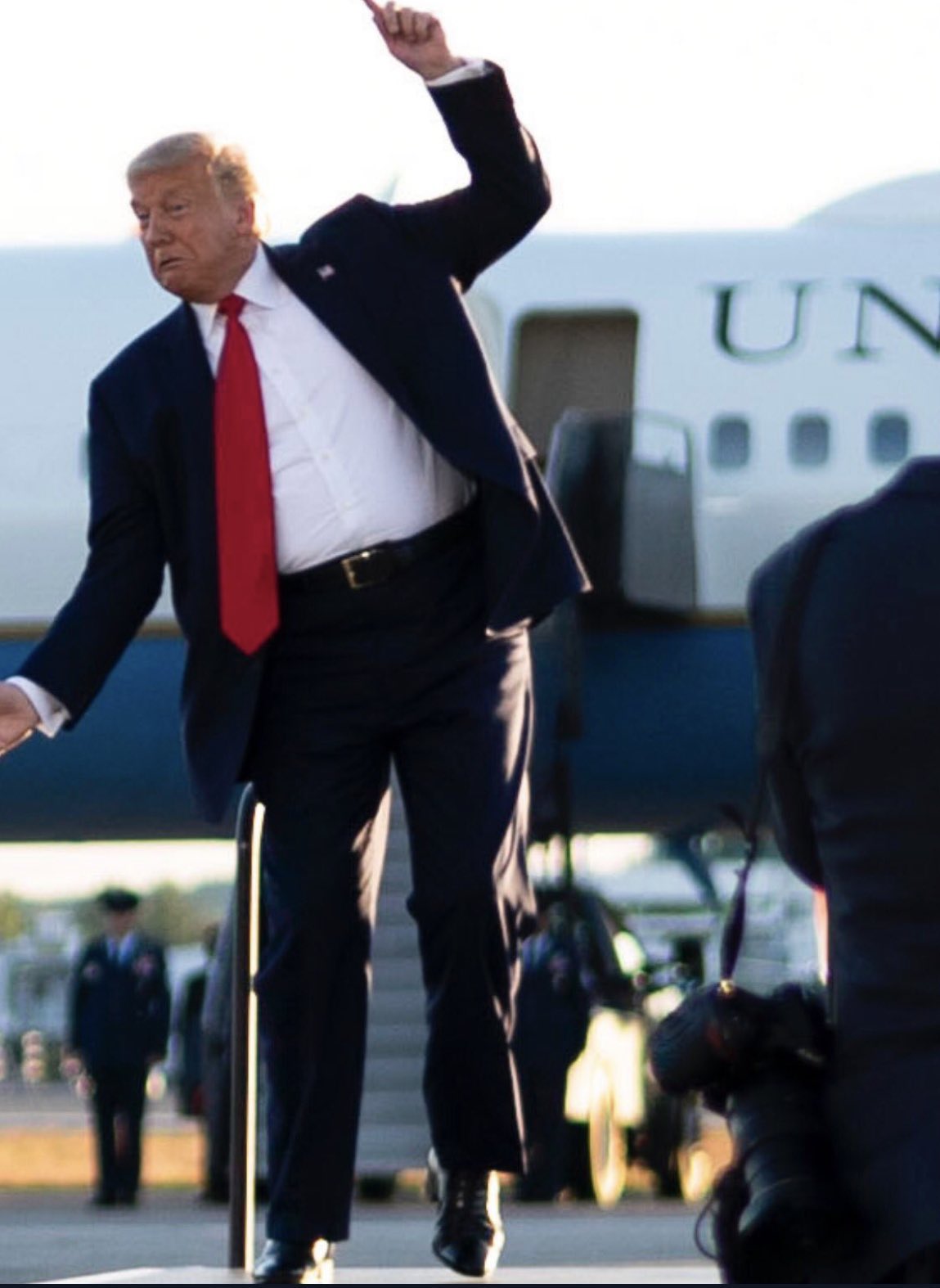
Then there's the gait. The slowing shuffle to Marine One. The right-handed lean. The drifting into associative word-salad that, on Biden, would have launched a thousand Fox News chyrons in sixty seconds. 

He has become, there is no way to say this without saying it, MAGA... doddering. Unsteady. Tired. A man whose physical envelope is visibly insufficient for the job he claims to be doing. 

Evil ages you. Sin rests as heavy as lead on the bones. Cruelty and malice corrupt and destroy their bearers. You can see it in him now, the way you could in Mobutu, in Mugabe, in the gangsters of history who used the state as a punishment and piggy bank for too long.  

Compare this with the saturation coverage of Biden's decline to the lullaby around Trump's.

When Biden trailed off, it was a three-day national emergency: cable hits, op-eds, anonymous-source pieces about West Wing concern. The 25th Amendment got more name-checks in 2024 than the Bill of Rights got in a decade.  

Trump goes to Walter Reed for the third time in a year, with bruises hand-painted out of existence and a diagnosed circulatory disorder, and the coverage is what? A polite CBS write-around. A Washington Post nothingburger story detailing the drive up to Bethesda. A few brave souls noting that "independent physicians say the White House hasn't answered keey questions." No Jake Tapper special. No glossy Original Sin book proposal. No "ten Republican senators speaking on background." Just the press doing what the press always does in the presence of an authoritarian project: flinching. 

This is the most dishonest White House about the President's physical condition since Edith Wilson was forging her stricken husband's signature behind the curtains in 1919. The parallel is not casual. The memos, the "excellent health," the "sharpest president in American history," the careful staging... the cover-up of Trump's diminished physical and mental capacity isn't coming.  

The cover-up is already running. Karoline Leavitt, Stephen Chung, and the rest of the White House noise machine have lied to the media for years about Trump's condition, and never once been held to account. 

Here is where the second death becomes impossible to ignore. 

Trump is winning nothing. Trump is holding nothing. He is narrowcasting to a withering, contracting MAGA base dying off at a rate that will soon reshape the political landscape again... and mistaking the cheers in ever-dwindling crowds, in ever-smaller halls for sound of a country still living in 2016.

Pew, last month: 34 percent. The lowest of his second term. Fox News... Fox News... has him down 24 points with Republicans since March 2025. Rural white voters, the base of the base of the base, have gone from +27 net approval to -6 in twelve months. Among his own 2024 voters, approval has slid from 95 percent to 78. 

The MAGA coalition is not growing. It is not holding. It is shedding, paycheck by smaller paycheck, grocery receipt by grocery receipt, slowly creeping away from cultlike adoration with every trip to the gas pump.  

The cable hosts and the Truth Social cheerleaders do not understand this, because they have marinated for a decade in a closed informational system: winning a MAGA primary is not winning the country. The cheers inside the tent get louder as the tent gets smaller. That's not strength. That's the acoustic property of a shrinking room.  

Which brings us to the ballroom, the arch, the White House glitter bukkake redecoration, the urgent desire to slap his name on every flat surface. Add those out-of-touch moments to the pardons, the no-bid contracts, the crypto scams, the $1.7 billion slush fund, and the snake-pit of grift the second term has become. 

The conventional read is that this is power... the dictator phase, the strongman unleashed. 

I want to suggest the opposite. Strongmen at the at the height of their game don't need the ballroom. They don't need to rename the Kennedy Center after themselves. They don't need the gold leaf, the fake portraits, the rebranded monuments and memorials.  

That's the behavior of a man who knows the clock is running and is grabbing what he can while the grabbing is good. That's Marcos in Manila in 1985. That's Ceausescu in 1988, before he and the missus were lined up against a wall. 

Genuine power doesn't need to be advertised this loudly. The frantic escalating, almost pornographic self-celebration is the tell. It's a confession in plain sight. The man building his mausoleum while he's still alive is the man who knows he's running out of road. 

So here we are. A 79-year-old man, swollen of extremity and bruised of hand, looking like the victim of a zombie bite by denying it until he turns, shuffling between Walter Reed and a half-built ballroom nobody asked for, with an approval rating in free fall, a base finally asking quiet questions about grocery prices, a press corps too cowed to say out loud what they all know, and a clock, biological, cultural, and political, that he cannot bully into stopping. 

He is not coming back from this. There is no third act. There is only the long, undignified, makeup-smeared decline of a man and a movement whose moment has passed, narrating itself ever more loudly into an ever emptier hall, a frowzy barfly of a man, replaying past glories that never happened and hoping you won't notice the bad wig. 

Trump is dying. 

Say it out loud. It will feel strange the first time. Less strange the second. By the tenth, you'll wonder why it took the rest of the press corps so long to catch up. 

And yes, when The Day comes, I promise you that my better angels will be taking PTO. 

Update: Tina  Brown weighs in. In a post on her own Substack, dated May 27, titled "Trump's Sweet Vengeance," and subtitled "Democrats are getting it wrong again," Tina presents an opposite view of the world:  

Democrats are getting it wrong again. After Trump’s 11th-hour endorsement of Texas attorney general and all-in Trump sycophant Ken Paxton, who was impeached for multiple charges of abuse of office, investigated on felony security charges, and dogged by adulterous sexual imbroglios, the slippery MAGA sleazebag still went on to pulverize Senate old-timer John Cornyn in the Republican primary on Tuesday. And yet, liberal cableheads deconstructing the results keep recycling the point that, somehow this was good news. Millions of dollars, they chortled, will now have to be diverted from other imperiled Republicans to defend a Senate seat that, for four terms, had been occupied by the beloved party elder Cornyn and now will be in play against the Democrats’ latest Texan mirage and Colbert candidate James Talarico. When has Trump ever found it difficult to raise millions of dollars, especially against a Senate candidate who tweeted in 2021 that his office was “the first in the history of the (Texas) Capitol to put pronouns on their business cards?” Paxton was already on a roll in his victory speech, immediately branding his Presbyterian seminarian opponent “James Talafreako,” “Six-Gender Jimmy,” and “Tofu Talarico” (“Soy boy!” yelled out an inventive Paxton supporter in the crowd).

Of course, as all the pundits tell us, Trump’s base loves him but, in using that term, I suspect they still subliminally conjure dated images of a Viking-horned, bare-chested QAnon shaman storming the Capitol. Today, that same lawless horde is now not only pardoned, but about to have access to Trump’s new $1,776 billion “Anti-Weaponization” slush fund. The fact that the comatose turtle, former Senate leader Mitch McConnell, has finally emerged from political hiding to denounce the outrage of a cop-bashing mob getting a financial pay-out is no threat to Trump. McConnell can exhume some principles because he isn’t running again. Trump’s resident House weenie Speaker Mike Johnson, with his own re-election looming, was so fearful of losing the slush fund vote that he sent lawmakers home early for a week’s recess to avoid it.

Don’t expect House members to return emboldened when Trump has just gone four for four in the primaries, whacking, not just Cornyn, but his Epstein Files Transparency Act foe Representative Thomas Massie of Kentucky and Georgia GOP gubernatorial candidate Brad Raffensperger, who committed the ultimate crime of failing to “find” 11,780 more Trump votes in Georgia in the 2020 election. Sorry, not sorry about Senator Bill Cassidy from Louisiana also hitting the bricks. He’s the physician who oversaw a nationally-recognized vaccine campaign in his home state, but later revealed his inner worm by casting the deciding vote to confirm RFK Jr. as HHS Secretary. Trump punished him anyway for having voted in 2021 for his second impeachment. So long, mofo.

Every liberal commentator now bangs on about an assured mid-term shellacking for the POTUS party over rising gas prices, thanks to the Trump-created catastrophe of the Strait of Hormuz closure and the universally unpopular Iran war. I suspect they and the polls are wrong again. It’s not just the creeping success of Republican redistricting creating more seats than Democratic efforts to do the same. Trump has found a diabolical way to separate his personal charisma from the destruction he perpetrates and the corruption he normalizes. He’s the angel of sabotage, freed from the shackles of his own malign deeds by the Supreme Court, the GOP’s moral turpitude, and the universal glint of greed from the Wall Street honchos, Silicon Valley bros, and Palm Beach plutocrats who see that the presidency is open for business. As last week’s Brennan Center newsletter put it, “There is a zone of lawlessness around the Oval Office.” In Trump’s first term, he was restrained by the need for a second, and by advisers schooled in the now-quaint ethos of governing by accepted norms. But then, he learned something transformative. Speaking to the NYT in January about prohibiting his family from profiteering overseas from proximity to official business in his first term, Trump said that, “he got no credit for it.” He then added a killer kicker that made less news at the time but has stayed with me as a rare moment of truth: “I found out that nobody cared.”

If there is any message that crystalizes the 250th anniversary of the U.S., it is not that America has changed but that Trump has changed America. There will be no snapback when he’s gone. Even as his approval ratings tank and the country is hurting, it feels as if his base has become wider and deeper and represents a new national state of mind. Tuned out on our phones, mesmerized by money porn, high on the idolatry of the big flashy win, we are getting used to the erosion of the rule of law, the threats to free speech, the banishment of government watchdogs, and the chasm of inequality. After ten years of Trump bludgeoning the first principles of the American experiment (ten because I don’t count the disappearing ink of Biden’s lame tenure when every headline was a new Trump indictment, scandal, or toxic blast from exile in Mar-a-Lago), Trump has refashioned the country in his image.

In the comments below the post, Tina says several times that she hopes she's wrong. I do too. 

Wednesday, December 23, 2020

Four Weeks To Go

This is how Donald is spending his time in the final weeks of his presidency, from the New York Times: 

With four weeks left in President Trump’s term, he is at perhaps his most unleashed — and, as events of the last few days have demonstrated, at the most unpredictable point in his presidency.

He remains the most powerful person in the world, yet he is focused on the one area in which he is powerless to get what he wants: a way to avoid leaving office as a loser.

He spends his days flailing for any hope, if not of actually reversing the outcome of the election then at least of building a coherent case that he was robbed of a second term.

When he has emerged from his relative isolation in recent days, it has been to suggest out of the blue that he would try to blow up the bipartisan stimulus package, driving a wedge through his party in the process, and to grant clemency to a raft of allies and supporters, mostly outside the normal Justice Department process.

He has otherwise sequestered himself in the White House, playing host to a cast of conspiracy theorists and hard-core supporters who traffic in ideas like challenging the election’s outcome in Congress and even invoking martial law, seeking to give some of them government jobs.

He is almost entirely disengaged from leading the nation even as Americans are being felled by the coronavirus at record rates. Faced with an aggressive cyberassault almost surely carried out by Russia, his response, to the degree that he has had one, has been to downplay the damage and to contradict his own top officials by suggesting that the culprit might actually have been China. He played almost no role in negotiating the stimulus bill that just passed Congress before working to disrupt it at the last minute.

It is not clear that Mr. Trump’s latest behavior is anything other than a temper tantrum, attention-seeking or a form of therapy for the man who controls a nuclear arsenal — though one alternative, if charitable, view is that it is strategic groundwork for a grievance-filled run in 2024.

If nothing else, it will make for an especially anxious next 27 days in Washington.

This article is based on interviews with more than a dozen current and former administration officials, Republicans and allies of the president.

Most of his advisers believe Mr. Trump will depart the White House for a final time by Jan. 20. The pardons he announced Tuesday night suggest he is comfortable using his powers aggressively until then. But how far he will go to subvert the election results, actually refuse to leave the White House or to unleash a wave of unilateral policy decisions in his final weeks is hard to discern.

Still, his erratic behavior and detachment from his duties have even some of his most loyal aides and advisers deeply concerned.

For the moment, Mr. Trump has told advisers he’s willing to stop listening to Sidney Powell, the lawyer who has appealed to him by peddling a conspiracy theory about the election, and people like Patrick Byrne, the former chief executive of Overstock.com, who was present for a wild, nearly five-hour meeting in the Oval Office and then the presidential residence last Friday.

But current advisers have described a daily struggle to keep Mr. Trump from giving in to his impulse to listen to those who are telling him what he wants to hear. And former advisers say the most worrisome issue is the gradual disappearance of the core group of West Wing aides who, often working in unison, consistently could get him to turn away from risky, legally dubious and dangerous ideas.

“The number of people who are telling him things he doesn’t want to hear has diminished,” said his former national security adviser, John R. Bolton, who had a very public parting of ways with Mr. Trump and who has been vocal in objecting to the president’s thrashing against his electoral loss.

Mr. Trump has turned to aides like Peter Navarro, a trade adviser who has been trying to gather evidence of election fraud to bolster his boss’s claims. And he is listening to Republicans who insist that Vice President Mike Pence could help sway the election during the normally routine process of ratifying the election early next month, despite the fact that it isn’t realistically possible.

Among Republicans on Capitol Hill, there is talk of clamping down on any of his supporters who might try to disrupt that process, a possibility made real by the president’s importuning of Senator-elect Tommy Tuberville of Alabama to gum up the works.

Yet it is not certain that Mr. Tuberville will carry through the president’s desires, and even he if does, there is the possibility that Senator Mitch McConnell of Kentucky, the Republican majority leader, could step in to prevent such a move. Mr. McConnell has already urged his caucus not to raise objections when the results are certified, because it would force others to publicly vote against the president.

Even in the best of times, Mr. Trump has searched for — and required — reinforcements from people outside the White House in support of whatever his aides will go along with.

But in the White House, Mr. Trump is turning on his closest of allies. He has complained to allies that Mr. Pence, who has been mocked for unflinching loyalty over the last four years, should be doing more to defend him. And he is angry that Mr. McConnell has recognized Mr. Biden as the winner of the election.

This week, Mr. Trump had an assistant send a chart featuring the timing of his endorsement of Mr. McConnell overlaid on polling data to claim he was responsible for Mr. McConnell winning re-election this year — a claim political professionals would dispute — and to suggest the majority leader is ungrateful for his help.

And on Tuesday evening, Mr. Trump tweeted a broadside against Senate leadership by attacking Mr. McConnell and the majority whip, Senator John Thune, of South Dakota, who had said any challenge to ratification of the election results would go down like a “shot dog.”

At the Justice Department, Attorney General William P. Barr’s public and emphatic rejection on Monday of the need for special counsels to investigate election fraud and Hunter Biden appeared intended in part to insulate his short-term successor, Jeffrey A. Rosen, from any further pressure on those fronts by the president.

Privately, allies who have stood by as Mr. Trump has weeded out others through loyalty purges, and who have dismissed criticisms that the president has authoritarian tendencies, are expressing concern about the next four weeks.

Mr. Barr, whose last day in the job is Wednesday, has told associates he had been alarmed by Mr. Trump’s behavior in recent weeks. Other advisers have privately said they feel worn out and are looking forward to the end of the term.

For those who remain, the days have been bleak endeavors during which government workers are forced to spend time either executing the president’s demand that election fraud be proven, or incurring his wrath.

As Axios reported, Pat A. Cipollone, the White House counsel who has implored Mr. Trump to steer clear of proposed maneuvers like having federal officials seize control of voting machines to inspect them, has become a target of the president’s anger.

Mr. Trump has characterized Mr. Cipollone derisively, invoking his own mentor, the infamously ruthless and unscrupulous lawyer Roy Cohn, as what a White House counsel should aspire to be like.

The White House chief of staff, Mark Meadows, has objected to some of the president’s desires, like appointing Ms. Powell as special counsel examining voter fraud, but he also made a trip to Georgia on Tuesday to investigate ballot safety measures. Mr. Meadows, a former House member, has also leaned into the effort by his old colleagues to challenge the vote in Congress, something that might keep the president from engaging further with Ms. Powell, but which many Republicans consider destructive to their party.

Other advisers have simply absented themselves at a time when the president is particularly unsteady.

The president’s son-in-law and senior adviser, Jared Kushner, has been out of the country for significant amounts of time since Election Day, traveling through the Middle East for deals that burnish his own credentials. He has responded to people seeking his help with Mr. Trump by saying that the president is his children’s grandfather, implying there are limits to what he can do to help.

Mr. Trump has spent his days watching television, calling Republicans in search of advice on how to challenge the electoral outcome and urging them to defend him on television. As always, he turns to Twitter for boosts of support and to vent his anger. He has not gone golfing since the weather has turned colder, and is cloistered in the White House, shuffling from the residence to the Oval Office.

Many Trump advisers hope that his planned trip to his private club in Palm Beach, Fla., Mar-a-Lago, will give him a change of scenery and a change of perspective. He is scheduled to leave on Wednesday and stay through the New Year holiday, although some aides said he still might decide against it.
(This is the article in its entirety.)

Friday, October 2, 2020

Donald Is Sick - Updated

This is a developing story this morning and who knows what twists and turns lie ahead. I'll post interesting things as I see them, starting with this: 

At about 9:15 this morning, the CNN bottom-of-screen crawler said this: 

National Security Council ordered masks for White House grounds back in February, but was met with sharp directive that masks were not "a good look," multiple officials tell CNN. "If you have the whole west wing running around wearing masks, it wasn't a good look," one admin official recalls of [the] directive that came down after some NSC staffers were told to wear masks. [The] west wing wanted to "portray confidence and make the public believe there was absolutely nothing to worry about," the official says, revealing for [the] first time the image-conscious reason for early opposition to masks within [the] White House. In late January when [the] U.S. confirmed several coronavirus cases, west wing staff often told others in the administration that this was nothing to worry about, one former official says; staffers were repeatedly told in internal White House meetings that the virus had been "contained" because there were only 15 cases at the time. One former admin official laments setbacks the early masks opposition dealt U.S. coronavirus response, telling CNN "we lost so much time... this could have been so different."

Several minutes later, there was this: 

Trump has several risk factors for more severe Covid-19 symptoms. He is 74, falling in [the] age range that faces five times greater risk of hospitalization and 90 times greater risk of death from the virus compared to young adults, [the] CDC says. Men are also more likely to die from coronavirus, and Trump is considered obese, which triples risk of hospitalization from Covid-19, CDC says. In 2018, one test indicated Trump had moderate heart disease. Not everything about Trump's health is known: [the] president made [a] relatively secret visit to Walter Reed National Military Medical Center last November, though [the] White House press secretary said the unannounced trip was to begin portions of his routine annual physical exam.

It's going to be an interesting day.

Update: Speaking of twists and turns, several people in my Twitter timeline were pointing out that Donald's illness is a distraction from the "Kimberly" situation. I assumed that meant Kimberly Guilfoyle, a.k.a. Don Jr.'s girlfriend, but I hadn't heard anything specific about her since her weird speech at the Republican convention a few weeks ago. A quick Google search turned up this, from Jane Meyer, writing at The New Yorker: 

As President Donald Trump heads into the 2020 elections, he faces a daunting gender gap: according to a recent Washington Post/ABC News poll, he trails Joe Biden by thirty percentage points among female voters. As part of his campaign, Trump has been doing all he can to showcase female stars in the Republican Party, from nominating Amy Coney Barrett for the Supreme Court to naming Kimberly Guilfoyle, the former Fox News host and legal analyst, his campaign’s finance chair. Guilfoyle, however, may not be an ideal emissary. In November, 2018, a young woman who had been one of Guilfoyle’s assistants at Fox News sent company executives a confidential, forty-two-page draft complaint that accused Guilfoyle of repeated sexual harassment, and demanded monetary relief. The document, which resulted in a multimillion-dollar out-of-court settlement, raises serious questions about Guilfoyle’s fitness as a character witness for Trump, let alone as a top campaign official.

In the 2020 campaign, Trump has spotlighted no woman more brightly than Guilfoyle. She was given an opening-night speaking slot at the Republican National Convention. And this fall Guilfoyle, who is Donald Trump, Jr.,’s girlfriend, has been crisscrossing the country as a Trump surrogate, on what is billed as the “Four More Tour.” At a recent “Women for Trump” rally in Pennsylvania, Guilfoyle claimed that the President was creating “eighteen hundred new female-owned businesses in the United States a day,” and praised Trump for promoting school choice, which, she said, was supported by “single mothers like myself.”

Guilfoyle has maintained that her decision to move from television news to a political campaign was entirely voluntary. In fact, Fox News forced her out in July, 2018—several years before her contract’s expiration date. At the time, she was a co-host of the political chat show “The Five.” Media reports suggested that she had been accused of workplace impropriety, including displaying lewd pictures of male genitalia to colleagues, but few additional details of misbehavior emerged. Guilfoyle publicly denied any wrongdoing, and last year a lawyer representing her told The New Yorker that “any suggestion” she had “engaged in misconduct at Fox is patently false.” But, as I reported at the time, shortly after Guilfoyle left her job, Fox secretly paid an undisclosed sum to the assistant, who no longer works at the company. Recently, two well-informed sources told me that Fox, in order to avoid going to trial, had agreed to pay the woman upward of four million dollars.

Until now, the specific accusations against Guilfoyle have remained largely hidden. The draft complaint, which was never filed in court, is covered by a nondisclosure agreement. The former assistant has not been publicly identified, and, out of respect for the rights of alleged victims of sexual harassment, The New Yorker is honoring her confidentiality. Reached for comment, she said, “I wish you well. But I have nothing to say.”

and last year a lawyer representing her told The New Yorker that “any suggestion” she had “engaged in misconduct at Fox is patently false.” But, as I reported at the time, shortly after Guilfoyle left her job, Fox secretly paid an undisclosed sum to the assistant, who no longer works at the company. Recently, two well-informed sources told me that Fox, in order to avoid going to trial, had agreed to pay the woman upward of four million dollars.

Until now, the specific accusations against Guilfoyle have remained largely hidden. The draft complaint, which was never filed in court, is covered by a nondisclosure agreement. The former assistant has not been publicly identified, and, out of respect for the rights of alleged victims of sexual harassment, The New Yorker is honoring her confidentiality. Reached for comment, she said, “I wish you well. But I have nothing to say.”

As serious as the draft complaint’s sexual-harassment allegations were, equally disturbing was what the assistant described as a coverup attempt by Guilfoyle, whose conduct was about to come under investigation by a team of outside lawyers. In July, 2016, the network had hired the New York-based law firm Paul, Weiss to investigate sexual misconduct at the company, which, under the leadership of Roger Ailes, had a long history of flagrant harassment and gender discrimination. According to those familiar with the assistant’s draft complaint, during a phone call on August 6, 2017, she alleged that Guilfoyle tried to buy her silence, offering to arrange a payment to her if she agreed to lie to the Paul, Weiss lawyers about her experiences. The alleged offering of hush money brings to mind Trump’s payments to the porn star Stormy Daniels, in order to cover up his sexual impropriety.
(Read the entire article here.)

Update #2: Josh Marshall, writing at Talking Points Memo, ponders the timeline of events:

The timeline of events leading up to the disclosure of President Trump’s diagnosis point overwhelmingly to some mix of a coverup and gross negligence and likely both.

Let’s review some key facts, as far as we presently know them.

The New Jersey Trip

Yesterday morning Hope Hicks received test results showing she was COVID positive. It’s not clear when the test was administered (we’ll get to that in a moment). But she received the confirmed positive test yesterday morning before Trump left for a campaign/fundraiser trip to New Jersey. On that trip Trump was frequently observed unmasked, including in an indoor roundtable meeting. He appears to have exposed dozens of people during that trip.

It is clear that the President’s medical staff and top staff (and almost certainly the President himself) knew before leaving on that trip that he had been exposed to COVID. But he went anyway and exposed dozens more.

That was at a minimum an act of gross irresponsibility.

As I’ll note in a moment it also suggests the strong possibility that the White House tried to keep the whole situation secret.

Who Infected Who and When?

Most people are assuming that Hicks infected President Trump. But based on what we know that’s not the only or even the most likely scenario. Indeed, their infections being discovered so close in time makes it probably more likely that some other person or persons infected both of them. But there are details here that don’t add up.

We’ve been led to believe that the President and the people around him are tested either daily or close to daily. The White House medical staff have both the rapid saliva tests which take on the order of 15 minutes or so and the PCR tests which a dedicated lab can turn around in something like an hour and a half. If these tests are being done that frequently there should never been more than hours between someone becoming virus positive (and thus infectious) and tripping off a test.

We know that you can be infectious before becoming symptomatic. Indeed there’s significant evidence that you’re more infectious before developing symptoms. But your infectiousness is about your viral load. A significant viral load should trip off a test.

But here’s the problem. We don’t just know Trump, Melania Trump and Hicks are COVID-positive. They all appear to be actively symptomatic, sick. Presumably their symptoms are currently mild. But it is unlikely that all three people reached viral levels capable of testing positive and became actively sick on the same day.

This throws into some question whether the top people at the White House, including the President, are actually being tested on a daily basis. It also suggests that these three and likely others have been infectious and possibly actively sick for a significant period of time. There’s some mix of failed surveillance and/or secrecy about what the surveillance has found.

Were They Keeping It a Secret?

A critical part of this equation is that the White House didn’t come forward with any of this. Jennifer Jacobs of Bloomberg News learned that Hicks had tested positive and reported that last night. That immediately focused attention on the President’s exposure and forced the overnight disclosure of his illness. Were they planning on disclosing that Hicks had tested positive? That is at best unclear. They hadn’t disclosed that Ronna McDaniel, the head of the RNC who met with Trump last week, tested positive. We just found that out this morning. And what about Trump himself? Trump had repeatedly traveled with Hicks. Her diagnosis Thursday morning should have led to President Trump’s being immediately tested and possibly diagnosed yesterday morning or at the latest in the afternoon. But news reports last night suggested – though without saying so directly – that they were being tested and waiting on results last night.

This timeline has serious holes in it.

This is a crisis situation. Things can get confused. And because it is a crisis situation we can’t assume that all the reporting we have is complete or entirely accurate. We can’t point with total confidence to the contradiction between two apparent facts. Because none of them are that certain. But there are lots of indications that the White House was trying to keep this information under wraps and possibly endangered the lives of numerous people in doing so, including that of the President himself and possibly his challenger Vice President Biden
. (This is the article in its entirety.) 

Some good news: It has now been announced that Joe and Jill Biden have both tested negative. 

Update #3: This is from Vanity Fair; apparently Hope Hicks is "frustrated" with Donald for his cavalier approach to the virus:  

Trumpworld is gripped by fear and panic this morning as the country absorbs the news that Donald Trump, Melania, and Hope Hicks tested positive for COVID-19. “There are so many threads to pull. No one knows where this is going to go,” a stunned former West Wing official told me.

The biggest unknown is the state of the president’s health. This morning the New York Times reported that Trump is exhibiting “coldlike symptoms.” Two Republicans in close contact with the White House told me that Trump’s symptoms have included a cough and fever. Melania is said to be asymptomatic. “They are worried about the president because of his age,” one of the sources said. Sources said Trump will likely want to be seen in public as soon as possible to blunt the narrative that he is sidelined by the virus he’s spent the last six months downplaying. “He’s going to want to get out there a lot sooner than people think,” the former official said. “But it will be hard to hide if he’s sick. Also, who will want to be in a room with him?” The White House did not respond to a request for comment.

Campaign advisers are also gaming out how Trump’s COVID diagnosis will play out with only 32 days left until the election. Sources I spoke with are doubtful the next two debates will happen. “There really can be nothing for 14 days. It’s as if the campaign ended yesterday,” a second former West Wing official told me. Republicans close to Trump are discussing what kind of message Trump should put out that might limit the political damage. “He could come out and say, ‘Look, I had COVID and it wasn’t that bad. It just shows that I’m strong and we should open up the country,’” the former West Wing official said. “He could make a mockery of it.”

Meanwhile, Hicks has experienced more pronounced symptoms than the president. Two sources said she has had a high fever and a cough, with one source adding she lost her sense of smell. Hicks is said to be frustrated with Trump for taking such a cavalier approach to the virus. She was one of the few West Wing staffers to wear a mask in meetings, which her colleagues chided her for. “She was made fun of because she wore a mask,” a friend said. Sources told me Hicks is also upset that news coverage has made it appear that she gave Trump the virus, when in fact no one knows where he got it. “It’s so unfair she’s sort of being blamed,” the friend told me.

Hicks did not respond to a request for comment.
(This is the article in its entirety.)

Note: Apparently the fundraising message I posted was not authentic. Apologies, I've deleted it. 

Monday, September 7, 2020

Donald's Press Conference

Tom Nichols took one for the team today, watching Donald's press conference so you and I didn't have to. He live-tweeted the whole thing:


Saturday, August 29, 2020

#TrumpIsNotWell - Updated

Donald slipped a little last night, causing #TrumpIsNotWell to once again be trending on Twitter. Here's the video:


And someone captured an unpleasant screenshot:


Image


I'll add to this post as I see other examples.

Update on September 1: Donald continues to sound like someone who is losing his marbles and I'm seeing more talk about his (assumed but not definitively known) impairment:


Here's how Talking Points Memo is reporting the story, reported by Nicole Lafond:

Title: Why Is Trump Tweeting About Mini-Strokes?

My roommate just asked me this question. There’s not a solid answer, but it’s related to news out of New York Times reporter Michael Schmidt’s forthcoming book, which was obtained by CNN.

According to the book, Vice President Mike Pence was reportedly put on standby to possibly temporarily assume presidential powers while Trump made an abrupt visit to Walter Reed late last year. There have been conflicting reports about the visit, and hospital officials alerted staff via a mass-memo about Trump visit, an indication it was not a routine check-up as the White House claimed.

From Schmidt’s book:

Word went out in the West Wing for the vice president to be on standby to take over the powers of the presidency temporarily if Trump had to undergo a procedure that would have required him to be anesthetized.

Trump responded Tuesday morning:


Why Trump is specifically denying having a stroke is not entirely clear. Twitter responded to President Trump’s tweets with many a “he doth protest too much” memes. But Trump may be pulling the accusation from this report: CNN contributor Joe Lockhart apparently at one time floated the theory that Trump might have had a secret stroke and was trying to hide it from the American people.

It’s convoluted and I’m sure we’ll learn more when Schmidt’s book is out.


Donald's White House doctor apparently felt compelled to weigh in. I'd take what he says with a grain of salt: 


Update #2 on Wednesday afternoon. Donald is sounding more and more out-of-it:


Sunday, August 2, 2020

The Books Of Donald, Part 2 - Updated

The New York Times considers a new genre of literature, Political Revenge, featuring our old friend The Mooch:

Title: In Trumpworld, the Grown-Ups in the Room All Left, and Got Book Deals

Subtitle: A large club of Trump administration evictees have turned their bracingly bad experiences into a new genre: political revenge literature.

It was the summer of 2016, and the Republican Party was about to nominate Donald J. Trump for president. Until then, many party members had aggressively opposed his candidacy. “I think he’s crazy,” Senator Lindsey Graham, Republican of South Carolina, said earlier that year. “I think he’s unfit for office.”

But faced with the inevitable reality of Mr. Trump, the party was forced to perform what the British tabloids call a “reverse-ferret” — a messaging U-turn in which you abruptly take the opposite position of the one you espoused a moment earlier.

Contrary to what they said before, the Republicans announced, Mr. Trump was totally suited for the presidency. He would rise to the occasion. Being president would render him, tautologically, presidential. In any case, at least he would be surrounded by adults who would steer him in the right direction.

“It began to dawn on me,” Anthony Scaramucci, who went on to (briefly) work in the Trump White House, wrote of hearing about the then-candidate’s tax proposals. “Donald J. Trump wasn’t the extreme, unhinged, unserious candidate that I thought he was.”

Mr. Scaramucci spent just 11 days as the White House communications director in 2017 before being unceremoniously removed, a victim of his own operatic ineptitude as well as the dysfunction of the White House. He now regrets the error, as he sees it, of ever having admired Mr. Trump. “The guy stinks,” he said recently.

As it happens, Mr. Scaramucci wrote a book about his brief, unhappy White House experience, joining a large club of Trump administration evictees who have turned their bracingly bad experiences into a new genre of political revenge literature. These include James Comey, former F.B.I. director; Omarosa Manigault Newman, former assistant to the president; Andrew McCabe, former deputy F.B.I. director; John Bolton, former national security adviser; Cliff Sims, former White House communications aide; and Anonymous, current senior figure, at least by his or her own account, in the Trump administration.

(There’s also Sean Spicer, former press secretary, who wrote a mostly complimentary book about his fleeting White House tenure; and Mary Trump, not an ex-staffer but the president’s niece, whose scathing portrait of Trump family pathology came out in July and sold 1.35 million copies across all formats in its first week. That book is currently No. 1 on hardback nonfiction best-seller lists in the United States, Britain, Canada and Ireland, and No. 2 in Australia.)

Taken en masse, the books paint a damning portrait of the 45th president of the United States. But the sheer volume of unflattering material they contain can have the paradoxical danger of blunting their collective impact. After the 10th time you read about Mr. Trump’s short attention span, your own attention is in danger of wandering.

“There is only so much the public can absorb,” Anonymous writes in “A Warning.”

There are even more memoirs scheduled for the fall: one by Michael Cohen, the president’s disgraced ex-personal lawyer, which federal officials tried to block but then said could proceed, and another by H.R. McMaster, who was Mr. Trump’s second national security adviser and is no fan of the president.

But at this point, nearly four years in, is there anything left to say about Mr. Trump that might surprise us? Or, as Mr. McCabe writes in “The Threat”: “What more could a person do to erode the credibility of the presidency?”

Reading all these books, one after the other, is like swimming for days in a greasy, brackish canal whose bottom is teeming with shards of broken-down old industrial equipment. The experience is not pleasant, you might hurt yourself, and it leaves you covered in grime. The picture they paint of their protagonist — Mr. Trump — is so outrageous that if they were fiction they would be dismissed as too broad, too much of a caricature.

As different as the authors are, the books share a number of common observations about the president. And so, with the Republican Party set to renominate him this month, here is a reminder of what sort of leader Mr. Trump has turned out to be, according to his growing band of disgruntled former employees.


Trump vs. his employees

Mr. Trump is universally presented in the memoirs as a flamboyantly mean and intemperately indiscreet boss, wrong-footing and humiliating cabinet members and aides with constant criticism, sometimes to their faces, sometimes behind their backs.

The president dismisses Jim Mattis, his first secretary of defense, as “a liberal Democrat,” yells at him in meetings and notes that “I never really liked him.” (“I felt sorry for Mattis, not to mention the country as a whole,” Mr. Bolton writes.)

He derides Kirstjen Nielsen, his second secretary of homeland security as ineffectual and “not mentally able” to handle her job and then, in a fit of pique, futilely attempts to reassign her responsibilities first to Jared Kushner, his son-in-law, and then to Mr. Bolton.

He muses aloud on multiple occasions about dumping Vice President Mike Pence from the ticket in 2020 and replacing him with Nikki Haley, the UN ambassador. “Did we make a mistake with Gina?” he asks, referring to his decision to make Gina Haspel director of the C.I.A.

“Rex was terrible,” he says about Rex Tillerson, his original secretary of state. “What good is he?” he asks rhetorically about Steven Mnuchin, his treasury secretary. “I thought we had the right guy at Treasury. But now I don’t know.”

He yells at his trade adviser, Peter Navarro, when Mr. Navarro attempts to show him a complicated chart outlining a policy point. (“I have no idea what I’m even looking at,” the president snaps.) He tells Mr. Kushner in meetings: “Jared, you don’t know what you’re talking about.” He mocks his original chief economic adviser, Gary Cohn, as a “globalist,” elongating the “O” in a sneering tone, as if the word were akin to “Antifa member.”

Just as the president uses derisive nicknames for his political enemies, so he does for his own subordinates. He mocks Jeff Sessions, his first attorney general, as “Benjamin Button.” He calls Betsy DeVos, the education secretary, “Ditzy DeVos.” “This place is really taking a toll on Kellyanne,” he says of Kellyanne Conway, counselor to the president, implying that she looks tired and worn out.


The president and the truth

The Trump administration surged into life with a whomping great Trumpian untruth: that Mr. Trump’s inauguration crowd was the largest in history. Even Mr. Spicer did not believe it, though he had to pretend otherwise.

“It was hard to keep a straight face as Sean proceeded to lie to the American people,” Ms. Manigault Newman writes.

All the memoirists present Mr. Trump as supremely untrustworthy. He is “a deliberate liar, someone who will say whatever he pleased to get whatever he wishes,” Mr. McCabe writes. “People who’ve known him for years accept it as common knowledge,” Anonymous writes.
Sometimes Mr. Trump asserts one thing and then, a few minutes later, just the opposite.

On other occasions, he conjures pieces of misinformation designed to bolster his thesis, as when he insisted that “three to five million people” voted illegally in the 2016 election. He has a habit of plucking figures from thin air — first $20 billion, for instance, then $38 billion, to drive home his point about trade deficits in a meeting with President Moon Jae-in of South Korea — regardless of the numbers’ relationship to fact.

The memoirists have different ways of dealing with all this presidential slipperiness. Mr. Comey and Mr. McCabe start keeping detailed logs of their encounters with the president, the way you would if you had an unstable spouse and wanted to catalog his erratic behavior for use in future divorce proceedings.

Too bad, is the apparent view of Reince Priebus, the original chief of staff.

“The directive came down from Reince,” Ms. Manigault Newman writes, “that our default position was to back up whatever the president said or tweeted, regardless of its accuracy.”


How to describe the experience

Striving for new ways to characterize the head-spinning unreality of the Trump White House, the authors of the memoirs turn to a variety of vivid figures of speech.

Mr. Spicer: “I sometimes felt like a scuba diver, abandoned in the middle of the ocean, treading water.”

Mr. Comey: “The demand was like Sammy the Bull’s Cosa Nostra induction ceremony — with Trump, in the role of the family boss, asking me if I have what it takes to be a ‘made man.’”

Ms. Manigault Newman: “The selection process for his cabinet was like an episode of ‘The Bachelor.’”

Mr. Bolton: “It was like making and executing policy inside a pinball machine.”

Anonymous: Working for Mr. Trump was like “showing up at the nursing home at daybreak to find your elderly uncle running pantsless across the courtyard and cursing loudly about the cafeteria food.”

Trump as instigator

To read these books is to read of a chaotic, paranoiac workplace, where the boss delights in fomenting discord and instability among the employees.

He encourages them to keep tabs on one another. “Give me their names,” he tells Mr. Sims, wielding a Sharpie and a White House note card, vowing to rid the White House of nonloyalists.

He praises their rivals. “Keith Kellogg knows all about NATO,” the president says airily to Mr. Bolton, speaking with ominous intent of Mr. Pence’s national security adviser. “He never offers his opinions unless I ask.”

(This causes some merriment between Mr. Bolton and Mike Pompeo, the current secretary of state, who plays dual roles in Mr. Bolton’s drama: as a rival he suspects of conspiring and leaking against him, and as his partner in anti-Trump incredulity and black-humored job insecurity.

“As Pompeo and I reflected later, this statement told us exactly who my likely replacement would be if I resigned soon,” Mr. Bolton writes. “I said, ‘Of course, if you resign, maybe Keith would be Secretary of State.’” To which Mr. Pompeo responds: “Or, if we both resign, Keith could become Henry Kissinger and have both jobs.’”)


The president’s verbal style

Mr. Trump likes to talk, the memoirists agree, and he does not like to listen.

He meanders from topic to topic, loops back around, adds new topics, repeats himself, boasts, mixes facts with fake facts, throws in his latest obsession, continuing on and on according to some labyrinthine stream-of-consciousness impulse in which whatever is on his mind is worthy of public utterance. He does this in rallies and at campaign events; he also does it in briefings, in one-on-one conversations and at policy meetings.

“I don’t use the word ‘conversation’ because the term doesn’t apply when one person speaks nearly the entire time,” Mr. Comey writes of the experience.

The presidential attention span

It is true that Mr. Trump successfully repeated the words “person, woman, man, camera, TV” on television in an effort to demonstrate the superiority of his mental acuity, but it is also true, the books argue, that he rarely reads, gets bored easily, is irritable and distracted, has trouble remembering complicated things, has no intellectual curiosity and is ignorant not just about his job but about things generally considered common knowledge.

With his short attention span, he is averse to learning anything at briefings if he finds the information difficult to follow, boring, or in contravention of what he already thinks. Staff members are told to to stick to a single point and repeat it often, and to boil complex proposals down to a single page — or, better, a single paragraph. They are told not to present Mr. Trump with too-long briefing papers, lest he shout at them, or with too many slides, lest his eyes glaze over.

“Any time somebody new came in to brief him, he’d get angry and say, “Who’s that guy? What’s he want?” Ms. Manigault Newman writes.

The presidential schedule

The president keeps unconventional office hours, is ofte
n late to meetings and events and watches a lot of TV.
“At 9:35 I called Trump, who was as usual still in the residence,” Mr. Bolton writes.

“He often doesn’t start the day in the Oval Office until 10 or 11 a.m.,” Anonymous writes. He is “channel-surfing his way through the presidency.”

“His official schedule was more of a loose outline than a strict regimen,” Mr. Sims writes.

The presidential ego

In “Too Much and Never Enough,” Mary Trump describes her uncle as “a savant of self-promotion” with a “delusional belief in his own brilliance and superiority” stemming from a bottomless insecurity that needs to be assuaged with a constant stream of ego-boosting compliments.

That is why the president often asserts that he is the best at everything.

“It was the most presidential act in decades,” he says, after he directs the Pentagon to bomb Iran and then calls it off at the last minute. (Mr. Bolton has a different take: “In my government experience, this was the most irrational thing I ever witnessed any president do.” )

“They say I might be the world’s greatest brander,” he says to Mr. Sims, before unveiling his marketing idea for his tax-cut plan: calling the legislation the “Cutting Cutting Cutting Bill” (it ended up being called something else).

Several memoirists describe how Mr. Trump, to soothe a wounded psyche bruised by his failure to win the popular vote in 2016, continually invited visitors to admire posters illustrating how he had won the election anyway.

“Trump kept big charts in his private dining room, in his den, in his study, that showed the electoral map color coded in red and blue,” Ms. Manigault Newman writes. “When anyone walked in, he’d point to the chart and talk about the election results.”

Anonymous was familiar with the maps, as well. “Trump carried around maps outlining his electoral victory, which he would pull out at odd times,” he writes. “He would beckon guests, as well as aides, advisers and incoming cabinet officers, to gaze at the sea of red on the map.”


Does Mr. Trump use a tanning bed?

“His face appeared slightly orange, with bright white half-moons under his eyes where I assumed he placed small tanning goggles,” Mr. Comey writes.

Ms. Manigault Newman mentions the tanning-adjacent chatter around the abrupt firing of Angella Reid, chief usher of the White House, several months into Mr. Trump’s administration.

“Allegedly, Trump didn’t approve of her handling of his tanning bed,” she says. “I’d heard he was unhappy with her efforts to procure the bed, to bring it into the East Wing securely, to find a discreet place for it, and to set it up properly.”

Aides on the president’s conduct

The memoirs paint a picture of the West Wing as a place of baroque workplace dysfunction, where workers gather to trade “Guess what he did now” stories about their boss and to save him (and themselves, and the country) from his worst impulses.

And so, in “A Warning,” Anonymous writes that cabinet-level administration officials contemplated “a midnight self-massacre,” which would entail “resigning en masse to call attention to Trump’s misconduct and erratic leadership.”

Many staffers are perpetually on the brink of quitting, keeping resignation letters on hand should the time come. And if his colleagues hate working for the Trump administration, John Kelly, the president’s second chief of staff, apparently hates it the most.

“This is the worst” (insert expletive here) “job I’ve ever had,” Mr. Kelly tells Mr. Sims.

“You can’t imagine how desperate I am to get out of here,” he tells Mr. Bolton. “This is a very bad place to work.”

Things John Bolton claims people said to him

A striking aspect of “The Room Where it Happened” is how frequently cabinet-level officials confide incredulously in Mr. Bolton about the president’s irrationality and narcissism, as if they and the former national security adviser formed a gang of rebellious high-school students, quietly plotting resistance against the incompetent autocrats running the school.

“As McGahn often whispered to me,” Mr. Bolton writes, speaking of Donald McGahn, who served for a while as White House counsel, “This is not the Bush Administration.”

“Has there ever been a presidency like this?” Mr. Kelly asks Mr. Bolton, mentioning that the president has just said, apropos of nothing, that it would be “cool” to invade Venezuela. (“I assured him there had not,” Mr. Bolton responds.)

“This is getting pretty silly,” Mr. Mattis says to Mr. Bolton as the men listen to Mr. Trump rail at Jens Stoltenberg, the secretary general of NATO, about how America’s allies mock it behind its back because it pays too much in annual dues.

As for Mr. Pompeo, Mr. Bolton describes how the secretary of state passed him a snarky anti-Trump note in the middle of the president’s summit with Kim Jong-un of North Korea in 2018. And he describes how, after listening to the president yell at Ms. Nielsen about border security in a particularly fruitless meeting, Mr. Pompeo whispers to Mr. Bolton: “Why are we still here?”


Leaving Trump’s orbit

What Donald can do in order to offset the powerlessness and rage he feels is punish the rest of us,” Mary Trump writes.

This is clear by the way he behaves when he has fired someone or they have quit, frequent occurrences in an administration with such a high turnover. After he fires Mr. Comey, the FBI director, while he is in California, for instance, Mr. Trump is incensed to learn that Mr. Comey has returned to Washington on the same government plane that he traveled out on.

“That’s not right! I didn’t approve of that!” he rants to Mr. McCabe. Then he decrees that Mr. Comey should never be allowed to enter the F.B.I. headquarters again, not even to clean out his desk. “I’m banning him from the building,” the president says.

After Mr. Mattis resigns as defense secretary, Anonymous writes, the wounded president throws “a temper tantrum,” insists that Mr. Mattis leave the job immediately, before his successor has been named, and then falsely claims that in fact he fired Mr. Mattis, rather than the other way around.

How the Trump administration said ‘you’re fired’

Mr. Comey: Saw the news reported on TV in the back of the auditorium while he was in the middle of making a speech in California.

Mr. McCabe: Saw the news on TV, followed by a presidential tweet: “Andrew McCabe FIRED, a great day for the hard working men and women of the FBI.”

Ms. Manigault Newman: Called into the Situation Room before the 2017 White House Christmas Party, was informed by Mr. Kelly that “there are significant integrity violations related to you,” and was not allowed to leave until the stress of the encounter triggered an asthma attack and she went home.

Mr. Sims: Submitted his resignation after being told by Mr. Kelly: “In the past 40 years, I don’t think I’ve ever had a subordinate whose reputation is worse than yours.”

Mr. Priebus: Idling in the presidential motorcade after a trip to New York on the day after he had submitted his resignation, learned that his removal was effective immediately when he read on Twitter that Mr. Kelly was replacing him. The motorcade went on Twitter that Mr. Kelly was replacing him. The motorcade went on to the White House; his car peeled away and drove off into oblivion.

Trump on the authors

Mr. Comey: “A weak and untruthful slime ball”

Mr. McCabe: “A major sleazebag.”

Ms. Manigault Newman: “Vicious, but not smart.”

Mary Trump: “A seldom seen niece who knows little about me, says untruthful things about my wonderful parents (who couldn’t stand her!) and me, and violated her NDA. … She’s a mess!”

Mr. Sims: “A low level staffer that I hardly knew. … He is a mess!”

Mr. Bolton: A “sick puppy.” 
(This is the article in its entirety.)

All this stuff is interesting but almost all of it could have been discerned by anyone who was paying attention to Donald before the election. The books mentioned above have all been written and published while Donald is still president, theoretically at least the most powerful man in the world. I can only imagine what we'll learn in the memoirs written after the clock strikes twelve and he turns into an old, tired, worn-out, unhealthy, unpowerful and unloved former president. (January 20. Noon. Eastern time.) 

And speaking of unhealthy, apparently Donald made another unscheduled visit to Walter Reed hospital yesterday; I've seen quite a bit of chatter about what could have caused the bruise on his right hand:


In the spirit of "What's wrong with Donald," remember the "Orange Death Mask" picture from last Wednesday: 

Trump
(AP Photo/Susan Walsh)

I was thinking it must have been photoshopped. It just didn't seem possible that his staff would let him go out in public looking like that, but that's the picture direct from AP Images. It's very strange.