Showing posts with label Trump Coward. Show all posts

Friday, September 4, 2020

Serving Their Country - Updated

My father served in the U.S. Navy during World War II. His older brother, my uncle, was killed in the war and his body was never found.

Another uncle served a 20+ year career as an Air Force officer, including in Vietnam.

His son, my cousin Jim, graduated from the Air Force Academy and served a 20+ year career as an officer. He has two sons, one of whom is serving as an officer in the Army and the other as an officer in the Air Force.

My former husband is also an Air Force Academy graduate and served a 20+ year career as an officer.

Jim's sister Terry's youngest son graduated from Air Force and is now serving as an Air Force officer.

My niece's husband's brother served a two-year enlistment in the Air Force and is now in the Reserves. Starting last November he was deployed for six months in the Middle East.         

There are no words strong enough to express my rage.


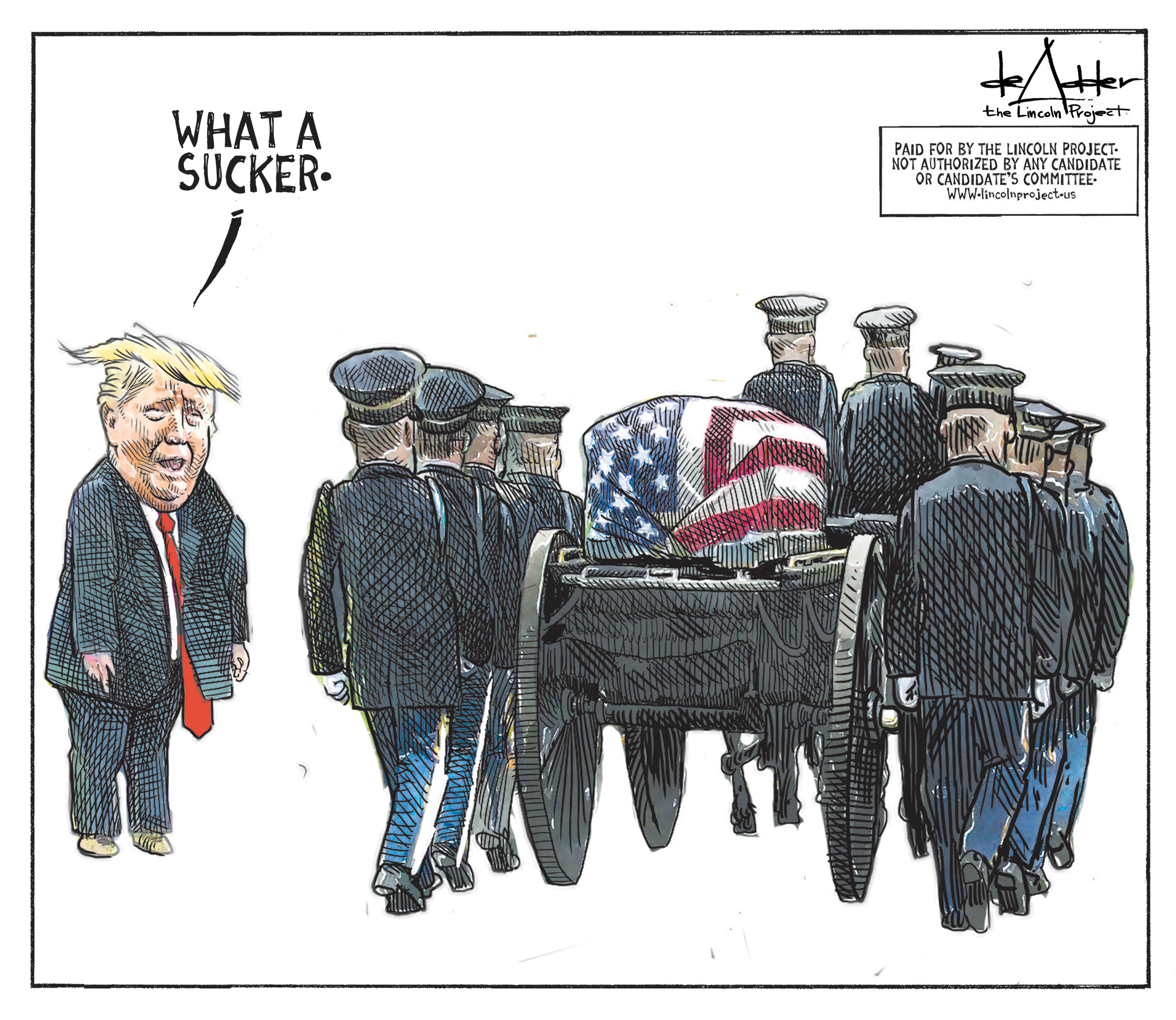
This is from 2013:


Image


Update: This is a tweet thread that was posted this afternoon. What makes it interesting is that it's from Jennifer Griffin, a National Security Correspondent for Fox News:

Two former sr Trump admin officials confirm .@JeffreyGoldberg reporting that President Trump disparaged veterans and did not want to drive to honor American war dead at Aisne-Marne Cemetery outside Paris. 

According to one former senior Trump administration official: "When the President spoke about the Vietnam War, he said, 'It was a stupid war. Anyone who went was a sucker'." 

This former official heard the President say about American veterans: "What's in it for them? They don't make any money." Source: "It was a character flaw of the President. He could not understand why someone would die for their country, not worth it." 

I read the source a few quotes from The Atlantic article. This former Trump admin official said, "The President would say things like that. He doesn't know why people join the military. He would muse, 'Why do they do it'?" 

Re: trip to mark 100th anniversary of WW I

Source: "The President was not in a good mood. Macron had said something that made him mad about American reliability and the need perhaps for a European army. He questioned why he had to go to two cemeteries. 'Why do I have to do two'?" 

President Trump's staff explained he could cancel (his visit to the cemetery), but he was warned, 'They (the press) are going to kill you for this'." The President was mad as a hornet when they did.
When asked IF the President could have driven to the Aisne-Marne Cemetery, this former official said confidently:

"The President drives a lot. The other world leaders drove to the cemeteries. He just didn't want to go." 

Regarding Trump's July 4th military parade, during a planning session at the White House after seeing the Bastille Day parade in 2017, the President said regarding the inclusion of "wounded guys" "that's not a good look" "Americans don't like that," source confirms. 

Regarding McCain, "The President just hated John McCain. He always asked, 'Why do you see him as a hero?" Two sources confirmed the President did not want flags lowered but others in the White House ordered them at half mast. There was a stand off and then the President relented.


Update #2 on Saturday morning. Another tweet thread that touched me, from Army veteran Charlotte Clymer. She includes some details about a very specific process that I didn't know very much about:

The straight line distance between Washington, D.C. and Dover, Delaware is less than 85 miles. It takes a helicopter about 40-45 minutes to make the trip. I was 19 years-old, and it was my first time riding a helicopter. I barely remember any of it. I was distracted. 

I was more nervous than I've ever been in my life about what was to come next, and so, as this Black Hawk floated above the earth with my casket team--me being the youngest and most junior--I could only think: "What if I mess this up? What if I fail? How will I live with myself?"

That's how it should be in a moment like this. You should be nervous. You should let that sharpen your focus. Because there is no room for error when handling the remains of a service member returning to the U.S. after being killed in combat. You should strive for perfection.

The helicopter landed, and my anxiety spiked. In retrospect, I recall noticing the silence of the rest of the casket team. These were young men, mostly early 20s, loud and boisterous and chests puffed. Now, they were quiet. It was unnerving.

When you're a new enlisted soldier in an infantry unit--the FNG--you're treated like you know nothing. Because you don't. Everyone around you is older and vastly more competent and confident. Yet, in this moment, despite having done this before, they were all nervous, too. Scary.

We were brought into a holding area near the tarmac on Dover Air Force Base in Delaware, where the remains of service members who have died in a theater of operations arrive on a C-17 transport plane. We rehearsed our steps. And did it again. And then again. No room for error.

The plane arrived. The ramp was lowered. The transfer vehicle that would complete the next leg of the journey was parked. Our casket team was positioned. We were now each wearing ceremonial white cotton gloves we had held under the bathroom faucet. Damp gloves have a better grip.

We’re a casket team, but these are not caskets. They're transfer cases: rectangular aluminum boxes that bear a resemblance to a crate for production equipment. Yet, the dimensions are obvious. Any given civilian would take only a few moments to realize that's for carrying bodies.

It's called a "dignified transfer", not a "ceremony", because officials don't want loved ones to feel obligated to be there while in mourning, but it is as highly choreographed as any ceremony, probably more so. It is done as close to perfection as anything the military does.

I was positioned in formation with my casket team, and I could see the transfer cases precisely laid out, dress right dress, in the cavernous space of the C-17, each draped with an American flag that had been fastened perfectly. I remember my stomach dropping.

There is simply no space for other thoughts. Your full brain capacity is focused on not screwing up. The casket team steps off in crisp, exact steps toward the plane, up the ramp (please, oh god, don't slip), aside the case, lift up ceremonially, face back and down the ramp.

During movement, everyone else is saluting: the plane personnel, the OIC (officer-in-charge), any senior NCOS and generals, and occasionally, the president. The family is sometimes there. No ceremonial music or talking. All silent, save for the steps of the casket team.

You don't see the family during this. You're too focused. There are other distractions. Maybe they forgot, but no one told me there'd be 40-60 lbs. of ice in the transfer case to prevent decomposition over the 10-hour plane ride. You can sometimes feel it sloshing around a bit.

Some of the transfer cases feel slightly heavier, some slightly lighter. The weight is distributed among six bearers, so it's not a big difference. But then you carry a case that's significantly lighter, and you realize those are the only remains they were able to recover.

It probably takes all of 30-40 seconds to carry the transfer case from the plane to the mortuary vehicle, but it felt like the longest walk ever each time. The case is carefully placed in the back of the mortuary vehicle, and the casket team moves away in formation.

I don't know how to describe the feeling after you're done and on your way back to D.C., but it's a mixture of intense relief that you didn't screw up and profound sobriety over what you've just done and witnessed. I wouldn't call it a good feeling. Maybe a numbed pain.

From the outside, the most egalitarian place in America is a military transfer case. They all look exactly the same: an aluminum box covered with the American flag. We didn't know their names, rank, race, ethnicity, gender, religion, sexual orientation--none of it. All the same.

Whatever cruel and unfathomable politics had brought all of us to that moment--from the killed service member in the box to those of us carrying it to the occasional elected official who attends to pay respects--there were no politics to be found during a dignified transfer.

The fallen service members I helped receive and carry during this part of the journey to their final resting place were not "losers" or "suckers". They were selfless and heroic, and I had the honor of being among the first to hold them when they returned home.

There are service members around the world involved in caring for our war fatalities. The mortuary specialists, the casket teams, the family liaisons--so many people who work to ensure that this final act is done with the greatest amount of dignity and honor, seeking perfection.

I suppose the one thing we all took for granted is that dignity would always be affirmed by all our civilian leaders to those service members who gave everything. I never would have predicted any official, let alone a sitting president, would insult fallen service members.

I cannot adequately describe my anger at Donald Trump for being so willing to send service members halfway around the world to die on his own behalf and then call them "losers" for doing so. This coward is unfit for his office and the power it holds. He needs to go. 

Thursday, September 3, 2020

Losers And Suckers - Updated

This is from Jeffrey Goldberg, writing at The Atlantic:

When President Donald Trump canceled a visit to the Aisne-Marne American Cemetery near Paris in 2018, he blamed rain for the last-minute decision, saying that “the helicopter couldn’t fly” and that the Secret Service wouldn’t drive him there. Neither claim was true.

Trump rejected the idea of the visit because he feared his hair would become disheveled in the rain, and because he did not believe it important to honor American war dead, according to four people with firsthand knowledge of the discussion that day. In a conversation with senior staff members on the morning of the scheduled visit, Trump said, “Why should I go to that cemetery? It’s filled with losers.” In a separate conversation on the same trip, Trump referred to the more than 1,800 marines who lost their lives at Belleau Wood as “suckers” for getting killed.

Belleau Wood is a consequential battle in American history, and the ground on which it was fought is venerated by the Marine Corps. America and its allies stopped the German advance toward Paris there in the spring of 1918. But Trump, on that same trip, asked aides, “Who were the good guys in this war?” He also said that he didn’t understand why the United States would intervene on the side of the Allies.

Trump’s understanding of concepts such as patriotism, service, and sacrifice have interested me since he expressed contempt for the war record of the late Senator John McCain, who spent more than five years as a prisoner of the North Vietnamese. “He’s not a war hero,” Trump said in 2015 while running for the Republican nomination for president. “I like people who weren’t captured.”

There was no precedent in American politics for the expression of this sort of contempt, but the performatively patriotic Trump did no damage to his candidacy by attacking McCain in this manner. Nor did he set his campaign back by attacking the parents of Humayun Khan, an Army captain who was killed in Iraq in 2004.

Trump remained fixated on McCain, one of the few prominent Republicans to continue criticizing him after he won the nomination. When McCain died, in August 2018, Trump told his senior staff, according to three sources with direct knowledge of this event, “We’re not going to support that loser’s funeral,” and he became furious, according to witnesses, when he saw flags lowered to half-staff. “What the fuck are we doing that for? Guy was a fucking loser,” the president told aides. Trump was not invited to McCain’s funeral. (These sources, and others quoted in this article, spoke on condition of anonymity. White House spokeswoman Kayleigh McEnany did not respond to email and telephone requests for comment.)

Trump’s understanding of heroism has not evolved since he became president. According to sources with knowledge of the president’s views, he seems to genuinely not understand why Americans treat former prisoners of war with respect. Nor does he understand why pilots who are shot down in combat are honored by the military. On at least two occasions since becoming president, according to three sources with direct knowledge of his views, Trump referred to former President George H. W. Bush as a “loser” for being shot down by the Japanese as a Navy pilot in World War II. (Bush escaped capture, but eight other men shot down during the same mission were caught, tortured, and executed by Japanese soldiers.)

When lashing out at critics, Trump often reaches for illogical and corrosive insults, and members of the Bush family have publicly opposed him. But his cynicism about service and heroism extends even to the World War I dead buried outside Paris—people who were killed more than a quarter century before he was born. Trump finds the notion of military service difficult to understand, and the idea of volunteering to serve especially incomprehensible. (The president did not serve in the military; he received a medical deferment from the draft during the Vietnam War because of the alleged presence of bone spurs in his feet. In the 1990s, Trump said his efforts to avoid contracting sexually transmitted diseases constituted his “personal Vietnam.”)

On Memorial Day 2017, Trump visited Arlington National Cemetery, a short drive from the White House. He was accompanied on this visit by John Kelly, who was then the secretary of homeland security, and who would, a short time later, be named the White House chief of staff. The two men were set to visit Section 60, the 14-acre area of the cemetery that is the burial ground for those killed in America’s most recent wars. Kelly’s son Robert is buried in Section 60. A first lieutenant in the Marine Corps, Robert Kelly was killed in 2010 in Afghanistan. He was 29. Trump was meant, on this visit, to join John Kelly in paying respects at his son’s grave, and to comfort the families of other fallen service members. But according to sources with knowledge of this visit, Trump, while standing by Robert Kelly’s grave, turned directly to his father and said, “I don’t get it. What was in it for them?” Kelly (who declined to comment for this story) initially believed, people close to him said, that Trump was making a ham-handed reference to the selflessness of America’s all-volunteer force. But later he came to realize that Trump simply does not understand non-transactional life choices.

“He can’t fathom the idea of doing something for someone other than himself,” one of Kelly’s friends, a retired four-star general, told me. “He just thinks that anyone who does anything when there’s no direct personal gain to be had is a sucker. There’s no money in serving the nation.” Kelly’s friend went on to say, “Trump can’t imagine anyone else’s pain. That’s why he would say this to the father of a fallen marine on Memorial Day in the cemetery where he’s buried.”

I’ve asked numerous general officers over the past year for their analysis of Trump’s seeming contempt for military service. They offer a number of explanations. Some of his cynicism is rooted in frustration, they say. Trump, unlike previous presidents, tends to believe that the military, like other departments of the federal government, is beholden only to him, and not the Constitution. Many senior officers have expressed worry about Trump’s understanding of the rules governing the use of the armed forces. This issue came to a head in early June, during demonstrations in Washington, D.C., in response to police killings of Black people. James Mattis, the retired Marine general and former secretary of defense, lambasted Trump at the time for ordering law-enforcement officers to forcibly clear protesters from Lafayette Square, and for using soldiers as props: “When I joined the military, some 50 years ago, I swore an oath to support and defend the Constitution,” Mattis wrote. “Never did I dream that troops taking that same oath would be ordered under any circumstance to violate the Constitutional rights of their fellow citizens—much less to provide a bizarre photo op for the elected commander-in-chief, with military leadership standing alongside.”

Another explanation is more quotidian, and aligns with a broader understanding of Trump’s material-focused worldview. The president believes that nothing is worth doing without the promise of monetary payback, and that talented people who don’t pursue riches are “losers.” (According to eyewitnesses, after a White House briefing given by the then-chairman of the Joint Chiefs of Staff, General Joe Dunford, Trump turned to aides and said, “That guy is smart. Why did he join the military?”)

Yet another, related, explanation concerns what appears to be Trump’s pathological fear of appearing to look like a “sucker” himself. His capacious definition of sucker includes those who lose their lives in service to their country, as well as those who are taken prisoner, or are wounded in battle. “He has a lot of fear,” one officer with firsthand knowledge of Trump’s views said. “He doesn’t see the heroism in fighting.” Several observers told me that Trump is deeply anxious about dying or being disfigured, and this worry manifests itself as disgust for those who have suffered. Trump recently claimed that he has received the bodies of slain service members “many, many” times, but in fact he has traveled to Dover Air Force Base, the transfer point for the remains of fallen service members, only four times since becoming president. In another incident, Trump falsely claimed that he had called “virtually all” of the families of service members who had died during his term, then began rush-shipping condolence letters when families said the president was not telling the truth.

Trump has been, for the duration of his presidency, fixated on staging military parades, but only of a certain sort. In a 2018 White House planning meeting for such an event, Trump asked his staff not to include wounded veterans, on grounds that spectators would feel uncomfortable in the presence of amputees. “Nobody wants to see that,” he said.
(This is the article in its entirety.)

I wrote about Donald's visit to France in November, 2018; click here to read that post.

Update: This article is getting a lot of attention; I'll post reactions as I see them.


Update #2: The author of this article, Jeffrey Goldberg said this today (Sunday 9/6) on CNN:

"I would fully expect more reporting to come out about this and more confirmation and new pieces of information in the coming days and weeks," Goldberg told CNN's Chief Media Correspondent Brian Stelter on "Reliable Sources" Sunday. "We have a responsibility and we're going to do it regardless of what he says." (Read the entire article here.)

Update #3 on Tuesday, September 8. CNN says Donald is "visibly distressed" about this story: 

President Donald Trump was visibly distressed this weekend over the fallout that ensued from the story published in The Atlantic alleging that he privately disparaged the war dead.

In several conversations since the story was published Thursday, Trump vigorously denied that he made the comments and touted what he's done for the military. Two people who spoke with him said it was clearly a sign of how much the story had resonated with Trump -- and his fear that it could hurt his support with the military.

When the story first appeared on Thursday, Trump was outraged during his flights to and from Pennsylvania and demanded that aides begin denying it. That included sending his chief of staff Mark Meadows to the back of Air Force One to tell reporters it wasn't true. His angered reaction prompted officials to mobilize the massive pushback effort that began Thursday night.
By the weekend, however, Trump appeared more deflated than outraged at the allegations lobbed against him, based on conversations he had.

It was a relatively quiet weekend at the White House until Trump decided he wanted to hold a Labor Day news conference. Just as aides believed the story was quieting down, Trump accused top Pentagon military leaders of being beholden to defense contractors, an astonishing comment from the President as he's trying to bolster support with those people. Trump had been privately upset that more of the top brass at the Pentagon had not defended him in the wake of The Atlantic's story and some saw this as a response to that.
(Read the entire article here.)