Showing posts with label Trump Lies. Show all posts

Saturday, January 30, 2021

The Weakest, Wimpiest, Most Pathetic Crop Of Needy Nincompoops In U.S. History

I always smile when a serious writer uses the word "nincompoop." (Click here to read previous posts about this cool word.) Now conservative Pulitzer Prize-winning columnist Kathleen Parker, writing at the Washington Post, has this to say about Republicans in 2021: 

With the electoral eviction of Donald Trump from the Oval Office, Republicans had a shot at redemption and resurrection.

They missed and failed — and deserve to spend the next several years in political purgatory. The chaos now enveloping what’s left of the Grand Old Party after four years of catering to an unstable president is theirs to own. Where conservatism once served as a moderating force — gently braking liberalism’s boundless enthusiasm — the former home of ordered liberty has become a halfway house for ruffians, insurrectionists and renegadewarriors.

What does Trump have on these people, one wonders? The continuing loyalty of so many to a man so demonstrably dangerous can’t be explained by “the base,” a word never more aptly applied. What secrets were shared by Trump and House Minority Leader Kevin McCarthy (R-Calif.), who, after blaming Trump for the Jan. 6 mob attack, visited Trump at Mar-a-Lago this week to make amends? It seems that The Don, yet another appropriate nickname, need only purse his button lips and whistle to summon his lap dogs to Palm Beach, there to conspire for the next Big Lie.

The party’s end was inevitable, foreshadowed in 2008 when little-boy Republican males, dazzled by the pretty, born-again, pro-life Alaska governor, thought Sarah Palin should be a heartbeat away from the presidency. The dumbing down of conservatism, in other words, began its terminal-velocity plunge, with a wink and a pair of shiny red shoes. Palin cast a spell as potent as the poppy fields of Oz, but turned the United States into her own moose-poppin,’ gum-smackin’ reality show.

Forget Kansas. We’re not in America anymore.

Eight years of Barack Obama added insult to injury and paved the way for Trump — a gaudier, cinematic version of the “thrillah from Wasilla.” Seizing upon our every worst instinct, he turned Palin’s lipsticked pig into a herd of seething, primitive barbarians. Now, the Department of Homeland Security is warning of yet more violence by domestic extremists, presumably from the ranks of the mob and QAnon conspiracists who stormed the Capitol with blood on their minds.

For Donald Trump, you went down this road? Either Trump has a stockpile of incriminating videos — his people have people, you know — or today’s Republicans are the weakest, wimpiest, most pathetic crop of needy nincompoops in U.S. history.

Suddenly, the “good ones” are worried about their newest member, Marjorie Taylor Greene (R-Ga.), a QAnon-promoting female version of Trump — only without the charm. You begin to see how this monster mutates like a certain virus into ever-more-dangerous versions of itself. Among other things, Greene embraces the conspiracy theory that the Sandy Hook Elementary School massacre and the slaughter at Marjory Stoneman Douglas High School in Parkland, Fla., were staged. One struggles for words, but I’ll settle for “creep.”

Recently unearthed video shows Greene chasing David Hogg, the Parkland student who rose to public prominence as a gun-control activist after the February 2018 shooting, goading him to respond to her insinuation that his ability to get appointments with U.S. senators when she couldn’t obviously meant he was a public relations spawn and not a survivor of a terrorist attack.

I confess to early uncertainty about Hogg, who was preternaturally adept at media management and public speaking, suddenly materializing from the fog of horror. But the notion that he was somehow complicit in a manufactured act of mass murder is beyond the pale even for the farthest right.

Good work, GOP. You got yourself a live one. Naturally, Greene has been assigned to the Education and Labor Committee.

Going forward, not only will House Republicans be associated with a colleague who “liked” a Twitter post calling for Speaker Nancy Pelosi’s murder. They’ll be attached to QAnon, which promotes the extraordinary fiction that Trump was leading a war against Satan-worshiping pedophiles and cannibals, whose leadership includes Hillary Clinton, Barack Obama, Oprah Winfrey, Tom Hanks and, oh, by the way, yours truly, as well as U2’s Bono.

To those Republicans who can read: You own all of this. The party isn’t doomed; it’s dead. The chance to move away from Trumpism, toward a more respectful, civilized approach to governance that acknowledges the realities of a diverse nation and that doesn’t surrender to the clenched fist, has slipped away. What comes next is anybody’s guess. But anyone who doesn’t speak out against the myths and lies of fringe groups, domestic terrorists and demagogues such as Trump deserves only defeat — and a lengthy exile in infamy. Good riddance. (This is the column in its entirety.)

Sunday, January 17, 2021

Forbes Says "Don't Hire Them"

Randall Lane, the Chief Content Officer of Forbes Media, issued the following statement on January 7. He buried the lede in the second-to-last paragraph:

Let it be known to the business world: Hire any of Trump’s fellow fabulists above, [Sean Spicer, Kellyanne Conway, Sarah Huckabee Sanders, Stephanie Grisham & Kayleigh McEnany] and Forbes will assume that everything your company or firm talks about is a lie. We’re going to scrutinize, double-check, investigate with the same skepticism we’d approach a Trump tweet. Want to ensure the world’s biggest business media brand approaches you as a potential funnel of disinformation? Then hire away.
  
In other words, Karma.

This is the article in full:

Yesterday’s insurrection was rooted in lies. That a fair election was stolen. That a significant defeat was actually a landslide victory. That the world’s oldest democracy, ingeniously insulated via autonomous state voting regimens, is a rigged system. Such lies-upon-lies, repeated frequently and fervently, provided the kindling, the spark, the gasoline.

That Donald Trump devolved from commander-in-chief to liar-in-chief didn’t surprise Forbes: As we’ve chronicled early and often, for all his billions and Barnum-like abilities, he’s been shamelessly exaggerating and prevaricating to our faces for almost four decades. More astonishing: the number of people willing to lend credence to that obvious mendacity on his behalf.

In this time of transition – and pain – reinvigorating democracy requires a reckoning. A truth reckoning. Starting with the people paid by the People to inform the People.

As someone in the business of facts, it’s been especially painful to watch President Trump’s press secretaries debase themselves. Yes, as with their political bosses, spins and omissions and exaggerations are part of the game. But ultimately in PR, core credibility is the coin of the realm.

From Day One at the Trump White House, up has been down, yes has been no, failure has been success. Sean Spicer set the tone with the inauguration crowd size – the worst kind of whopper, as it demanded that people disbelieve their own eyes. The next day, Kellyanne Conway defended Spicer’s lie with a new term, “alternative facts.” Spicer’s successor, Sarah Huckabee Sanders lied at scale, from smearing those who accused Trump of sexual harassment to conjuring jobs statistics. Her successor, Stephanie Grisham, over the course of a year, never even held a press conference, though the BS continued unabated across friendly outlets. And finally, Kayleigh McEnany, Harvard Law graduate, a propaganda prodigy at 32 who makes smiling falsehood an art form. All of this magnified by journalists too often following an old playbook ill-prepared for an Orwellian communication era.

As American democracy rebounds, we need to return to a standard of truth when it comes to how the government communicates with the governed. The easiest way to do that, from where I sit, is to create repercussions for those who don’t follow the civic norms. Trump’s lawyers lie gleefully to the press and public, but those lies, magically, almost never made it into briefs and arguments – contempt, perjury and disbarment keep the professional standards high.

So what’s the parallel in the dark arts of communication? Simple: Don’t let the chronic liars cash in on their dishonesty. Press secretaries like Joe Lockhart, Ari Fleischer and Jay Carney, who left the White House with their reputations in various stages of intact, made millions taking their skills — and credibility — to corporate America. Trump’s liars don’t merit that same golden parachute. Let it be known to the business world: Hire any of Trump’s fellow fabulists above, and Forbes will assume that everything your company or firm talks about is a lie. We’re going to scrutinize, double-check, investigate with the same skepticism we’d approach a Trump tweet. Want to ensure the world’s biggest business media brand approaches you as a potential funnel of disinformation? Then hire away.

This isn’t cancel culture, which is a societal blight. (There’s surely a nice living for each of these press secretaries on the true-believer circuit.) Nor is this politically motivated, as Forbes’ pro-entrepreneur, pro-growth worldview has generally placed it in the right-of-center camp over the past century — this standard needs to apply to liars from either party. It’s just a realization that, as Daniel Patrick Moynihan famously said, in a thriving democracy, everyone is entitled to their own opinions, but not their own facts. Our national reset starts there.

Tuesday, January 5, 2021

A Pickle For Mike Pence (Or Let's Watch The VP Squirm)

One week ago, in an Opinion piece at the NY Times titled "Will Pence Do the Right Thing?," Neal K. Katyal and John Monsky pondered the vice president's situation: 

President Trump recently tweeted that “the ‘Justice’ Department and FBI have done nothing about the 2020 Presidential Election Voter Fraud,” followed by these more ominous lines: “Never give up. See everyone in D.C. on January 6th.”

The unmistakable reference is to the day Congress will count the Electoral College’s votes, with Vice President Mike Pence presiding. Mr. Trump is leaning on the vice president and congressional allies to invalidate the November election by throwing out duly certified votes for Joe Biden.

Mr. Pence thus far has not said he would do anything like that, but his language is worrisome. Last week, he said: “We’re going to keep fighting until every legal vote is counted. We’re going to win Georgia, we’re going to save America,” as a crowd screamed, “Stop the steal.”

And some Republicans won’t let up. On Monday, Representative Louie Gohmert of Texas and other politicians filed a frivolous lawsuit, which has multiple fatal flaws in both form and substance, in an attempt to force the vice president to appoint pro-Trump electors.

Mr. Trump himself has criticized virtually everyone’s view of the election, from that of the Supreme Court to the F.B.I. to Senator Mitch McConnell, but he has never attacked Mr. Pence, suggesting he has hopes for the vice president.

But as a matter of constitutional text and history, any effort on Jan. 6 is doomed to fail. It would also be profoundly anti-democratic and unconstitutional.

Both Article II of the Constitution and the 12th Amendment say that the votes of the Electoral College are to be opened by the “president of the Senate,” meaning the vice president. The Electoral Count Act, passed in 1887 to avoid chaotic counts like the one that followed the 1876 election, adds important details. It provides a detailed timeline to tabulate electoral votes, culminating with the final count to take place on Jan. 6, and it delineates the powers of the vice president.

He is to be the “presiding officer” (meaning he is to preserve order and decorum), open the ballot envelopes, provide those results to a group of tellers, call for any objection by members of Congress, announce the results of any votes on objections, and ultimately announce the result of the vote.

Nothing in either the text of the Constitution or the Electoral Count Act gives the vice president any substantive powers. His powers are ministerial, and that circumscribed role makes general sense: The whole point of an election is to let the people decide who will rule them. If an incumbent could simply maneuver to keep himself in office — after all, a maneuver to protect Mr. Trump also protects Mr. Pence — the most foundational precept of our government would be gravely undermined. In America, “we the people,” not “we, the vice president,” control our destiny.

The drafters of the Electoral Count Act consciously insisted on this weakened role for the vice president. They guarded against any pretense he might have to throw out a particular state’s votes, saying that the vice president must open “all certificates and papers purporting to be” electoral votes. They further said, in the event of a dispute, both chambers of Congress would have to disagree with a particular state’s slate of electoral votes to reject them. And they made it difficult for Congress to disagree, adding measures such as a “safe harbor” provision and deference to certification by state officials.

In this election, certification is clear. There are no ongoing legal challenges in the states of any merit whatsoever. All challenges have lost, spectacularly and often, in the courts. The states and the electors have spoken their will. Neither Vice President Pence nor the loyal followers of President Trump have a valid basis to contest anything.

To be sure, this structure creates awkwardness, as it forces the vice president to announce the result even when personally unfavorable.

After the close election of 1960, Richard Nixon, as vice president, counted the votes for his opponent, John Kennedy. Al Gore, in perhaps one of the more dramatic moments of our Republic’s short history, counted the votes and reported them in favor of George W. Bush.

Watching Mr. Gore count the votes, shut off all challenges and deliver the presidency to Mr. Bush was a powerful moment in our democracy. By the time he counted the votes, America and the world knew where he stood. And we were all lifted up when Mr. Gore, at the end, asked God to bless the new president and vice president and joined the chamber in applause.

Republican leaders — including Senators McConnell, Roy Blunt and John Thune — have recognized the outcome of the election, despite the president’s wrath. Mr. McConnell put it in clear terms: “The Electoral College has spoken. So today, I want to congratulate President-elect Joe Biden.”

Notably, Mr. Pence has been silent. He has not even acknowledged the historic win by Kamala Harris, the nation’s first female, first African-American and first Asian-American vice president.

He now stands on the edge of history as he begins his most consequential act of leadership. The question for Vice President Pence, as well as other members of Congress, is which side of history he wants to come down on. Can he show the integrity demonstrated by every previous presidential administration? The American people accept a graceful loser, but a sore loser never goes down well in the history books.

We urge Mr. Pence to study our first president. After the Revolutionary War, the artist Benjamin West reported that King George had asked him what General Washington would do now that America was independent. West said that Washington would give up power and go back to farming. King George responded with words to the effect that “if he does that, he will be the greatest man in the world.”

Indeed, Washington did so, surrendering command of the army to Congress and returning to Mount Vernon for years until he was elected president. And he again relinquished power eight years later, even though many would have been happy to keep him president for life. Washington in this way fully realized the American Republic, because there is no Republic without the peaceful transfer of power.

And it’s now up to Mr. Pence to recognize exactly that. Like all those that have come before him, he should count the votes as they have been certified and do everything he can to oppose those who would do otherwise. This is no time for anyone to be a bystander — our Republic is on the line.
(This is the article in its entirety.)

About the authors: Mr. Katyal, a law professor at Georgetown, is a former acting solicitor general of the United States. Mr. Monsky is the creator of the American History Unbound Series of multimedia productions that covers watershed moments in American history and a board member of the New-York Historical Society.  

Today, in an article titled "Pence's Choice: Side With the Constitution or His Boss" and subtitled "The vice president will preside on Wednesday when Congress convenes to ratify Joe Biden's victory. President Trump still seems to hold out hope that his loyal No. 2 could change the outcome," the Times has this to say: 

WASHINGTON — Speaking to supporters of President Trump on Monday at the Rock Springs Church in Milner, Ga., Vice President Mike Pence implored the crowd to vote in the two runoff elections Tuesday that will determine whether Republicans maintain control of the Senate.

“I am here for one reason and one reason only, and that is that Georgia and America need David Perdue and Kelly Loeffler back in the Republican majority,” Mr. Pence said.

But the crowd had a message for him, too.

“We need you do the right thing Jan. 6!” one supporter cried out. “Stop the steal!” shouted others. The crowd applauded.

If Mr. Pence has tried to skirt Mr. Trump’s efforts to cling to power, his reception in Georgia on Monday served as the latest reminder of the delicate role he will play on Wednesday, when Congress conducts what is typically a ceremonial duty of opening and counting certificates of electoral votes.

As president of the Senate, Mr. Pence is expected to preside over the pro forma certification of the Electoral College vote count in front of a joint session of Congress. It is a constitutionally prescribed, televised moment in which Mr. Pence will name the winner of the 2020 presidential election, Joseph R. Biden Jr.

It is also a moment some of Mr. Pence’s advisers have been bracing themselves for ever since the president lost the election and stepped up his baseless claims of widespread voter fraud. There is no chance of Mr. Pence not being there, people close to him said. Mr. Pence’s aides have told people that they view the vice president’s role as largely ceremonial.

“I know we all have got our doubts about the last election,” Mr. Pence said Monday in Georgia, attempting to assuage Trump supporters. “I want to assure you that I share the concerns of millions of Americans about voting irregularities. I promise you, come this Wednesday, we will have our day in Congress.”

It was not clear, perhaps by design, what he meant. Mr. Pence does not have unilateral power to affect the outcome of Wednesday’s proceedings. But he has carefully tried to look like he is loyally following the president’s lead even as he goes through a process that is expected to end with him reading out a declaration that Mr. Biden is the winner.

After nearly a dozen Republican senators said they plan to object to the certification of the vote on Wednesday, the vice president’s chief of staff, Marc Short, issued a carefully worded statement intended not to anger anyone.

“The vice president welcomes the efforts of members of the House and Senate to use the authority they have under the law to raise objections and bring forward evidence before the Congress and the American people on Jan. 6,” he said.

The statement, which frustrated senators who say Mr. Trump is trying to thwart democracy, helped to mollify the president, according to one person close to him.

But it was not enough to squash the belief of many Trump supporters — and the president himself — that the vice president could still somehow help overturn the results.

Two people briefed on the discussions said Mr. Trump had directly pressed Mr. Pence to find an alternative to certifying Mr. Biden’s win, such as preventing him from having 270 electoral votes and letting the election be thrown to the House to decide.

In Georgia on Monday night at a rally for Senators David Perdue and Kelly Loeffler, Mr. Trump openly pressured the vice president, saying, “I hope Mike Pence comes through for us, I have to tell you.” He added, “Of course, if he doesn’t come through, I won’t like him as much,” before saying that he really likes Mr. Pence.

On Monday, after Mr. Pence returned from Georgia, the vice president and Mr. Trump were expected to hear a last-minute pitch at the White House from John Eastman, another Trump lawyer. Mr. Pence also met with Senate parliamentarians for hours on Sunday to prepare himself and the president for what he would say while on the Senate floor.

The fact that Mr. Pence’s role is almost entirely scripted by those parliamentarians is not expected to ease a rare moment of tension between himself and the president, who has come to believe Mr. Pence’s role will be akin to that of chief justice, an arbiter who plays a role in the outcome. In reality, it will be more akin to the presenter opening the Academy Award envelope and reading the name of the movie that won Best Picture, with no say in determining the winner.

“President Trump’s real understanding of this process is minimal,” said Scott Reed, a Republican strategist.

Some of Mr. Trump’s other advisers have helped fuel the idea that Mr. Pence could affect the outcome of the election. In an interview with Jeanine Pirro on Fox News on Saturday night, Peter Navarro, a White House trade adviser, claimed inaccurately that Mr. Pence could unilaterally grant a demand by Senator Ted Cruz of Texas and 11 other Republican senators for an “emergency 10-day audit” of the election returns in the states Trump allies are disputing.

On Saturday morning, Mr. Trump called Mr. Pence and expressed “surprise” that the Justice Department had weighed in against a lawsuit filed by Trump supporters, including House members, seeking to expand Mr. Pence’s powers in the process. The suit was dismissed on Friday by a federal judge in Texas whom Mr. Trump had appointed.

One person close to Mr. Pence described Wednesday’s duties as gut-wrenching, saying that he would need to balance the president’s misguided beliefs about government with his own years of preaching deference to the Constitution.

Members of the vice president’s circle expect that Mr. Pence will follow the rules while on the Senate floor and play his ceremonial role as scripted, aides said. But after that, he will have to compensate by showing his fealty to Mr. Trump.

A tentative final foreign trip by Mr. Pence to visit Israel, Bahrain and Belgium was scrapped, while more events to talk up Mr. Trump’s legacy at home are being considered, according to a person familiar with the plans. Aides would not say whether Mr. Pence would attend Mr. Biden’s inauguration.

Pence aides said they expected the vice president to walk through what is expected to happen on Capitol Hill with Mr. Trump before Wednesday, in part to inoculate himself against public criticism in real time.

But even with his practice at managing the president, Republican strategists described Mr. Pence as being in the worst political position of any potential 2024 major Republican presidential candidate. The vice president will be unable to avoid a nationally televised moment when he declares Mr. Biden the winner, potentially disappointing those who believe Mr. Trump was the victor and angering those who think he has the power to change the outcome.

“His best bet is to buck and dodge and make it through without infuriating either side,” said William Kristol, the conservative columnist and prominent “Never Trump” Republican who was chief of staff to Vice President Dan Quayle.

“He has to hope the Trump people are furious at Tom Cotton and anyone else who doesn’t go along,” Mr. Kristol said, referring to Senator Tom Cotton of Arkansas, an ally of the president’s who said he would not join the effort to challenge the Electoral College results. “He has to hope establishment Republicans are furious at Josh Hawley and Ted Cruz. And then he’s the guy who didn’t offend anyone.”

Four years ago, Mr. Pence was facing a difficult re-election for governor of Indiana when Mr. Trump’s advisers at the time saw opportunity in choosing the mild-mannered, silver-haired conservative who was popular among the evangelical voters whose support Mr. Trump needed.

Since then, Mr. Pence has played the role of the president’s relentless defender and — with rare exception — prevented daylight from coming between them.

In an administration that has cycled through four chiefs of staff, four national security advisers and four press secretaries, the vice president’s political calculation has long been that being the unstintingly loyal No. 2 would give him the best shot at inheriting the Trump mantle.

But with just 16 days left in the administration, Mr. Pence is at risk of meeting the fate that he has successfully avoided for four years: being publicly attacked by the president.
(This is the article in its entirety.) 

I have no admiration for Mike Pence, so I'm enjoying watching him squirm about this. I also like the idea of him being in the worst political position of any potential 2024 major Republican presidential candidate. Someone recently declared that Pence has the charisma of a ream of paper, and I agree. Even without his current between-a-rock-and-a-hard-place quandary, it's hard for me to imagine him getting elected to anything in the future. 

Friday, September 4, 2020

Serving Their Country - Updated

My father served in the U.S. Navy during World War II. His older brother, my uncle, was killed in the war and his body was never found.

Another uncle served a 20+ year career as an Air Force officer, including in Vietnam.

His son, my cousin Jim, graduated from the Air Force Academy and served a 20+ year career as an officer. He has two sons, one of whom is serving as an officer in the Army and the other as an officer in the Air Force.

My former husband is also an Air Force Academy graduate and served a 20+ year career as an officer.

Jim's sister Terry's youngest son graduated from Air Force and is now serving as an Air Force officer.

My niece's husband's brother served a two-year enlistment in the Air Force and is now in the Reserves. Starting last November he was deployed for six months in the Middle East.         

There are no words strong enough to express my rage.


This is from 2013:


Image


Update: This is a tweet thread that was posted this afternoon. What makes it interesting is that it's from Jennifer Griffin, a National Security Correspondent for Fox News:

Two former sr Trump admin officials confirm .@JeffreyGoldberg reporting that President Trump disparaged veterans and did not want to drive to honor American war dead at Aisne-Marne Cemetery outside Paris. 

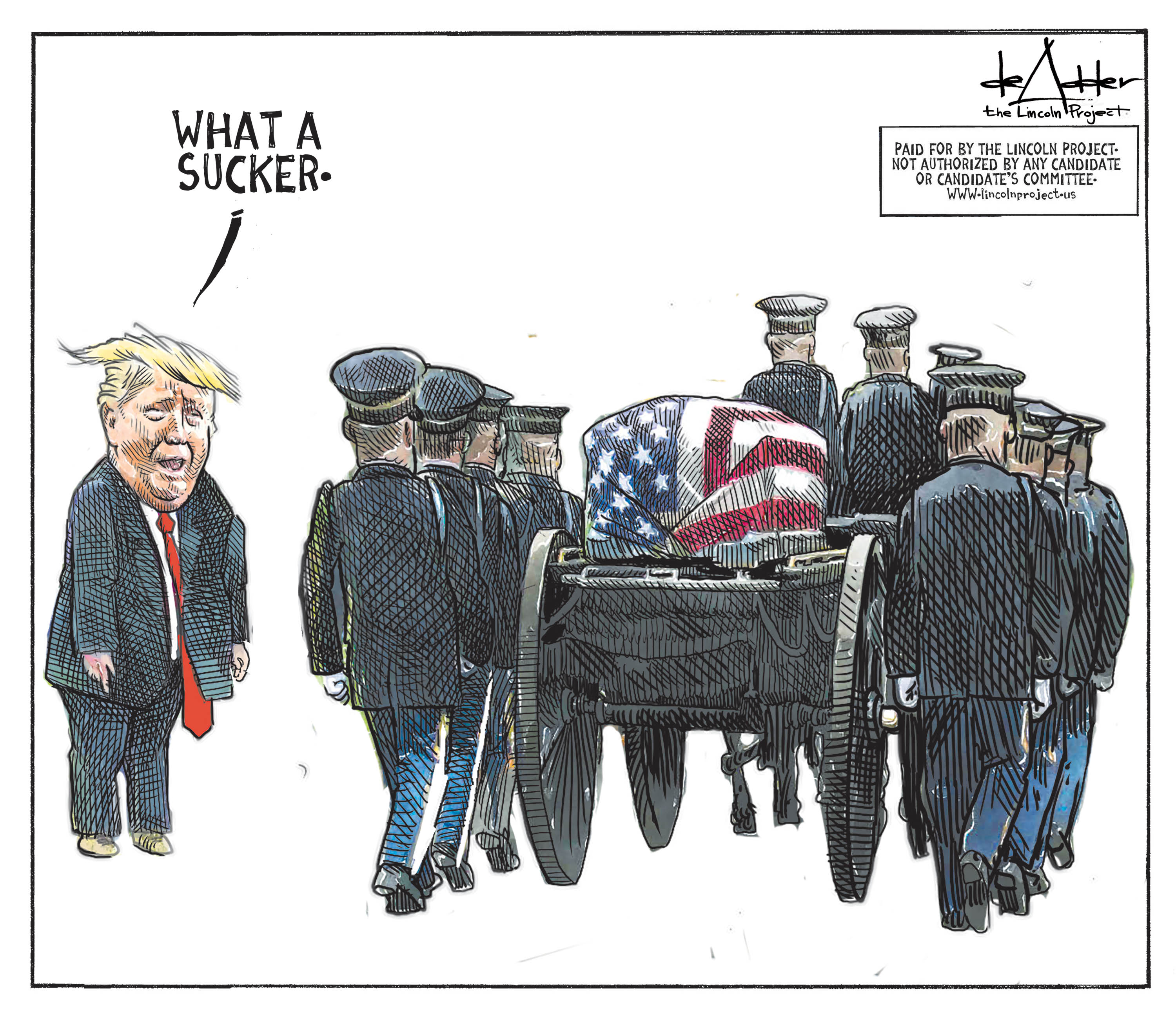
According to one former senior Trump administration official: "When the President spoke about the Vietnam War, he said, 'It was a stupid war. Anyone who went was a sucker'." 

This former official heard the President say about American veterans: "What's in it for them? They don't make any money." Source: "It was a character flaw of the President. He could not understand why someone would die for their country, not worth it." 

I read the source a few quotes from The Atlantic article. This former Trump admin official said, "The President would say things like that. He doesn't know why people join the military. He would muse, 'Why do they do it'?" 

Re: trip to mark 100th anniversary of WW I

Source: "The President was not in a good mood. Macron had said something that made him mad about American reliability and the need perhaps for a European army. He questioned why he had to go to two cemeteries. 'Why do I have to do two'?" 

President Trump's staff explained he could cancel (his visit to the cemetery), but he was warned, 'They (the press) are going to kill you for this'." The President was mad as a hornet when they did.
When asked IF the President could have driven to the Aisne-Marne Cemetery, this former official said confidently:

"The President drives a lot. The other world leaders drove to the cemeteries. He just didn't want to go." 

Regarding Trump's July 4th military parade, during a planning session at the White House after seeing the Bastille Day parade in 2017, the President said regarding the inclusion of "wounded guys" "that's not a good look" "Americans don't like that," source confirms. 

Regarding McCain, "The President just hated John McCain. He always asked, 'Why do you see him as a hero?" Two sources confirmed the President did not want flags lowered but others in the White House ordered them at half mast. There was a stand off and then the President relented.


Update #2 on Saturday morning. Another tweet thread that touched me, from Army veteran Charlotte Clymer. She includes some details about a very specific process that I didn't know very much about:

The straight line distance between Washington, D.C. and Dover, Delaware is less than 85 miles. It takes a helicopter about 40-45 minutes to make the trip. I was 19 years-old, and it was my first time riding a helicopter. I barely remember any of it. I was distracted. 

I was more nervous than I've ever been in my life about what was to come next, and so, as this Black Hawk floated above the earth with my casket team--me being the youngest and most junior--I could only think: "What if I mess this up? What if I fail? How will I live with myself?"

That's how it should be in a moment like this. You should be nervous. You should let that sharpen your focus. Because there is no room for error when handling the remains of a service member returning to the U.S. after being killed in combat. You should strive for perfection.

The helicopter landed, and my anxiety spiked. In retrospect, I recall noticing the silence of the rest of the casket team. These were young men, mostly early 20s, loud and boisterous and chests puffed. Now, they were quiet. It was unnerving.

When you're a new enlisted soldier in an infantry unit--the FNG--you're treated like you know nothing. Because you don't. Everyone around you is older and vastly more competent and confident. Yet, in this moment, despite having done this before, they were all nervous, too. Scary.

We were brought into a holding area near the tarmac on Dover Air Force Base in Delaware, where the remains of service members who have died in a theater of operations arrive on a C-17 transport plane. We rehearsed our steps. And did it again. And then again. No room for error.

The plane arrived. The ramp was lowered. The transfer vehicle that would complete the next leg of the journey was parked. Our casket team was positioned. We were now each wearing ceremonial white cotton gloves we had held under the bathroom faucet. Damp gloves have a better grip.

We’re a casket team, but these are not caskets. They're transfer cases: rectangular aluminum boxes that bear a resemblance to a crate for production equipment. Yet, the dimensions are obvious. Any given civilian would take only a few moments to realize that's for carrying bodies.

It's called a "dignified transfer", not a "ceremony", because officials don't want loved ones to feel obligated to be there while in mourning, but it is as highly choreographed as any ceremony, probably more so. It is done as close to perfection as anything the military does.

I was positioned in formation with my casket team, and I could see the transfer cases precisely laid out, dress right dress, in the cavernous space of the C-17, each draped with an American flag that had been fastened perfectly. I remember my stomach dropping.

There is simply no space for other thoughts. Your full brain capacity is focused on not screwing up. The casket team steps off in crisp, exact steps toward the plane, up the ramp (please, oh god, don't slip), aside the case, lift up ceremonially, face back and down the ramp.

During movement, everyone else is saluting: the plane personnel, the OIC (officer-in-charge), any senior NCOS and generals, and occasionally, the president. The family is sometimes there. No ceremonial music or talking. All silent, save for the steps of the casket team.

You don't see the family during this. You're too focused. There are other distractions. Maybe they forgot, but no one told me there'd be 40-60 lbs. of ice in the transfer case to prevent decomposition over the 10-hour plane ride. You can sometimes feel it sloshing around a bit.

Some of the transfer cases feel slightly heavier, some slightly lighter. The weight is distributed among six bearers, so it's not a big difference. But then you carry a case that's significantly lighter, and you realize those are the only remains they were able to recover.

It probably takes all of 30-40 seconds to carry the transfer case from the plane to the mortuary vehicle, but it felt like the longest walk ever each time. The case is carefully placed in the back of the mortuary vehicle, and the casket team moves away in formation.

I don't know how to describe the feeling after you're done and on your way back to D.C., but it's a mixture of intense relief that you didn't screw up and profound sobriety over what you've just done and witnessed. I wouldn't call it a good feeling. Maybe a numbed pain.

From the outside, the most egalitarian place in America is a military transfer case. They all look exactly the same: an aluminum box covered with the American flag. We didn't know their names, rank, race, ethnicity, gender, religion, sexual orientation--none of it. All the same.

Whatever cruel and unfathomable politics had brought all of us to that moment--from the killed service member in the box to those of us carrying it to the occasional elected official who attends to pay respects--there were no politics to be found during a dignified transfer.

The fallen service members I helped receive and carry during this part of the journey to their final resting place were not "losers" or "suckers". They were selfless and heroic, and I had the honor of being among the first to hold them when they returned home.

There are service members around the world involved in caring for our war fatalities. The mortuary specialists, the casket teams, the family liaisons--so many people who work to ensure that this final act is done with the greatest amount of dignity and honor, seeking perfection.

I suppose the one thing we all took for granted is that dignity would always be affirmed by all our civilian leaders to those service members who gave everything. I never would have predicted any official, let alone a sitting president, would insult fallen service members.

I cannot adequately describe my anger at Donald Trump for being so willing to send service members halfway around the world to die on his own behalf and then call them "losers" for doing so. This coward is unfit for his office and the power it holds. He needs to go. 

Thursday, August 27, 2020

The Trump National Celebration? Unimpressive. - Updated

Political scientist Jonathan Bernstein, writing at Bloomberg, weighs in on the first three days of the Republican National Convention:

Way back in March, President Donald Trump gave an Oval Office speech about the coronavirus, which was immediately rendered irrelevant by the breaking news that Tom Hanks had contracted it and that the National Basketball Association was shutting down.

The Republican convention has had a similar feel all week, but on Wednesday the impression was overwhelming. Republicans went through a series of (mostly taped) speeches that felt entirely out of touch with current events, as the NBA once again shut down, along with the WNBA and three Major League Baseball games, this time to protest the police shooting of Jacob Blake. And of course those NBA games were supposed to take place in a “bubble,” a brand-new term that for most people evokes the ongoing pandemic — except for Republicans, who continue to pretend that the coronavirus is something that Trump solved long ago.

Even when they’re not explicitly talking about the crisis in the past tense, they’re effectively doing so. Vice President Mike Pence proclaimed that “we’re re-opening America’s schools” even as many districts are staying remote and dealing with impossible choices — and without the extra funds that even Trump concedes they need but hasn’t been able to deliver. Pence at least addressed the pandemic, which most other speakers have ignored. But he gave no hint that there are still tens of thousands of new cases a day, or that the toll in the U.S. is among the worst in the world.

And while it’s probably true that Democrats last week underplayed the violence and looting that have broken out in some cities in the wake of protests, Republicans have exaggerated the discord out of all proportion — and blamed it all on Democrats, who (as Joe Biden just did) have mostly condemned the violence while supporting peaceful protests. Again, that was true on the first two nights of the convention, but it seems increasingly out of touch.

The second notable thing Wednesday, and really throughout the convention, is just how hollowed out this Republican Party is. I counted four administration officials and two candidate family members among the speakers, and there have been several other relatives featured so far. It’s unusual (and potentially illegal) for White House staff and other administration officials to speak at political events. But it’s also, well, unimpressive. Senators, governors, community leaders and ordinary citizens all presumably speak on behalf of the presidential candidate out of genuine support. Staff … well, sure, they wouldn’t be working for the president if they didn’t support him, but the bottom line is that they’re praising the boss, and the only folks apt to be impressed by that are those who already support the candidate.

Regardless of how effective those speeches are, they suggest that the party is atrophying rapidly (at the level of party actors, that is, not of voters, where there’s been little change). It’s not clear whether other politicians just don’t want to be associated with the convention or if Trump doesn’t want them there, but either way the whole week has seemed more like a Trump National Celebration (and airing of grievances) than a Republican National Convention. And that’s all the more true because the Trump family members are for the most part giving standard political speeches, not talking personally about the president in a way that others could not. In that se
nse, it’s hard to see the logic of why they’re speaking at all. (This is the column in its entirety.)

Why, exactly, didn't Don Jr., Eric, Lara, Tiffany, Melania and quasi-family member Kimberly Guilfoyle tell heartwarming personal stories about Donald as a person, a father, a husband? Why didn't they tell lovely stories about those times when he supported them, encouraged them, inspired them? Why didn't they talk about those times when he helped someone? Times when he was inspirational? Heroic? Courageous? Why didn't they tell those stories? That's easy. They can't, because there aren't any.

In the interest of fairness I'll note that daughter-in-law Lara Trump did tell a nice story about when when she first met husband Eric's family, saying that she liked them because they were "down to earth." She was quickly laughed out of the room:


And one more thing. The Lincoln Project is out with a new video that points out the hypocrisy behind Mike Pence's slobbering, sycophantic adoration of Donald:


Update: Eugene Robinson's thoughts about Mike Pence's speech last night:

What 176,000-plus deaths from covid-19? What devastating shutdown and recession? What double-digit unemployment? What mass uncertainty over whether and how to open the schools? What shocking police killings of African Americans? What long-overdue reckoning with systemic racism?

Let me put it another way: What country does Vice President Pence live in?

During his acceptance speech at the Republican National Convention on Wednesday, Pence sounded as though he lived in some kind of fantasyland that perhaps had encountered a few tiny little bumps in the road. His party has spent the week claiming to represent “the common man,” but Pence spoke as though he knew next to nothing about the daunting challenges that Americans are having to deal with every day. The most he could muster was an acknowledgement that “we’re passing through a time of testing,” as though he were consoling a motorist after a fender bender.

He did offer “our prayers” for victims of Hurricane Laura, and he acknowledged there had been deaths from the coronavirus pandemic, though not how many. But his only pointed and specific words were his attacks against the Democratic nominee — “You won’t be safe in Joe Biden’s America” — and his full-throated endorsement of President Trump’s “law and order” rhetoric.

The vice president rejected the idea of systemic racism, instead focusing on the protest and demanding its end. He blasted “violence and chaos . . . rioting and looting . . . tearing down statues” — with no mention of why those things might be happening.

Pence spoke from an iconic American setting, the site of the War of 1812 battle whose “rocket’s red glare” and “bombs bursting in air” inspired Francis Scott Key to write “The Star-Spangled Banner.” Fort McHenry is meant to symbolize national unity. It was an act of defilement to use such a place for partisan political rhetoric intended to provoke division and fear.

But as far as this Republican convention is concerned, what else is new?

So far, the GOP has misused the White House — the people’s house — to have President Trump and his acting secretary of homeland security stage a naturalization ceremony, crassly reducing five newly minted U.S. citizens to photogenic props; have Trump pardon an African American ex-convict, as part of an all-out attempt to whitewash the administration’s shocking racism; and have first lady Melania Trump deliver her convention address, standing before Republican partisans in the Rose Garden she recently renovated.

The party also had Secretary of State Mike Pompeo speak to the convention from Jerusalem, playing an active partisan role in a way no sitting secretary of state has done in living memory — in the middle of an overseas diplomatic trip, no less. He is supposed to represent the entire nation, but apparently he represents only the loyal Trump base.

Trump and his campaign aides see this ostentatious disregard for hallowed norms as an element of the Trump brand. Despite having been in office for 3½ years, Trump still wants to cast himself as some kind of rough-hewn outsider willing to smash all the china, if necessary, to “get things done.” It’s pure razzle-dazzle, designed to create the illusion of blunt effectiveness — and distract from the administration’s dismal, tragic failures.

Pence is supposedly leading the nation’s response to the coronavirus emergency. One might have expected that he, of all speakers, would at least try to deal with that crisis substantively. But one would have been wrong.

As Pence spoke, a potentially catastrophic Category 4 storm was grinding toward landfall along the Gulf Coast. Many thousands of people were trying to evacuate their homes near the Texas-Louisiana border — and, because the Trump administration so bungled its response to covid-19, had to scramble for shelter and safety in the middle of a raging pandemic.

Meanwhile, Kenosha, Wis., was under a tense dusk-to-dawn curfew following angry protests that were sparked by the shocking police shooting Sunday of yet another Black man, Jacob Blake. Pence apparently hadn’t noticed the reason for the Kenosha protests. And he apparently really didn’t notice the killing Tuesday of two protesters, allegedly by a young White vigilante and Trump supporter.

I wasn’t surprised. Earlier in the evening, the convention brought out Michael McHale, president of the National Association of Police Organizations, to describe Biden (who wrote the 1994 crime bill) and vice-presidential nominee Kamala D. Harris (a former prosecutor) as somehow anti-police — and call Trump “the most pro-law-enforcement president we’ve ever had.” Be afraid, America, be very afraid.

But what all of this actually reveals is Trump’s own naked fear.

He and the Republicans are pulling these stunts because they know that right now, according to polls, they are losing this election. Badly. And deep down, I hope, at least some of them realize that defeat is what they richly deserve. (This is the column in its entirety.)  

Sunday, August 2, 2020

The Books Of Donald, Part 2 - Updated

The New York Times considers a new genre of literature, Political Revenge, featuring our old friend The Mooch:

Title: In Trumpworld, the Grown-Ups in the Room All Left, and Got Book Deals

Subtitle: A large club of Trump administration evictees have turned their bracingly bad experiences into a new genre: political revenge literature.

It was the summer of 2016, and the Republican Party was about to nominate Donald J. Trump for president. Until then, many party members had aggressively opposed his candidacy. “I think he’s crazy,” Senator Lindsey Graham, Republican of South Carolina, said earlier that year. “I think he’s unfit for office.”

But faced with the inevitable reality of Mr. Trump, the party was forced to perform what the British tabloids call a “reverse-ferret” — a messaging U-turn in which you abruptly take the opposite position of the one you espoused a moment earlier.

Contrary to what they said before, the Republicans announced, Mr. Trump was totally suited for the presidency. He would rise to the occasion. Being president would render him, tautologically, presidential. In any case, at least he would be surrounded by adults who would steer him in the right direction.

“It began to dawn on me,” Anthony Scaramucci, who went on to (briefly) work in the Trump White House, wrote of hearing about the then-candidate’s tax proposals. “Donald J. Trump wasn’t the extreme, unhinged, unserious candidate that I thought he was.”

Mr. Scaramucci spent just 11 days as the White House communications director in 2017 before being unceremoniously removed, a victim of his own operatic ineptitude as well as the dysfunction of the White House. He now regrets the error, as he sees it, of ever having admired Mr. Trump. “The guy stinks,” he said recently.

As it happens, Mr. Scaramucci wrote a book about his brief, unhappy White House experience, joining a large club of Trump administration evictees who have turned their bracingly bad experiences into a new genre of political revenge literature. These include James Comey, former F.B.I. director; Omarosa Manigault Newman, former assistant to the president; Andrew McCabe, former deputy F.B.I. director; John Bolton, former national security adviser; Cliff Sims, former White House communications aide; and Anonymous, current senior figure, at least by his or her own account, in the Trump administration.

(There’s also Sean Spicer, former press secretary, who wrote a mostly complimentary book about his fleeting White House tenure; and Mary Trump, not an ex-staffer but the president’s niece, whose scathing portrait of Trump family pathology came out in July and sold 1.35 million copies across all formats in its first week. That book is currently No. 1 on hardback nonfiction best-seller lists in the United States, Britain, Canada and Ireland, and No. 2 in Australia.)

Taken en masse, the books paint a damning portrait of the 45th president of the United States. But the sheer volume of unflattering material they contain can have the paradoxical danger of blunting their collective impact. After the 10th time you read about Mr. Trump’s short attention span, your own attention is in danger of wandering.

“There is only so much the public can absorb,” Anonymous writes in “A Warning.”

There are even more memoirs scheduled for the fall: one by Michael Cohen, the president’s disgraced ex-personal lawyer, which federal officials tried to block but then said could proceed, and another by H.R. McMaster, who was Mr. Trump’s second national security adviser and is no fan of the president.

But at this point, nearly four years in, is there anything left to say about Mr. Trump that might surprise us? Or, as Mr. McCabe writes in “The Threat”: “What more could a person do to erode the credibility of the presidency?”

Reading all these books, one after the other, is like swimming for days in a greasy, brackish canal whose bottom is teeming with shards of broken-down old industrial equipment. The experience is not pleasant, you might hurt yourself, and it leaves you covered in grime. The picture they paint of their protagonist — Mr. Trump — is so outrageous that if they were fiction they would be dismissed as too broad, too much of a caricature.

As different as the authors are, the books share a number of common observations about the president. And so, with the Republican Party set to renominate him this month, here is a reminder of what sort of leader Mr. Trump has turned out to be, according to his growing band of disgruntled former employees.


Trump vs. his employees

Mr. Trump is universally presented in the memoirs as a flamboyantly mean and intemperately indiscreet boss, wrong-footing and humiliating cabinet members and aides with constant criticism, sometimes to their faces, sometimes behind their backs.

The president dismisses Jim Mattis, his first secretary of defense, as “a liberal Democrat,” yells at him in meetings and notes that “I never really liked him.” (“I felt sorry for Mattis, not to mention the country as a whole,” Mr. Bolton writes.)

He derides Kirstjen Nielsen, his second secretary of homeland security as ineffectual and “not mentally able” to handle her job and then, in a fit of pique, futilely attempts to reassign her responsibilities first to Jared Kushner, his son-in-law, and then to Mr. Bolton.

He muses aloud on multiple occasions about dumping Vice President Mike Pence from the ticket in 2020 and replacing him with Nikki Haley, the UN ambassador. “Did we make a mistake with Gina?” he asks, referring to his decision to make Gina Haspel director of the C.I.A.

“Rex was terrible,” he says about Rex Tillerson, his original secretary of state. “What good is he?” he asks rhetorically about Steven Mnuchin, his treasury secretary. “I thought we had the right guy at Treasury. But now I don’t know.”

He yells at his trade adviser, Peter Navarro, when Mr. Navarro attempts to show him a complicated chart outlining a policy point. (“I have no idea what I’m even looking at,” the president snaps.) He tells Mr. Kushner in meetings: “Jared, you don’t know what you’re talking about.” He mocks his original chief economic adviser, Gary Cohn, as a “globalist,” elongating the “O” in a sneering tone, as if the word were akin to “Antifa member.”

Just as the president uses derisive nicknames for his political enemies, so he does for his own subordinates. He mocks Jeff Sessions, his first attorney general, as “Benjamin Button.” He calls Betsy DeVos, the education secretary, “Ditzy DeVos.” “This place is really taking a toll on Kellyanne,” he says of Kellyanne Conway, counselor to the president, implying that she looks tired and worn out.


The president and the truth

The Trump administration surged into life with a whomping great Trumpian untruth: that Mr. Trump’s inauguration crowd was the largest in history. Even Mr. Spicer did not believe it, though he had to pretend otherwise.

“It was hard to keep a straight face as Sean proceeded to lie to the American people,” Ms. Manigault Newman writes.

All the memoirists present Mr. Trump as supremely untrustworthy. He is “a deliberate liar, someone who will say whatever he pleased to get whatever he wishes,” Mr. McCabe writes. “People who’ve known him for years accept it as common knowledge,” Anonymous writes.
Sometimes Mr. Trump asserts one thing and then, a few minutes later, just the opposite.

On other occasions, he conjures pieces of misinformation designed to bolster his thesis, as when he insisted that “three to five million people” voted illegally in the 2016 election. He has a habit of plucking figures from thin air — first $20 billion, for instance, then $38 billion, to drive home his point about trade deficits in a meeting with President Moon Jae-in of South Korea — regardless of the numbers’ relationship to fact.

The memoirists have different ways of dealing with all this presidential slipperiness. Mr. Comey and Mr. McCabe start keeping detailed logs of their encounters with the president, the way you would if you had an unstable spouse and wanted to catalog his erratic behavior for use in future divorce proceedings.

Too bad, is the apparent view of Reince Priebus, the original chief of staff.

“The directive came down from Reince,” Ms. Manigault Newman writes, “that our default position was to back up whatever the president said or tweeted, regardless of its accuracy.”


How to describe the experience

Striving for new ways to characterize the head-spinning unreality of the Trump White House, the authors of the memoirs turn to a variety of vivid figures of speech.

Mr. Spicer: “I sometimes felt like a scuba diver, abandoned in the middle of the ocean, treading water.”

Mr. Comey: “The demand was like Sammy the Bull’s Cosa Nostra induction ceremony — with Trump, in the role of the family boss, asking me if I have what it takes to be a ‘made man.’”

Ms. Manigault Newman: “The selection process for his cabinet was like an episode of ‘The Bachelor.’”

Mr. Bolton: “It was like making and executing policy inside a pinball machine.”

Anonymous: Working for Mr. Trump was like “showing up at the nursing home at daybreak to find your elderly uncle running pantsless across the courtyard and cursing loudly about the cafeteria food.”

Trump as instigator

To read these books is to read of a chaotic, paranoiac workplace, where the boss delights in fomenting discord and instability among the employees.

He encourages them to keep tabs on one another. “Give me their names,” he tells Mr. Sims, wielding a Sharpie and a White House note card, vowing to rid the White House of nonloyalists.

He praises their rivals. “Keith Kellogg knows all about NATO,” the president says airily to Mr. Bolton, speaking with ominous intent of Mr. Pence’s national security adviser. “He never offers his opinions unless I ask.”

(This causes some merriment between Mr. Bolton and Mike Pompeo, the current secretary of state, who plays dual roles in Mr. Bolton’s drama: as a rival he suspects of conspiring and leaking against him, and as his partner in anti-Trump incredulity and black-humored job insecurity.

“As Pompeo and I reflected later, this statement told us exactly who my likely replacement would be if I resigned soon,” Mr. Bolton writes. “I said, ‘Of course, if you resign, maybe Keith would be Secretary of State.’” To which Mr. Pompeo responds: “Or, if we both resign, Keith could become Henry Kissinger and have both jobs.’”)


The president’s verbal style

Mr. Trump likes to talk, the memoirists agree, and he does not like to listen.

He meanders from topic to topic, loops back around, adds new topics, repeats himself, boasts, mixes facts with fake facts, throws in his latest obsession, continuing on and on according to some labyrinthine stream-of-consciousness impulse in which whatever is on his mind is worthy of public utterance. He does this in rallies and at campaign events; he also does it in briefings, in one-on-one conversations and at policy meetings.

“I don’t use the word ‘conversation’ because the term doesn’t apply when one person speaks nearly the entire time,” Mr. Comey writes of the experience.

The presidential attention span

It is true that Mr. Trump successfully repeated the words “person, woman, man, camera, TV” on television in an effort to demonstrate the superiority of his mental acuity, but it is also true, the books argue, that he rarely reads, gets bored easily, is irritable and distracted, has trouble remembering complicated things, has no intellectual curiosity and is ignorant not just about his job but about things generally considered common knowledge.

With his short attention span, he is averse to learning anything at briefings if he finds the information difficult to follow, boring, or in contravention of what he already thinks. Staff members are told to to stick to a single point and repeat it often, and to boil complex proposals down to a single page — or, better, a single paragraph. They are told not to present Mr. Trump with too-long briefing papers, lest he shout at them, or with too many slides, lest his eyes glaze over.

“Any time somebody new came in to brief him, he’d get angry and say, “Who’s that guy? What’s he want?” Ms. Manigault Newman writes.

The presidential schedule

The president keeps unconventional office hours, is ofte
n late to meetings and events and watches a lot of TV.
“At 9:35 I called Trump, who was as usual still in the residence,” Mr. Bolton writes.

“He often doesn’t start the day in the Oval Office until 10 or 11 a.m.,” Anonymous writes. He is “channel-surfing his way through the presidency.”

“His official schedule was more of a loose outline than a strict regimen,” Mr. Sims writes.

The presidential ego

In “Too Much and Never Enough,” Mary Trump describes her uncle as “a savant of self-promotion” with a “delusional belief in his own brilliance and superiority” stemming from a bottomless insecurity that needs to be assuaged with a constant stream of ego-boosting compliments.

That is why the president often asserts that he is the best at everything.

“It was the most presidential act in decades,” he says, after he directs the Pentagon to bomb Iran and then calls it off at the last minute. (Mr. Bolton has a different take: “In my government experience, this was the most irrational thing I ever witnessed any president do.” )

“They say I might be the world’s greatest brander,” he says to Mr. Sims, before unveiling his marketing idea for his tax-cut plan: calling the legislation the “Cutting Cutting Cutting Bill” (it ended up being called something else).

Several memoirists describe how Mr. Trump, to soothe a wounded psyche bruised by his failure to win the popular vote in 2016, continually invited visitors to admire posters illustrating how he had won the election anyway.

“Trump kept big charts in his private dining room, in his den, in his study, that showed the electoral map color coded in red and blue,” Ms. Manigault Newman writes. “When anyone walked in, he’d point to the chart and talk about the election results.”

Anonymous was familiar with the maps, as well. “Trump carried around maps outlining his electoral victory, which he would pull out at odd times,” he writes. “He would beckon guests, as well as aides, advisers and incoming cabinet officers, to gaze at the sea of red on the map.”


Does Mr. Trump use a tanning bed?

“His face appeared slightly orange, with bright white half-moons under his eyes where I assumed he placed small tanning goggles,” Mr. Comey writes.

Ms. Manigault Newman mentions the tanning-adjacent chatter around the abrupt firing of Angella Reid, chief usher of the White House, several months into Mr. Trump’s administration.

“Allegedly, Trump didn’t approve of her handling of his tanning bed,” she says. “I’d heard he was unhappy with her efforts to procure the bed, to bring it into the East Wing securely, to find a discreet place for it, and to set it up properly.”

Aides on the president’s conduct

The memoirs paint a picture of the West Wing as a place of baroque workplace dysfunction, where workers gather to trade “Guess what he did now” stories about their boss and to save him (and themselves, and the country) from his worst impulses.

And so, in “A Warning,” Anonymous writes that cabinet-level administration officials contemplated “a midnight self-massacre,” which would entail “resigning en masse to call attention to Trump’s misconduct and erratic leadership.”

Many staffers are perpetually on the brink of quitting, keeping resignation letters on hand should the time come. And if his colleagues hate working for the Trump administration, John Kelly, the president’s second chief of staff, apparently hates it the most.

“This is the worst” (insert expletive here) “job I’ve ever had,” Mr. Kelly tells Mr. Sims.

“You can’t imagine how desperate I am to get out of here,” he tells Mr. Bolton. “This is a very bad place to work.”

Things John Bolton claims people said to him

A striking aspect of “The Room Where it Happened” is how frequently cabinet-level officials confide incredulously in Mr. Bolton about the president’s irrationality and narcissism, as if they and the former national security adviser formed a gang of rebellious high-school students, quietly plotting resistance against the incompetent autocrats running the school.

“As McGahn often whispered to me,” Mr. Bolton writes, speaking of Donald McGahn, who served for a while as White House counsel, “This is not the Bush Administration.”

“Has there ever been a presidency like this?” Mr. Kelly asks Mr. Bolton, mentioning that the president has just said, apropos of nothing, that it would be “cool” to invade Venezuela. (“I assured him there had not,” Mr. Bolton responds.)

“This is getting pretty silly,” Mr. Mattis says to Mr. Bolton as the men listen to Mr. Trump rail at Jens Stoltenberg, the secretary general of NATO, about how America’s allies mock it behind its back because it pays too much in annual dues.

As for Mr. Pompeo, Mr. Bolton describes how the secretary of state passed him a snarky anti-Trump note in the middle of the president’s summit with Kim Jong-un of North Korea in 2018. And he describes how, after listening to the president yell at Ms. Nielsen about border security in a particularly fruitless meeting, Mr. Pompeo whispers to Mr. Bolton: “Why are we still here?”


Leaving Trump’s orbit

What Donald can do in order to offset the powerlessness and rage he feels is punish the rest of us,” Mary Trump writes.

This is clear by the way he behaves when he has fired someone or they have quit, frequent occurrences in an administration with such a high turnover. After he fires Mr. Comey, the FBI director, while he is in California, for instance, Mr. Trump is incensed to learn that Mr. Comey has returned to Washington on the same government plane that he traveled out on.

“That’s not right! I didn’t approve of that!” he rants to Mr. McCabe. Then he decrees that Mr. Comey should never be allowed to enter the F.B.I. headquarters again, not even to clean out his desk. “I’m banning him from the building,” the president says.

After Mr. Mattis resigns as defense secretary, Anonymous writes, the wounded president throws “a temper tantrum,” insists that Mr. Mattis leave the job immediately, before his successor has been named, and then falsely claims that in fact he fired Mr. Mattis, rather than the other way around.

How the Trump administration said ‘you’re fired’

Mr. Comey: Saw the news reported on TV in the back of the auditorium while he was in the middle of making a speech in California.

Mr. McCabe: Saw the news on TV, followed by a presidential tweet: “Andrew McCabe FIRED, a great day for the hard working men and women of the FBI.”

Ms. Manigault Newman: Called into the Situation Room before the 2017 White House Christmas Party, was informed by Mr. Kelly that “there are significant integrity violations related to you,” and was not allowed to leave until the stress of the encounter triggered an asthma attack and she went home.

Mr. Sims: Submitted his resignation after being told by Mr. Kelly: “In the past 40 years, I don’t think I’ve ever had a subordinate whose reputation is worse than yours.”

Mr. Priebus: Idling in the presidential motorcade after a trip to New York on the day after he had submitted his resignation, learned that his removal was effective immediately when he read on Twitter that Mr. Kelly was replacing him. The motorcade went on Twitter that Mr. Kelly was replacing him. The motorcade went on to the White House; his car peeled away and drove off into oblivion.

Trump on the authors

Mr. Comey: “A weak and untruthful slime ball”

Mr. McCabe: “A major sleazebag.”

Ms. Manigault Newman: “Vicious, but not smart.”

Mary Trump: “A seldom seen niece who knows little about me, says untruthful things about my wonderful parents (who couldn’t stand her!) and me, and violated her NDA. … She’s a mess!”

Mr. Sims: “A low level staffer that I hardly knew. … He is a mess!”

Mr. Bolton: A “sick puppy.” 
(This is the article in its entirety.)

All this stuff is interesting but almost all of it could have been discerned by anyone who was paying attention to Donald before the election. The books mentioned above have all been written and published while Donald is still president, theoretically at least the most powerful man in the world. I can only imagine what we'll learn in the memoirs written after the clock strikes twelve and he turns into an old, tired, worn-out, unhealthy, unpowerful and unloved former president. (January 20. Noon. Eastern time.) 

And speaking of unhealthy, apparently Donald made another unscheduled visit to Walter Reed hospital yesterday; I've seen quite a bit of chatter about what could have caused the bruise on his right hand:


In the spirit of "What's wrong with Donald," remember the "Orange Death Mask" picture from last Wednesday: 

Trump
(AP Photo/Susan Walsh)

I was thinking it must have been photoshopped. It just didn't seem possible that his staff would let him go out in public looking like that, but that's the picture direct from AP Images. It's very strange. 

Saturday, August 1, 2020

A Full And Complete Healthcare Plan - Updated


Donald's interview with Chris Wallace took place on July 19:


At the 43-second point he says "We're signing a healthcare plan within two weeks. A full and complete healthcare plane."

Two weeks from July 19 is August 2, which is tomorrow. He said this yesterday:


Update on Sunday afternoon:


Looks like Donald spent a good part of today, Sunday, at his golf course. Don't worry, it's only mid-afternoon. He still has plenty of time to present his full and complete plan to the nation. 

Update #2. There was, of course, no plan.

Thursday, July 30, 2020

Can Donald Postpone The Election? - Updated

Fortunately the short answer is no, he can't. (Big sigh of relief.) He suggested it this morning and of course, the political world went nuts. Even Mitch McConnell spoke against the president, which he almost never does:

“Never in the history of the Congress, through wars, depressions and the Civil War have we ever not had a federally scheduled election on time, and we’ll find a way to do that again this Nov. 3,” McConnell told Max Winitz, the lead evening anchor at WNKY 40.

When Winitz asked whether the Nov. 3 election date is “set in stone,” McConnell responded, “That’s right.”

“We’ll cope with whatever the situation is and have the election on Nov. 3 as already scheduled,” the GOP leader said.
(From The Hill, read the entire story here.)

Still, I was surprised to read how sharply Steven G. Calabresi, an arch conservative and a co-founder of the Federalist Society, pushed back on Donald's stupid idea. In an opinion column at the New York Times, titled: Trump Might Try to Postpone the Election. That’s Unconstitutional and subtitled He should be removed unless he relents, Calabresi said this:

I have voted Republican in every presidential election since 1980, including voting for Donald Trump in 2016. I wrote op-eds and a law review article protesting what I believe was an unconstitutional investigation by Robert Mueller. I also wrote an op-ed opposing President Trump’s impeachment.

But I am frankly appalled by the president’s recent tweet seeking to postpone the November election. Until recently, I had taken as political hyperbole the Democrats’ assertion that President Trump is a fascist. But this latest tweet is fascistic and is itself grounds for the president’s immediate impeachment again by the House of Representatives and his removal from office by the Senate.

Here is what President Trump tweeted:


The nation has faced grave challenges before, just as it does today with the spread of the coronavirus. But it has never canceled or delayed a presidential election. Not in 1864, when President Abraham Lincoln was expected to lose and the South looked as if it might defeat the North. Not in 1932 in the depths of the Great Depression. Not in 1944 during World War II.

So we certainly should not even consider canceling this fall’s election because of the president’s concern about mail-in voting, which is likely to increase because of fears about Covid-19. It is up to each of the 50 states whether to allow universal mail-in voting and Article II of the Constitution explicitly gives the states total power over the selection of presidential electors.

Election Day was fixed by a federal law passed in 1845, and the Constitution itself in the 20th Amendment specifies that the newly elected Congress meet at noon on Jan. 3, 2021, and that the terms of the president and vice president end at noon on Jan. 20, 2021. If no newly elected president is available, the speaker of the House of Representatives becomes acting president.

President Trump needs to be told by every Republican in Congress that he cannot postpone the federal election. Doing so would be illegal, unconstitutional and without precedent in American history. Anyone who says otherwise should never be elected to Congress again.
(This is the column in its entirety.)

Steven G. Calabresi is a co-founder of the Federalist Society and a professor at Northwestern University’s Pritzker School of Law.

Update. In a story labeled "News Analysis," this is how the New York Times is covering Donald's tweet and the reaction to it:

For several years, it has been the stuff of his opponents’ nightmares: that President Trump, facing the prospect of defeat in the 2020 election, would declare by presidential edict that the vote had been delayed or canceled.

Never mind that no president has that power, that the timing of federal elections has been fixed since the 19th century and that the Constitution sets an immovable expiration date on the president’s term. Given Mr. Trump’s contempt for the legal limits on his office and his oft-expressed admiration for foreign dictators, it hardly seemed far-fetched to imagine he would at least attempt the gambit.

But when the moment came on Thursday, with Mr. Trump suggesting for the first time that the election could be delayed, his proposal appeared as impotent as it was predictable — less a stunning assertion of his authority than yet another lament that his political prospects have dimmed amid a global public-health crisis. Indeed, his comments on Twitter came shortly after the Commerce Department reported that American economic output contracted last quarter at the fastest rate in recorded history, underscoring one of Mr. Trump’s most severe vulnerabilities as he pursues a second term.

Far from a strongman, Mr. Trump has lately become a heckler in his own government, promoting medical conspiracy theories on social media, playing no constructive role in either the management of the coronavirus pandemic or the negotiation of an economic rescue plan in Congress — and complaining endlessly about the unfairness of it all.

“It will be a great embarrassment to the USA,” Mr. Trump tweeted of the election, asserting without evidence that mail-in voting would lead to fraud. “Delay the Election until people can properly, securely and safely vote???”

The most powerful leaders in Congress immediately shot down the idea of moving the election, including the top figures in Mr. Trump’s own party.

“Never in the history of the country, through wars, depressions, and the Civil War have we ever not had a federally scheduled election on time, and we’ll find a way to do that again this Nov. 3,” Mitch McConnell, the Senate Majority Leader, said in an interview with WNKY television in Kentucky. “We’ll cope with whatever the situation is and have the election on Nov. 3 as already scheduled.”

Mr. Trump’s tweet about delaying the election marked a phase of his presidency defined not by the accumulation of executive power, but by an abdication of presidential leadership on a national emergency.

Faced with the kind of economic wreckage besieging millions of Americans, any other president would be shoulder-deep in the process of marshaling his top lieutenants and leaders in Congress to form a robust government response. Instead, Mr. Trump has been absent this week from economic-relief talks, even as a crucial unemployment benefit is poised to expire and the Federal Reserve chairman, Jerome H. Powell, warned publicly that the country’s recovery is lagging.

And any other president confronted with a virulent viral outbreak across huge regions of the country would be at least trying to deliver a clear and consistent message about public safety. Instead, Mr. Trump has continued to promote a drug of no proven efficacy, hydroxychloroquine, as a potential miracle cure, and to demand that schools and businesses reopen quickly — even as he has also claimed that it might be impossible to hold a safe election.

William F. Weld, the former governor of Massachusetts who mounted a largely symbolic challenge to Mr. Trump in the Republican primaries this year, said on Thursday that the president’s tweet was a sign that Mr. Trump was panicked and unmoored. Though Mr. Weld has argued for years that Mr. Trump had dictatorial impulses, he said Thursday that the election-delay idea was “not a legitimate threat.”

“So many dead and the economy in free fall — and what’s his reaction? Delay the election,” Mr. Weld said. “It’s a sign of a mind that’s having a great deal of difficulty coming to terms with reality.”

Mr. Trump has attacked the legitimacy of American elections before, including the one in 2016 that made him president. Even after winning the Electoral College that year, Mr. Trump cast doubt on the popular vote and postulated baselessly that Hillary Clinton’s substantial lead in that metric had been tainted by illegal voting.

With that as precedent, there has never been much doubt — certainly among his opponents — that Mr. Trump would attempt to undercut the election if it appeared likely he would lose it. While Mr. Trump does not have the power to shift the date of the election, there is ample concern among Democrats that his appointees in Washington or his allies in state governments could make a large-scale effort to snarl the process of voting.

Given the extreme nature of Mr. Trump’s suggestion, there was an odd familiarity to the response it garnered from political leaders in both parties. There was no immediate call to the barricades, or renewed push from Democrats for presidential impeachment. Opposition leaders expressed outrage, but most agreed, in public and private, that Mr. Trump’s outburst should be treated as a distress call rather than a real statement of his governing intentions.

House Speaker Nancy Pelosi, the most powerful Democrat in government, replied to Mr. Trump’s tweet simply by posting on Twitter the language from the Constitution stating that Congress, not the president, sets the date of national elections. Representative Zoe Lofgren of California, a Democrat who chairs the congressional committee that oversees elections, suggested in no uncertain terms that Mr. Trump’s tweet was another symptom of his inability to master the coronavirus.

“Only Congress can change the date of our elections,” Ms. Lofgren said, “and under no circumstances will we consider doing so to accommodate the President’s inept and haphazard response to the coronavirus pandemic, or give credence to the lies and misinformation he spreads regarding the manner in which Americans can safely and securely cast their ballots.”

Republicans, who typically answer the president with a combination of evasion or no comment, did not rush to become profiles in courage by thundering against an out-of-control presidency, and some ducked the issue entirely when confronted by reporters. But many others were blunt in their rejection of Mr. Trump’s position.

“Make no mistake: the election will happen in New Hampshire on November 3rd. End of story,” Gov. Chris Sununu of New Hampshire, a Republican who is up for re-election, said on Twitter.

Senator Marco Rubio of Florida said on Capitol Hill, “Since 1845, we’ve had an election on the first Tuesday after November first and we’re going to have one again this year.”

Representative Kevin McCarthy, the House minority leader and one of Mr. Trump’s staunchest allies in Congress, echoed that position, saying “we should go forward.”

Others were more equivocal, following a well-worn Republican playbook for avoiding direct conflict with the president over his wilder pronouncements. Secretary of State Mike Pompeo, asked in a Senate hearing whether he believed it was legal for a president to delay an election, said he was “not going to enter a legal judgment on that on the fly this morning.” That would be an assessment, he said, for the Justice Department.

Even Mr. Trump’s campaign declined to turn his tweet into a rallying cry, instead playing down the notion that it might have been a policy prescription. Hogan Gidley, a spokesman for the campaign, said Mr. Trump was “just raising a question about the chaos Democrats have created with their insistence on all mail-in voting” — an obviously false paraphrase of the president’s tweet, one that minimized the gravity of what Mr. Trump had said.

The timing of Mr. Trump’s tweet, as much as the content, highlighted the extent to which he has become a loud but isolated figure in government, and in the public life of the country. In addition to failing to devise a credible national response to the coronavirus pandemic, he has not played the traditional presidential role of calming the country in moments of fear and soothing it in moments of grief.

Never was that more apparent than on Thursday, when Mr. Trump spent the morning posting a combination of incendiary and pedestrian tweets, while his three immediate predecessors — Barack Obama, George W. Bush and Bill Clinton — gathered in Atlanta for the funeral of John Lewis, the congressman and civil rights hero.

As mourners assembled at the Ebenezer Baptist Church, Mr. Trump had other matters on his mind, like hypothetical election fraud and, as it happened, Italian food.

“Support Patio Pizza and its wonderful owner, Guy Caligiuri, in St. James, Long Island (N.Y.).” the president tweeted, referring to a restaurateur who said he faced backlash for supporting Mr. Trump. “Great Pizza!!!”
(This is the story in its entirety.)

And this is the front page of today's issue of the Times: