Showing posts with label Trump Is Unpopular. Show all posts

Monday, October 19, 2020

Can Donald Win?

In a post titled "Could Trump Still Pull Off an Upset?" and subtitled "With two weeks left, the president's chances are dwindling. But don't count him out just yet," political scientist Jonathan Bernstein ponders Donald's chances with 15 days to go: 

Fifteen days to go.

Former Vice President Joe Biden has maintained his polling lead over President Donald Trump; the FiveThirtyEight polling average has Biden at 52.4 percent with Trump at 41.9 percent. That’s a whopping huge lead with only two weeks to go and more than 28 million votes already tabulated. Still, it’s not hard to see where Trump could make up enough ground to win, even though it’s by now an unlikely outcome.

So let’s go through one more time all the ways that Trump could do better than the current polls suggest — or worse. The numbers here aren’t meant to be taken too precisely; they’re just rough estimates to show the range of realistic expectations.

Biden’s recent gains fade (Trump potential gain: 0 to 4 percentage points). As recently as Sept. 29, Biden’s lead was only 7 percentage points. That was on the low end of where polling averages have been, but overall — until the news about Trump’s taxes, the first debate and Trump’s coronavirus diagnosis — the typical Biden lead had fluctuated between 7 and 9 percentage points, only occasionally going a bit lower or higher. It’s possible that as those events fade so will Biden’s surge.

Late events shift the contest (-5 to +5 percentage points). Nate Silver has a chart comparing polling leads 15 days out to the final numbers in the last 12 presidential elections, and the news isn’t good for Trump. In nine out of the 12 contests, the lead shifted by fewer than 2 percentage points. Still, the polls shifted significantly in 1992, with Bill Clinton losing half of a 14-point lead; Trump gained 3.1 points in 2016, and Bob Dole gained 2.1 points in 1996. Let’s say that the plausible maximum shift here is five points, in either direction, but it’s much more likely that any such shift will be small.

Polling error (-4 to +4 points). National polls may not get things exactly correct, but they’re usually pretty good, and large errors are rare. In 2016, Trump only exceeded the final national polls by 1 percentage point, although he did better in a handful of states. As with late events, this could go in either direction. I can imagine some reasons that polls could be underestimating Trump’s support, but I could do the same for Biden. I don’t see any reason to think one is likelier than the other.

Electoral College bias (2 to 4 points in Trump’s favor). It’s likely that Trump wins the Electoral College if the national vote is tied. The question is how big his advantage might be. Right now, it looks pretty large — the “tipping point” state, the one that would give Trump the election if each state shifts the same amount in his favor, is Pennsylvania, where the president is losing by only 6.7 percentage points. That may be an artifact of which outfits have conducted recent polls. Still, the forecast models from FiveThirtyEight and from the Economist project about a 3-point tilt.

If you add up the best-case scenario for Trump from each of those possibilities, you can see how he could win. But remember: There’s no particular reason to think that there will be any shift at all from late events, or that the shift would be toward Trump rather than away from him. Same for any potential polling error.

The best news for Trump in October: Biden has been unable, so far, to push any of the other states that Trump won in 2016 into the same range as Wisconsin and Pennsylvania. What that means is that Biden probably has to win both of those (and Michigan, where he’s opened up a somewhat bigger lead). If Biden’s lead in Arizona or Florida or North Carolina were comparable to those two states, he’d be safer. As long as Biden’s lead is large it won’t matter, but if it gets under 5 percentage points, then Electoral College considerations start kicking in.

The best news for Biden in the last week: His post-debate surge doesn’t appear to be fading. If anything, his national lead seems to be a bit larger than it was a week ago. That strongly suggests that the top category above is going to zero out. Which is good news indeed for Biden, given that the next two categories, late events and polling error, are as likely to help him as hurt him.

Of course, we could toss all of that out and go back to basics: A president at 42.8% approval and 54.2% disapproval two weeks before the election, and who has been underwater virtually his entire presidency, is simply very unlikely to win re-election.
(This is the column in its entirety.)

Saturday, August 8, 2020

Dump Pence? - Updated

I've written several times here in the blog about the possibility that Donald would dump VP Mike Pence in favor of Nikki Haley, so much so that I started using a "Dump Pence" tag. (Click here to see those posts.) Now, as we wait for the name of Joe Biden's (female) pick, there's a little more Veepstakes intrigue, this time on the Republican side.

Do you know who Kristi Noem is? Neither did I, until this morning. She's the Republican governor of South Dakota and now she's the one who may be trying to shove Mike Pence aside. How? With some serious sucking up to Donald.

In an article titled How Kristi Noem, Mt. Rushmore and Trump Fueled Speculation About Pence’s Job, and sub-titled After Ms. Noem, the South Dakota governor, flew to Washington on Air Force One, speculation about her ambitions ensued. She made a second trip to smooth things over with Mike Pence, New York Times reporters Jonathan Martin and Maggie Haberman tell an intriguing story:

WASHINGTON — Since the first days after she was elected governor of South Dakota in 2018, Kristi Noem had been working to ensure that President Trump would come to Mount Rushmore for a fireworks-filled July 4 extravaganza.

After all, the president had told her in the Oval Office that he aspired to have his image etched on the monument. And last year, a White House aide reached out to the governor’s office with a question, according to a Republican official familiar with the conversation: What’s the process to add additional presidents to Mount Rushmore?

So last month, when the president arrived in the Black Hills for the star-spangled spectacle he had pined for, Ms. Noem made the most of it.

Introducing Mr. Trump against the floodlit backdrop of his carved predecessors, the governor played to the president’s craving for adulation by noting that in just three days more than 125,000 people had signed up for only 7,500 seats; she likened him to Theodore Roosevelt, a leader who “braves the dangers of the arena”; and she mimicked the president’s rhetoric by scorning protesters who she said were seeking to discredit the country’s founders.

In private, the efforts to charm Mr. Trump were more pointed, according to a person familiar with the episode: Ms. Noem greeted him with a four-foot replica of Mount Rushmore that included a fifth presidential likeness: his.

But less than three weeks later, Ms. Noem came to the White House with far less fanfare — to meet not with Mr. Trump, but with Vice President Mike Pence. Word had circulated through the Trump administration that she was ingratiating herself with the president, fueling suspicions that there might have been a discussion about her serving as his running mate in November. Ms. Noem assured Mr. Pence that she wanted to help the ticket however she could, according to an official present.

She never stated it directly, but the vice president found her message clear: She was not after his job.

There is no indication Mr. Trump wants to replace Mr. Pence. Mr. Trump last month told Fox News that he’s sticking with Mr. Pence, whom he called a “friend.”

Yet with polls showing the president trailing Joseph R. Biden Jr., the presumptive Democratic nominee, and Republicans at risk of being shut out of power in Congress, a host of party leaders have begun eyeing the future, maneuvering around a mercurial president.

Senator Tom Cotton of Arkansas was in New Hampshire late last month, Senator Rick Scott of Florida is angling to take over the Senate Republican campaign arm to cultivate donors, and Representative Liz Cheney of Wyoming is defending Dr. Anthony S. Fauci, the government’s leading expert on infectious disease, while separating herself from Mr. Trump on some national security issues.

At the same time, Secretary of State Mike Pompeo is attempting to shore up his conservative credentials by pushing a hard line on China, and Senators Ted Cruz of Texas and Rand Paul of Kentucky are attempting to reclaim their standing as fiscal hawks by loudly opposing additional spending on coronavirus relief.

Drawing less attention, but working equally hard to burnish her national profile, is Ms. Noem. The governor, 48, has installed a TV studio in her state capitol, become a Fox News regular and started taking advice from Mr. Trump’s former 2016 campaign manager, Corey Lewandowski, who still has the president’s ear.

Next month, she’ll address a county Republican dinner in Iowa.

“There seems like there might be some interest on her part — it certainly gets noticed,” Jon Hansen, a Republican state representative in South Dakota, said of Ms. Noem’s positioning for national office.

Her efforts have paid off, as evidenced by the news-driving celebration at Mount Rushmore. Yet Ms. Noem’s attempts to raise her profile have not been without complications. And they illustrate the risks in political maneuvering with a president who has little restraint when it comes to confidentiality, and a White House that shares his obsession about, and antenna for, palace intrigue.

To the surprise of some of her own advisers, Ms. Noem flew with Mr. Trump to Washington on Air Force One late in the evening after his Mount Rushmore speech. Joined by Mr. Lewandowski, she and the president spoke for over an hour privately during the flight — a fact that Mr. Trump and some of his aides soon shared with other Republicans, according to officials familiar with his disclosure.

An aide to Ms. Noem, Maggie Seidel, said she did not raise the vice presidency with Mr. Trump. Mr. Lewandowski, who is a paid adviser to the Pence-aligned Great America PAC, also denied that he or the governor ever raised the subject of replacing Mr. Pence on the ticket.

Mr. Lewandowski, in a brief interview, described Ms. Noem as a star who “has a huge future in Republican politics.”

A White House official laughed at the notion that Mr. Trump is open to replacing Mr. Pence, a move that, among other things, would exude desperation. And regarding the phone call about adding the president’s image to Mt. Rushmore, the official noted that it is a federal, not state, monument.

Still, word of the Air Force One conversation quickly reached White House officials, including those in Mr. Pence’s office.

A short time later, Ms. Noem was jetting back to the capital, this time in less grand fashion, after requesting a meeting with Mr. Pence.

White House aides kept Ms. Noem from meeting with Mr. Trump again, one person familiar with the planning said. But Mr. Pence’s office gladly put his session with the governor on his public schedule and the vice president tweeted about it afterward. Ms. Noem’s aides, hoping to tamp down questions about the second trip, emphasized that she had also met with officials from the Department of Health and Human Services and other agencies while she was in the capital.

One official close to the vice president said that Ms. Noem did not discuss her Air Force One flight with Mr. Pence but used the conversation to say she wanted to help the campaign however she could. The official suggested that the vice president’s team has an opportunity for her in mind: helping Mr. Pence prepare to debate whichever woman Mr. Biden selects as his running mate.

Yet one senior Trump adviser has recently lamented to others that Mr. Trump could have boosted his re-election campaign had he replaced Mr. Pence with a woman, according to people familiar with the conversations. One potential candidate mentioned was Nikki Haley, the former United Nations ambassador who is close to the president’s daughter and son-in-law, Ivanka Trump and Jared Kushner.

However, Mr. Pence has been an unstinting ally of Mr. Trump, and the vice president retains a number of allies in the president’s orbit.

“I think we’ll win South Dakota either way,” Brian Ballard, a lobbyist close to Mr. Trump, said.

That these kinds of speculative conversations about a different running mate have taken place at all, though, illustrates the depth of frustration in Mr. Trump’s inner circle over his political fortunes.With early voting starting in less than two months in some states, the president’s ineffectual response to the coronavirus has alienated voters and made the election primarily a referendum on him.

Speculation has long lingered in Republican circles that Mr. Trump could swap out Mr. Pence for Ms. Haley, partly because of the president’s own musings about it.

For a time in 2018, Mr. Trump queried people about Mr. Pence’s loyalty. And officials in the administration, including some close to Mr. Pence, said they believed that Mr. Kushner and Ms. Trump were angling to replace him with Ms. Haley.

In his memoir, “The Room Where It Happened,” the former national security adviser John R. Bolton recounts how, flying to Iraq on Christmas night in 2018, the president asked him for his opinion on jettisoning Mr. Pence.

Ms. Noem, the daughter of a rancher who took over her family’s property after her father died, has insisted that she has little appetite to return to Washington, where she served as South Dakota’s sole House member for eight years before becoming governor.

“She’s focused on being the governor of South Dakota,” said Ms. Seidel, her senior adviser.

The president’s transition team contacted her about interviewing for a cabinet post after the 2016 election, but she was already planning to run for governor then. Some of her allies believe she’d also be open to the interior or agricultural secretary roles in a second Trump term ahead of the 2024 race.

Ms. Noem’s poll numbers have increased after a difficult first year in office. But to some of her aides, Mr. Lewandowski, a hard-charging New Englander, has been a disruptive presence in Pierre, South Dakota’s small state capital. He appeared as a guest speaker at one luncheon with cabinet officials and pressed the governor’s appointees to make a more aggressive case for her, irritating the state officials, according to a person briefed on the events.

The governor is now on her third chief of staff because the last one, Joshua Shields, left in part because of the increased role of Mr. Lewandowski, according to South Dakota Republicans.

Mr. Lewandowski has sought opportunities that could benefit both Mr. Trump and Ms. Noem. He recently discussed with the president’s advisers sending Mr. Trump to the annual motorcycle rally in Sturgis, S.D., where there would be a big crowd and where the two might have appeared together again; Mr. Trump’s aides did not want him in the same politically safe state twice in two months.

Ms. Noem has been a steadfast ally of Mr. Trump and has mirrored his handling of the virus.

She has pushed for schools to reopen for in-person classes, denounced mask mandates and had South Dakota participate in a study on hydroxychloroquine, the malaria treatment Mr. Trump has trumpeted.

It was her star turn at Mount Rushmore, though, that has gotten Republicans talking and been a boon to South Dakota tourism, the state’s second-largest industry.

Recognizing the president’s immense interest in the monument, Ms. Noem worked with his Interior Department to ensure there would be fireworks for the celebration, a longstanding priority for Mr. Trump. There had been no fireworks there for the previous decade because of environmental and fire-risk concerns.

In the weeks leading up to the event, Ms. Noem went on Laura Ingraham’s show on Fox News to make clear she was expecting to “have a large event” for the president and would not require social distancing or masks.

Then, as the president sat watching her remarks in a bunting-wrapped box just offstage, she praised America as a place where someone who was “just a farm kid” could become “the first female governor of South Dakota.”
(This is the article in its entirety.)

I'm trying to decide which part of this is the most annoying, disgusting and/or pathetic:
  • A woman smart enough to get elected governor is taking advice from Corey Lewandowski
  • The Republican belief that putting a woman on the ticket will get women who don't like Donald to vote for him
  • Donald's dream of seeing his face on Mt. Rushmore
Now let's think about Governor Noem. A recently-elected female governor in a large, western state with a small population. The first female governor of that state and one of the youngest governors in the country. An ambitious woman with national-level dreams. Who does that remind you of? Our old friend Sarah Palin, of course. 

I think of Sarah every four years as we wait to hear who's been picked to run for VP. Ever since 2008, avoiding John McCain's catastrophic mistake has been Job One for every presidential candidate. I also assume that it's not just the person doing the picking who doesn't want to repeat the Palin disaster. Presumably everyone who's interviewing for the job is also determined to do it a hell of a lot better than Sarah Palin was able to do. Sarah was given a rare opportunity, one that probably every politician in America would kill for, and she squandered it. She wasn't ready in 2008, but she was only 44, young for a governor. She had political skills and many, many Republicans thought she had potential for the future and wanted her to succeed.  

So what happened? Where is she now? Twelve years after her star turn as the Republican VP candidate, followed by a couple of years in which she was the It Girl Of All It Girls, Palin, who even now is only 56 years old, is completely out of politics, and as far as I can tell, isn't doing much of anything. She quit her governorship without completing a single term and never ran for office again. She wrote a few books. She appeared on several reality TV shows, including most recently something called The Masked Singer. She has seven grandchildren. She's divorced. What's next? Believe it or not, in a recent interview with ABC News, she said that she's thinking of running for something again. Here's how People reported the story:

Palin told ABC that the woman who 2020 Democratic candidate Joe Biden picks to be his running mate "has really got to be strong and be vocal when it comes to those trying to shape them, mold them, tell them what to say," referencing campaign aides who advise politicians on everything from policy to clothes.

"That candidate had better be strong and stand up for what she knows is right," Palin said.

As for herself, Palin said she would run for office again "in a heartbeat" and that she planned to run for an elected position again at some point.

She said she would take more control of her public image the next time around, however.

"I would've gone rogue a lot earlier," she said, when addressing what she would do differently in a future campaign. "I would've fought back against those who were running the campaign who, you know, weren't in touch with the American people and what the American people wanted."

She continued: "I'd do it again in a heartbeat, and I want to do it again. I want to be back in there in public service."
(Read the entire article here.)

Hell will freeze over before Donald's face is carved into the mountains of South Dakota and my bet is that it'll be pretty cold before Sarah Palin runs for office again, too. (Unlike 10 years ago, when every little thing Sarah said got wall-to-wall coverage, her interview with ABC was almost invisible, although ABC could run it again as part of their coverage of Joe Biden's VP pick.)

Would Donald dump Pence for Kristi Noem or Nikki Haley? Unlikely, but nothing would surprise me.


Update:


Update #2:


And, by-the-way, Donald, no, you can't have your face carved on Mt. Rushmore. The Sioux City Argus Leader explains why, other than the obvious reasons, it's not possible:

The problem is, as most South Dakotans already know, adding Trump, let alone any president, is not possible.

Maureen McGee-Ballinger, public information officer at Mount Rushmore, said workers are asked daily whether any president can be added. And for years, people have suggested Franklin Roosevelt, John F. Kennedy and Ronald Reagan, among others. A website – MakeRoomonRushmore.com – advocates for Obama.

"There is no more carvable space up on the sculpture," McGee-Ballinger said. "When you are looking on the sculpture, it appears there might be some space on the left next to Washington or right next to Lincoln. You are either looking at the rock that is beyond the sculpture (on the right), which is an optical illusion, or on the left, that is not carvable."

A brief history lesson: Gutzon Borglum originally intended to put Thomas Jefferson first in the lineup. Washington had already been started in his current spot, but when work commenced on Jefferson, it was determined the rock wasn't usable. Washington remained, but Jefferson had to move.

Lincoln had to be relocated, as well, leaving behind another segment of worked rock. An inscription in the shape of the Louisiana Purchase was scrapped.
(Read the entire article here.)

Update #3 on Thursday, August 20. I don't know how credible reporter Helen Kennedy is, but I saw her tweet this morning and decided to put it here:


Will Donald kick Mike Pence to the curb next week? Stay tuned. 

Friday, July 24, 2020

The Death Toll Of 47 September 11's

Writing at The Bulwark in an article titled "Why Can't Trump Land A Punch?," Molly Jong-Fast ponders Donald's campaign and why it's not
going so well:

In 2015, Trump crushed an entire political dynasty with two words: “low energy.” But Jeb wasn’t the only recipient of a truly destructive nickname. Trump was the king of the takedown. In the Republican primary, Trump eviscerated his enemies with a single tweet or a mean nickname, impaling the other two heavyweight contenders with one adjective each—“Liddle Marco” and “Lyin’ Ted.”

What a difference four years makes.

Trump’s nicknames no longer shape the news cycle. Trump’s Twitter account no longer drives the narrative. And Trump’s lies are no longer reported as fact, even on Fox News. (Well, with some obvious exceptions.)

What happened?

In 2015, the American political world had never been confronted by a politician so deeply untethered to the truth. Trump lied the same way normal people breathe. Whether it was about his finances, or his health, or “watching Shark Week” with a porn star. (Best euphemism ever?)

Trump literally paid actors to come to his announcement that he was running for president and pretend to be supporters!

Can you imagine what would have happened to any other Republican presidential candidate in the history of Republican presidential candidates if they had gotten caught paying a crowd to show up for their launch?

John [sic] Huntsman: Dead.

Bob Dole: Dead.

Phil Gramm: Triple dog dead.

And Trump’s super power wasn’t just his shamelessness in lying about himself—he was willing to lie about what he wanted to do as president.

Presidential candidates are always promising crazy stuff that has no way of passing into law.

But there has always been a line. Like, if you were running for president you could promise that you would “end poverty” or “fit your entire tax return on a postcard.” And sure, everyone knew that you weren’t going to really do those things because the problems were complex and legislating is hard and blah, blah, blah. But at least, in a perfect world, these goals were theoretically possible.

No one was ever willing to say, “Vote for me and we’ll change the universal gravitational constant.” Or, “I pledge that together, we can make alicorns real.”

But Trump kind of was. He promised not only to build an unbroken physical wall stretching across America’s entire southern border—itself an exercise in magical thinking—but that Mexico would pay for this contraption.

He would have had a better chance with the alicorns. I hear InGen is doing amazing work these days.

Democrats didn’t know what to do with someone who lied like Trump. And the media found themselves totally at sea because there was no handbook in America for a free press covering an aspiring autocrat.

But things change. And people and institutions change, too. Donald Trump is no longer an outsider promising to blow things up. He’s the guy in charge and he blew things up real good. Promises made, promises kept!

Because of Trump’s administration, the United States has endured (so far) the equivalent death toll of 47 September 11’s. The unemployment rate is double digits, and many of us cannot safely leave our homes. Weirdly enough, people now seem to view “blowing it all up” as more bug than feature. Go figure.

Trump has other problems, too.

For instance, everything Trump accuses Biden of doing, he does himself, only worse. So when Trump World tried to shop the idea that Biden was creepy with women, all it really did was remind people that Trump has more than two dozen sexual assault allegations on his rap sheet.

When Trump World pushed the idea that Hunter Biden was somehow corrupt, you couldn’t help but think about Jivanka and DJTJ and all the ways the Trump family has been siphoning cash out of the public coffers.

Trump World tried painting Joe as doddering and old at the same time that the president was rambling through daily press conferences and struggling to walk down a ramp.

This is the problem with projection: Once people get wise to the pathology, then every boomerang you throw at your opponent comes back and pops you in the nose.

But ultimately, Trump’s biggest problem is himself.

Donald Trump has been president for 3 years and 186 days. He is no longer an outsider and the country is not better off than it was in 2016.

Unemployment is at 11 percent. Numerous countries have closed their borders to America (including, this past weekend, the Bahamas). And Trump still has no plan to slow the spread of coronavirus.

In 2015 Trump was able to make the case that he was a changemaker. He could say, as he did to African Americans, “what do you have to lose?”

But in mid-2020, the problem is that Americans can see exactly how much they’ve lost and are keenly aware of how much they still could lose.

And it’s a lot.
 (This is the article in its entirety.)

Thursday, July 2, 2020

Letting Trump Be Trump

In an article titled "Why June Was Such A Terrible Month For Trump," the New York Times ponders the state of Donald's re-election campaign. This is the article in its entirety:

Last Saturday night, over dinner at the White House, Bernard Marcus, a top Republican donor, told President Trump he was alarmed at Mr. Trump’s plummeting poll numbers and Jared Kushner’s stewardship of his father-in-law’s re-election effort.

Mr. Trump sought to assuage Mr. Marcus’s concerns, assuring the billionaire Home Depot founder that his political fortunes would soon change in part because he was bringing in “good people” to steady his campaign, according to a person briefed on their conversation.

The next morning, before setting off for a round of golf, the president tweeted a video from a Florida retirement community that featured a Trump supporter yelling, “white power,” setting Mr. Trump’s aides on a scramble to reach him on the course and have him delete the message.

As Mr. Trump heads to Mount Rushmore on Friday to spend the Independence Day holiday in the carved presence of presidential greatness, he is suffering through the most trying stretch of his administration thanks in large part to his self-inflicted wounds. June represented the political nadir of his three and a half years in the Oval Office, when a race in which he had been steadily trailing, but faring respectably, broke open and left him facing the possibility of not just defeat but humiliation this fall.

The disconnect between the surge in coronavirus cases and Mr. Trump’s dismissive stance toward the pandemic has been particularly pronounced, mystifying Democrats and Republicans alike; this week, as some states halted their reopening because of a record-setting number of new cases, the president predicted the virus would “just disappear.”

In addition to public surveys showing him losing decisively to Joseph R. Biden Jr. in a number of battleground states, private Republican polls in recent weeks show the president struggling even in conservative states, leading Mr. Biden by less than five points in Montana and trailing him in Georgia and even Kansas, according to G.O.P. officials who have seen the data.

Last month’s convergence of crises, and the president’s missteps in responding to them, have been well-chronicled: his inflammatory response to racial justice protesters and his ill-considered rally in Tulsa, his refusal to acknowledge the resurgent virus or seriously address detailed reports about Russian operatives’ putting a cash bounty on American soldiers. It’s this kind of behavior, polls indicate, that has alienated swaths of swing voters.

“People are making judgments about the president’s performance there and how he’s handling it,” said John Thune of South Dakota, the second-ranking Senate Republican, making no attempt to sugarcoat what he acknowledged has become a referendum on Mr. Trump’s performance. “Sometimes you get dealt a hand and you got to play it.”

Yet as demoralizing as June was for many Republicans, what was less visible were the frenetic, and often fruitless, attempts by top Republicans to soothe the president and steer him away from self-sabotage, while also manipulating him to serve their own purposes.

One Republican official who is in frequent contact with the campaign expressed incredulity at how some aides willfully distort the electoral landscape to mollify Mr. Trump, recalling one conversation in which they assured him he was faring well in Maine, a state where private polling shows he’s losing.

Interviews with almost four dozen Republican lawmakers, strategists and administration officials about Mr. Trump’s re-election bid paint a picture of a White House and a re-election effort adrift, at once paralyzed by Mr. Trump’s erratic behavior yet also dependent on him to execute his own Houdini-like political escape. Most of those interviewed requested anonymity to freely discuss internal deliberations, and to avoid retribution from the president.

Mr. Trump continues to hope for an economic recovery he can run on in the final four months of the campaign, and on Thursday he trumpeted as a sign of progress the employment report showing 4.8 million jobs gained in June. But it is not clear that Mr. Trump will get much credit for a partial — and possibly fleeting — rebound when coronavirus cases are soaring.

Some of Mr. Trump’s advisers say their internal polling is more competitive than myriad public surveys showing the president in a deep hole. The debates, which could reorient the race, still loom, and even as Mr. Biden catches up, the president still enjoys substantial fund-raising and organizational advantages.


On Thursday morning, top White House and campaign aides met to lay out a schedule for Mr. Trump through July, one that allows for politicking but, in a nod to Tulsa, at a far smaller scale than his signature rallies.

People close to the White House said that Mr. Trump remains stubbornly determined to feed the appetites of his hard-right base and deliver a message about what he describes as his great achievements in office. He’s also eager to recreate his tiny 2016 team.

Indeed, his well-financed political apparatus is more than ever a family affair, controlled by a small handful of Trump relatives and retainers who are exceedingly indulgent of the candidate — and often at war with one another.

In an interview, Mr. Kushner, whose influence in the administration is exceeded only by Mr. Trump, said his strategy amounted to letting the president dictate his own re-election.

“He’s really the campaign manager at the end of the day,” Mr. Kushner said, adding: “Our job is to present him with data, give him ideas, help him structure. And then when he makes decisions on where he wants to go, the campaign was designed to be like a custom suit for him.”

Letting Trump be Trump will delight some of his most committed supporters, but it is likely to dishearten Republicans who are already nervous about losing the Senate and yielding further ground in the House.

Some of the president’s closest outside allies are attempting to devise more of a strategic plan for his re-election.

Chris Christie, the former New Jersey governor, sent the president a memo last week that White House officials described as a blunt warning that he will lose if he does not stop running the 2016 campaign all over again and urging him to develop a clear vision for the next four years.

Senator Lindsey Graham of South Carolina, who joined Mr. Trump for his golf outing Sunday, is urging him to run as more of a populist on issues like stimulus spending, infrastructure and prescription drugs to combat the virus-driven recession.

A handful of Mr. Trump’s allies are more focused on the staff than the candidate. They are agitating for him to overhaul his operation and effectively demote the campaign manager, Brad Parscale; that’s a move Mr. Kushner has been encouraging in the wake of the Tulsa debacle, for which he has blamed Mr. Parscale, according to people familiar with his thinking.

But some of the president’s closest advisers believe that is unlikely to happen, in part because Mr. Trump is loath to take advice from new strategists anyway.

Mr. Kushner and Mr. Parscale appear increasingly at odds. Mr. Kushner has sent mixed signals about his view of the campaign manager: In a meeting with Republican officials this week, Mr. Kushner repeatedly shushed Mr. Parscale and told him to “shut up,” according to multiple people familiar with the events, but at other times he has urged friends of the president to tell Mr. Trump they think Mr. Parscale is doing a good job.

To some of Mr. Trump’s allies, including some in the conservative news media, the outsized role Mr. Kushner himself plays is part of the problem. And Mr. Trump, for his part, has been dismissive of Mr. Kushner in discussions with advisers in recent weeks, on matters including criminal justice reform, and has indicated that he wants to follow his own impulses, not his son-in-law’s, on how to campaign.

It’s those impulses that members of Mr. Trump’s inner circle spend much of their time on, seeking to quell his agitation over his sagging electoral prospects. Last week, for example, a handful of his White House advisers, but not Mr. Parscale, gathered in the Map Room to lift Mr. Trump’s spirits by showing him new campaign advertising.

Equally revealing — at a moment when Mr. Trump is bleeding support from independents and some moderate Republicans — is how often his advisers pacify him by highlighting his standing with voters he largely has in hand: those who participate in party primaries.

His campaign frequently trumpets the president’s record of success in influencing nominating contests, and in private, campaign officials wield his endorsement as a barely veiled threat.

In an email last month that was shared with Senate Republican chiefs of staff, Mr. Trump’s White House political director, Brian Jack, reminded the head of the Senate Republican campaign arm about the president’s then-unblemished record of endorsements.

“After last night’s election results,” Mr. Jack wrote in the message, obtained by The New York Times, “candidates endorsed by President Trump are now 64-0 in Congressional special and primary elections since the midterms.”

Such boasting, though, only drew more attention to an otherwise obscure House runoff last month for the North Carolina seat previously held by Mark Meadows, Mr. Trump’s chief of staff. Mr. Meadows’s wife nudged Mr. Trump to endorse a candidate who wound up getting trounced, leaving the president unhappy with Mr. Meadows.

There have been strides, if tardy ones, toward a more functional political structure. A key Florida-based operative who was dismissed because the governor of Florida wanted her fired was suddenly brought back this week.

And after he endorsed Kris Kobach, the firebrand Republican, in the 2018 Kansas governor’s race only to see him lose the general election in a deeply red state, Mr. Trump has played a hands-on role in attempting to deny Mr. Kobach the nomination for a Senate seat.

Last month, the president called David McIntosh, the head of the conservative Club for Growth, and persuaded him to have the group take down its ads attacking a rival to Mr. Kobach, Representative Roger Marshall, who is favored by many establishment-aligned Republicans. Still, Mr. Trump has not gone as far as endorsing Mr. Marshall, telling allies he did not want to anger his own voters by openly spurning Mr. Kobach.

Yet the campaign and the White House are still rife with fiefs.

Kimberly Guilfoyle, the former television personality who’s dating Mr. Trump’s eldest son, controls an expanding fund-raising division that is paying at least one donor, the socialite Somers Farkas, to help raise money.

At the same time, the campaign has quietly unwound a team dedicated to coordinating Vice President Mike Pence’s activities, shedding a group of staff members assigned to him.

Mr. Trump is sometimes unaware of moves made in his name, even though Mr. Kushner has made it part of his role to ensure that people don’t take advantage of him. At times, his newness to national politics haunts him as other Republicans seek to have him promote their agendas.

House Minority Leader Kevin McCarthy, for example, had lobbied the president to endorse Tony Gonzales for an open South Texas seat over a more hard-line candidate they feared would have little chance in the general election.

But Mr. Trump grew uneasy after a call from Senator Ted Cruz of Texas, who urged him not to take sides against Raul Reyes, a build-the-wall border hawk. Mr. Cruz endorsed Mr. Reyes on Tuesday, and it is now unclear what the president will do.

What mystifies many Republicans about Mr. Trump is why he is so unwilling to take easy steps that could help remedy his political difficulties.

The most visible example is Mr. Trump’s refusal to promote mask-wearing to fight the virus, which poses perhaps the most dire threat to his re-election. Several advisers have privately urged him to do so, to little avail.

“What I find hard to understand is that in order for the president to get re-elected, he’s going to want to see a really strong economy,” Senator Mitt Romney said, adding that a recovery can’t happen without slowing the spread of the virus, which includes wearing masks. “So I would think the president would be on the air hammering his base to get the economy back and win the election.”

Mr. Romney’s lament illustrates the limits on the ability of Mr. Trump’s staff to influence him.

The president has resisted appeals from some advisers to start an onslaught of television advertising against Mr. Biden. Several people in touch with Mr. Trump and his campaign said the president strongly preferred seeing positive ads about his own accomplishments to negative ones about Mr. Biden. And he has told people he believes the race won’t be decided until October, as it was last time.

Mike Shields, a G.O.P. strategist involved in outside-spending efforts to support Mr. Trump, said Republicans had to seize the opportunity to sully Mr. Biden in a new way. He said efforts to brand Mr. Biden as nearly senile were not working.

“He should not be portrayed as doddering; he should be portrayed as what he is: someone who will drown our vulnerable economy and gladly sign Nancy Pelosi’s radical left legislation into law,” Mr. Shields said, adding of Mr. Biden, “General election voters simply don’t know this yet, so the sooner the better.”

Such a plan of attack would, however, require a disciplined president. Asked if his advisers could separate Mr. Trump from his Twitter feed as they did for a stretch in 2016, a senior administration official laughed and said Mr. Trump would do what he wanted.

Or, as Senator Rick Scott of Florida put it: “He is who he is. People know who he is. You think he’s going to change?”


This is how co-author Jonathan Martin publicized the article on Twitter:  


... and note that he's not talking about Donald resigning his job. He means that the staff is resigned to having a really bad candidate. 


Carl Rove weighs in: 


Raise your hand if you think Donald can all-of-a-sudden demonstrate competence and discipline.

Tuesday, June 2, 2020

Days Until Election Day: 154

Not working.
photo credt: Shawn Thew/EPA/Bloomberg

How's Donald's re-election campaign going? Jonathan Bernstein says not that great:

After a month of bad news, President Donald Trump’s approval ratings have taken another hit. He’s in serious trouble for re-election.

Most of the damage is on the disapproval side. On May 1, Trump was at 43.3% approval and 50.7% disapproval, according to the estimate at FiveThirtyEight, which is based on an adjusted average of all the polls out there. Now? Although his approval is down just a bit, to 42.9%, his disapproval is up another three percentage points and sits at 53.6%. Two months ago, Trump was getting his best approval numbers since his brief honeymoon; now, he’s lost all of that and is back to where he’s been for most of the past two years.

As was the case last month, that means that his numbers resemble those of the last two elected presidents to be defeated for a second term, George H.W. Bush and Jimmy Carter. He’s solidly behind Barack Obama and George W. Bush, both of whom won re-election in reasonably contested efforts, and far behind landslide winners Richard Nixon, Ronald Reagan and Bill Clinton.

There’s a lot of speculation about how the current round of protests over police violence will affect Trump’s re-election prospects, including comparisons of his strategy to Nixon’s in 1968. I’m extremely skeptical that we can predict what effects these events will have — if any. After all, this would hardly be the first extremely important event that was either forgotten by Election Day or simply reinforced everyone’s previous vote choice.

If I had to guess, however, I’d say that the Nixon comparisons are off-base. Trump is the incumbent, so he’s not especially apt to pick up the support of undecided voters upset by the status quo. And Nixon was skilled at identifying issues that would put him on the side of large majorities, even at the cost of intensifying social fault lines. Trump is good at the inflaming part, but there’s just no evidence that he has any feel for where majorities are. Instead, while Nixon was willing to ignore “Goldwater conservatives” to appeal to the broad middle of the electorate, Trump specializes in appealing to only his strongest supporters — which since the early days of his presidency has essentially meant the core audience for Fox News and conservative talk radio.

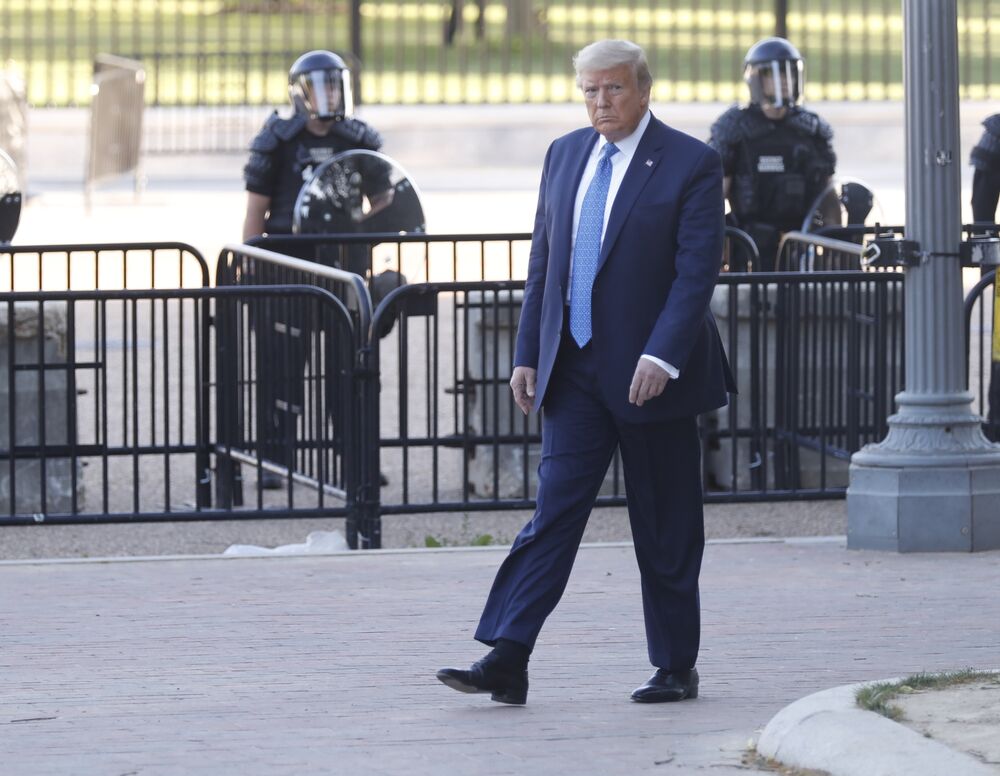
His actions Monday brought home the point. After giving a statement about the protests at the Rose Garden, Trump had police and members of the National Guard clear out peaceful protesters from in front of the White House so he could take a brief walk to nearby St. John’s Church, which had been damaged during earlier demonstrations. The idea that anyone other than Trump’s most dedicated supporters would find walking a block and back heroic seems … unlikely.
 (This is the article in its entirety.) 

Monday, November 25, 2019

Conventional Wisdom?

In a column titled "Don't Buy The Conventional Wisdom on Impeachment," political scientist Jonathan Bernstein says that Donald's support may not be as firm as it appears:

The conventional wisdom is getting a bit ahead of itself on impeachment.

I’m not predicting that President Donald Trump will be removed from office; that’s probably not going to happen. But there’s a big difference between probably and certainly. And after two weeks of public impeachment hearings, it seems to me that a certainty has set in: that there’s simply no way that Republicans will ever turn on Trump.

Perhaps! It’s true that congressional Republicans seem to be more solidly behind Trump than ever. In particular, Representative Will Hurd, who might’ve been the most likely member of the party to vote for impeachment and take a few others with him, seems to have decided against it. The most likely outcome may still be a close-to-party-line impeachment in the House and acquittal in the Senate.

But remember that conservative Republicans stuck with President Richard Nixon in 1974 … right up until they didn’t. Trump’s seemingly unanimous support right now is similar to the backing that Nixon had even as his original cover-up collapsed in early 1973; as the Senate Watergate committee hearings dominated that summer; as the Saturday Night Massacre unfolded in October; and as the House judiciary committee debated and voted on specific articles of impeachment in 1974. And then: The smoking gun tape came out and it all collapsed immediately. Even Nixon’s strongest supporter on the judiciary committee, the Jim Jordan of the day, who had just vigorously defended the president during televised deliberations, flipped and said he’d vote to impeach on the House floor.

That suggests Nixon’s support was never as solid as it seemed. Which in turn suggests we just can’t know how firm Trump’s support is among congressional Republicans this time. Perhaps they’re prepared for the worst and determined to stick with the president no matter what. But history tells me that we don’t know for sure — and that it’s quite possible that they don’t know for sure what they’ll ultimately do.

Again: I’m not predicting anything. But just since the last hearing, new evidence has emerged showing how the White House tried to justify a delay in delivering military aid to Ukraine; Rudy Giuliani’s indicted associate Lev Parnas has turned over recordings and other material to the House intelligence committee; one of Trump’s conspiracy theories about the FBI’s investigation into his 2016 campaign has apparently collapsed; and Democrats have started probing the possibility that Trump lied to former special counsel Robert Mueller. Moreover, the chaotic ouster of Navy Secretary Richard Spencer on Sunday shows that Trump remains quite capable of doing damage to himself, and gives another reason for Republicans who care about the traditional values of the U.S. military to think twice about backing him.

It all adds up to a lot more uncertainty than many people seem to appreciate.
(This is the column in its entirety.)

Saturday, June 1, 2019

The State Visit


Saturday, February 16, 2019

The Room Was Silent And The Golf Club Is Tacky


A comment from Washington Post reporter Dan Zak:


And what was Mike Pence's boss doing on the first day of the National Emergency?


Could the Trump International Golf Club in Palm Beach be any tackier? Seriously. To paraphrase a comment I saw on Twitter, there are airport Ramada Inns that are classier.