Our old friend Steve Schmidt had some time on his hands this morning:
I can’t wait for this moment. It will come early. “Fox News is now projecting Joseph R. Biden is the President-Elect of the United States” The American people are going to throw you out of office. You will be repudiated and disgraced. The oh leave nothing behind but the stench https://t.co/hwFK5ThKTM
Alliances and weakened our military. You are a disgrace. Your name will be a synonym for losing, failure and weakness. Biden is crushing you. You want to know why? It’s because he is a good man and you are a bad one. He cares about the American people and you do not. He is
Failures? He would not. He bailed you out over and over again. He bailed you out because you couldn’t cut it as anything other than a Conman. There will be no monuments and no encomiums for you. The whole country has watched you fail. The whole country is watching your
Apologies for the repeated tweet here, when they're threaded on Twitter sometimes the cut-and-paste goes awry.
Increasingly feeble state. The whole country is watching you lose. We will all watch you return to your golf clubs as the biggest loser the American Presidency has ever produced
In an article titled "The Revenge of the Trump Tattletales" and subtitled "Keep your friends close and your enemies away from book publishers," New York Times Opinion Columnist Frank Bruni starts with this:
Beware the number of enemies you make, and pray to God they don’t have literary agents.
That’s a lesson President Trump never learned. But he’ll be schooled anew in late July, the scheduled publication date for a book by his niece, Mary Trump. Spoiler alert: She’s not defending the honor of a misunderstood uncle. She’s reportedly plunging a dagger into him, though its lethalness is unclear. It’s not as if she had an Ivanka-grade seat to the circus of his life.
John Bolton had an excellent, if briefly occupied, perch as the third of Trump’s four national security advisers so far. That’s surely why he makes the president so nervous. Trump and his flunkies are raging about and suing to delay distribution of Bolton’s book, “The Room Where It Happened,” set for release early next week. (“He’s broken the law,” Trump fumed on Monday, referring to the administration’s claims that Bolton is trafficking in classified information. “I would think that he would have criminal problems.”) But Martha Raddatz of ABC News has done a long interview with Bolton to be aired on Sunday. One way or another, the truth will come out.
Then again, the truth was never in. While most presidential administrations leak like kitchen faucets — or at worst, garden hoses — Trump’s leaks like Niagara Falls, as many unflattering books and much unsparing journalism have already shown. And while most presidential administrations have a few embittered exiles, Trump’s has a teeming diaspora of disgusted refugees, many of whom tattled as soon as they fled, either on the record or in whispers to reporters. (Read the entire column here)
Titled "Too Much and Never Enough: How My Family Created the World's Most Dangerous Man," Mary Trump's book comes out July 28. These two books alone are undoubtedly two books too many for Donald, but it turns out there's a third book in the pipeline. Bob Woodward is taking another swing at Donald in a book, so far untitled, that comes out in September. All this in an election year? Poor Donald. Update: In a story posted late this afternoon, the NY Times wonders if Donald even wants to be reelected: In a recent meeting with his top political advisers, President Trump was impatient as they warned him that he was on a path to defeat in November if he continued his incendiary behavior in public and on Twitter.
Days earlier, Mr. Trump had sparked alarm by responding to protests over police brutality with a threat that “when the looting starts, the shooting starts.”
Mr. Trump pushed back against his aides. “I have to be myself,” he replied, according to three people familiar with the meeting. A few hours later, he posted on Twitter a letter from his former personal lawyer describing some of the protesters as “terrorists.”
In those moments, and in repeated ones since then, the president’s customary defiance has been suffused with a heightened sense of agitation as he confronts a series of external crises he has failed to contain, or has exacerbated, according to people close to him. They say his repeated acts of political self-sabotage — a widely denounced photo-op at a church for which peaceful protesters were forcibly removed, a threat to use the American military to quell protests — have significantly damaged his re-election prospects, and yet he appears mostly unable, or unwilling, to curtail them.
Mr. Trump doesn’t want to be seen as a “loser,” a label he detests, in the campaign against former Vice President Joseph R. Biden Jr. And some advisers believe Mr. Trump’s taste for battle will return in the fall, when the general election fight is more engaged.
But for now, they said, the president is acting trapped and defensive, and his self-destructive behavior has been so out of step for an incumbent in an election year that many advisers wonder if he is truly interested in serving a second term.
Rather than focus on plans and goals for another four years in office, Mr. Trump has been wallowing in self-pity about news coverage of him since the beginning of the coronavirus pandemic, people who have spoken with him said. He has told advisers that no matter what he does, he cannot get “good” stories from the press, which has often been his primary interest. “These people,” Mr. Trump has growled to advisers about reporters, throwing an expletive between the two words.
He has complained that nothing he does is good enough, bristling at criticism that he hasn’t sufficiently addressed the death of George Floyd, a black man killed by the police in Minneapolis. The remarks he made about Mr. Floyd when he attended the launch of the SpaceX shuttle should have been enough, the president told aides.
Mr. Trump has also become consumed, once again, with leaks from the White House, demanding that officials find and prosecute those responsible for information getting out about his trip to the bunker beneath the White House during unruly protests. And while he has shown enthusiasm for resuming his trademark rallies, he has not seemed excited about the possibility of governing for four more years, people close to him said. He has set up villains to blame if he loses — China’s mishandling of the coronavirus, the shutdown of the economy, and Democrats who he has told advisers will “steal” the election from him. (Read the entire article here.)
I've posted here before that Donald appears to be deteriorating. The speech in front of the flags is from 2015, during his campaign announcement; the speech at West Point was this morning. And there's this:
Trump had trouble walking down the ramp at the West Point grad ceremony. Balance & gait issues are part of his dementia symptoms. Bad planning here. His forward lean on a down slope w/ a normal sized step would make him fall over. To stay upright he had to take baby shuffle steps pic.twitter.com/skxlmFtgb7
Update on Sunday morning: Sippygate? Drinkgate? Gaitgate? Did anyone (besides me) notice Donald's weird walk down the ramp? Yes. Oh, yes. From the Washington Post:
BRIDGEWATER, N.J. — President Trump late Saturday tried to explain his slow and unsteady walk down a ramp at the U.S. Military Academy at West Point, which had generated concern and mockery on social media, by claiming the walkway was “very slippery” and that he was worried about falling.
The walk in question came at the conclusion of Saturday’s commencement exercises at West Point, where Trump was the guest speaker. As he exited the raised platform by descending a ramp alongside Lt. Gen. Darryl A. Williams, the academy’s superintendent, Trump was visibly tentative and took short, careful steps. This is Donald's tweet:
The ramp that I descended after my West Point Commencement speech was very long & steep, had no handrail and, most importantly, was very slippery. The last thing I was going to do is “fall” for the Fake News to have fun with. Final ten feet I ran down to level ground. Momentum!
... which the Post finds to be less than persuasive:
Elements of Trump’s explanation strained credulity. Trump’s claim that the ramp had been “very slippery” was inconsistent with the weather, which on Saturday in West Point, N.Y., was sunny and clear-skied. The grass plain on which the commencement took place was dry.
In addition, Trump wrote that he “ran down” the final stretch of the ramp. Video footage of the episode shows the president picking up his pace slightly for the final two steps, but that would hardly be considered a run or a jog by any standard definition. (Read the entire story here.) More from Twitter:
What is wrong with this guy? It’s not age. Plenty of Ironman competitors his age. There is something going on. His right arm can’t raise a water glass and he can’t walk down a ramp without someone holding on to him. Did he have a stroke? https://t.co/eOS3kCs1FS
— The Lincoln Project (@ProjectLincoln) June 14, 2020
The decay of our Country during the Trump years has been so overwhelming that it has distracted us from seeing the physical decay of Trump unfolding in front of our eyes. It is startling. He can barely walk or stand up. Look at the West Point speech. He is increasingly feeble
— The Lincoln Project (@ProjectLincoln) June 16, 2020
This ad will be running on Fox News in the Washington D.C. area. Wouldn't you love to be in the room when Donald sees it for the first time? And one more thing: John Weaver, one of the founders of the Lincoln Project, says there's more to come tomorrow. Update #4 on Wednesday afternoon. Here are the two new ads from the Lincoln Project:
Trump’s rally in Tulsa on the weekend of Juneteenth proves what we already knew: he’s the largest superspreader of division and hatred we’ve seen in generations. pic.twitter.com/LuNKjfK0pB
— The Lincoln Project (@ProjectLincoln) June 17, 2020
— Republican Voters Against Trump (@RVAT2020) June 12, 2020
Lindsey's line about Joe Biden rang a bell and then I remembered where I had heard it before. President Obama quoted it when he awarded Vice President Biden the Presidential Medal of Freedom With Distinction:
The Graham quote is at the 13.00 minute mark.
Update: It's not just Lindsey. Many Republicans were against Donald before they were for him:
— Republicans for Joe Biden (@RepsForBiden) June 11, 2020
Kellyanne Conway is a top-level staffer for Donald; I confess I had forgotten, but Rick Perry also works for the president. He doesn't get much attention, or to put it another way, he hasn't had any big scandals and has mostly stayed out of trouble, but he's still the Secretary of Energy.
Some thoughts from Jonathan Bernstein, posted on Tuesday:
Perhaps I should be focused on the larger themes of Donald Trump’s presidency, but today I just can’t get over the little stuff.
Item:
The Secret Service reportedly told Trump to head down to a secure space in the White House on May 29 because protesters across the street were getting unruly. Seems to me he had several options:
Defy the Secret Service, stay put and then have it leaked out that he heroically stood his ground.
Go down to the bunker, and then when the press reports it just ignore the whole thing.
Go down to the bunker, and then use the incident to bash the protesters (whom the president is portraying as violent).
Or go down the bunker, make up something about doing an “inspection,” fight it out with the media for a week and then be completely embarrassed when your attorney general lets out the truth.
Item:
Trump’s had a lousy run of polls, capped off by a CNN survey released Monday showing him down 14 percentage points to former Vice President Joe Biden. Options included highlighting the best poll out there, ignoring the polls and focusing on governing, or at least claiming to be ignoring the polls and focused on governing. Instead, Trump had a pollster draft a risible memo accusing the other pollsters of being out to get him and tweeted it out, thus confirming reporting that he’s obsessed with the polls, implying that similar reporting about bad internal polls is true, and drawing attention to the worst of all the recent public surveys.
Item:
Anti-Trump Republicans have been taking out attack ads on Washington TV during Trump’s favorite cable news shows. Apparently the president is so upset about this that his own campaign has spent almost half a million dollars to counter-advertise on the same programs, mainly to cheer him up and convince him that his staffers are hard at work. Granted, presidential campaigns generally have more money than they know what to do with, so it’s not as if swing-state advertising will suffer, but it’s still an interesting comment about what the campaign professionals think of their candidate.
All of those are from Monday’s news. I could easily go further. There’s also Trump’s continuing feud with Senator Mitt Romney, complete with more easily disproved statements. The president seems perfectly pleased to go forward without Romney or Senator Lisa Murkowski on his side. It’s worth remembering that Trump won narrowly in 2016, and can’t afford to lose any significant faction of Republicans.
There’s also Trump’s decision to begin his rallies again, regardless of best practices to control the coronavirus. Will it help him? He’s been holding those rallies since early in his presidency and they don’t appear to have done him much good, but he likes doing them and has no one around him to tell him otherwise. And while the story about the attack on protesters has centered on Attorney General William Barr more than on Trump personally, Monday marked a week into increasingly dubious administration claims about the event, including semantic arguments about what counts as using tear gas and evidence-free accusations of protester violence. The Washington Post has probably now debunked those claims for good. Again, even given the original events, there was simply no reason for the White House to stretch out the bad publicity for a week.
None of these items makes all that much difference on its own, but that’s a lot of missteps, easily exposed falsehoods and wasted effort, all from one day’s headlines. Have enough days like that and it adds up to a weak, unpopular president who seems to be flailing like no one since Jimmy Carter. We’ll see what Tuesday brings.
This is Admiral Mullen's article, titled "I Can't Remain Silent," in its entirety:
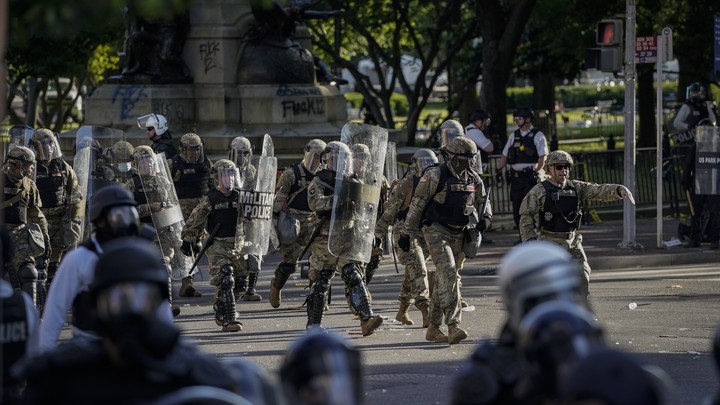
It sickened me yesterday to see security personnel—including members of the National Guard—forcibly and violently clear a path through Lafayette Square to accommodate the president's visit outside St. John's Church. I have to date been reticent to speak out on issues surrounding President Trump's leadership, but we are at an inflection point, and the events of the past few weeks have made it impossible to remain silent.
Whatever Trump's goal in conducting his visit, he laid bare his disdain for the rights of peaceful protest in this country, gave succor to the leaders of other countries who take comfort in our domestic strife, and risked further politicizing the men and women of our armed forces.
There was little good in the stunt.
While no one should ever condone the violence, vandalism, and looting that has exploded across our city streets, neither should anyone lose sight of the larger and deeper concerns about institutional racism that have ignited this rage.
As a white man, I cannot claim perfect understanding of the fear and anger that African Americans feel today. But as someone who has been around for a while, I know enough—and I’ve seen enough—to understand that those feelings are real and that they are all too painfully founded.
We must, as citizens, address head-on the issue of police brutality and sustained injustices against the African American community. We must, as citizens, support and defend the right—indeed, the solemn obligation—to peacefully assemble and to be heard. These are not mutually exclusive pursuits.
And neither of these pursuits will be made easier or safer by an overly aggressive use of our military, active duty or National Guard. The United States has a long and, to be fair, sometimes troubled history of using the armed forces to enforce domestic laws. The issue for us today is not whether this authority exists, but whether it will be wisely administered.
I remain confident in the professionalism of our men and women in uniform. They will serve with skill and with compassion. They will obey lawful orders. But I am less confident in the soundness of the orders they will be given by this commander in chief, and I am not convinced that the conditions on our streets, as bad as they are, have risen to the level that justifies a heavy reliance on military troops. Certainly, we have not crossed the threshold that would make it appropriate to invoke the provisions of the Insurrection Act.
Furthermore, I am deeply worried that as they execute their orders, the members of our military will be co-opted for political purposes.
Even in the midst of the carnage we are witnessing, we must endeavor to see American cities and towns as our homes and our neighborhoods. They are not “battle spaces” to be dominated, and must never become so.
We must ensure that African Americans—indeed, all Americans—are given the same rights under the Constitution, the same justice under the law, and the same consideration we give to members of our own family. Our fellow citizens are not the enemy, and must never become so.
Too many foreign and domestic policy choices have become militarized; too many military missions have become politicized.
This is not the time for stunts. This is the time for leadership. An update on Wednesday evening. Former Secretary of Defense James Mattis has also issued a statement: In Union There Is Strength
I have watched this week's unfolding events, angry and appalled. The words "Equal Justice Under Law" are carved in the pediment of the United States Supreme Court. This is precisely what protesters are rightly demanding. It is a wholesome and unifying demand—one that all of us should be able to get behind. We must not be distracted by a small number of lawbreakers. The protests are defined by tens of thousands of people of conscience who are insisting that we live up to our values—our values as people and our values as a nation.
When I joined the military, some 50 years ago, I swore an oath to support and defend the Constitution. Never did I dream that troops taking that same oath would be ordered under any circumstance to violate the Constitutional rights of their fellow citizens—much less to provide a bizarre photo op for the elected commander-in-chief, with military leadership standing alongside.
We must reject any thinking of our cities as a "battlespace" that our uniformed military is called upon to "dominate." At home, we should use our military only when requested to do so, on very rare occasions, by state governors. Militarizing our response, as we witnessed in Washington, D.C., sets up a conflict—a false conflict— between the military and civilian society. It erodes the moral ground that ensures a trusted bond between men and women in uniform and the society they are sworn to protect, and of which they themselves are a part.
Keeping public order rests with civilian state and local leaders who best understand their communities and are answerable to them.
James Madison wrote in Federalist 14 that "America united with a handful of troops, or without a single soldier, exhibits a more forbidding posture to foreign ambition than America disunited, with a hundred thousand veterans ready for combat." We do not need to militarize our response to protests. We need to unite around a common purpose. And it starts by guaranteeing that all of us are equal before the law.
Instructions given by the military departments to our troops before the Normandy invasion reminded soldiers that "The Nazi slogan for destroying us...was 'Divide and Conquer.' Our American answer is 'In Union there is Strength.'" We must summon that unity to surmount this crisis—confident that we are better than our politics.
Donald Trump is the first president in my lifetime who does not try to unite the American people—does not even pretend to try. Instead he tries to divide us. We are witnessing the consequences of three years of this deliberate effort. We are witnessing the consequences of three years without mature leadership. We can unite without him, drawing on the strengths inherent in our civil society. This will not be easy, as the past few days have shown, but we owe it to our fellow citizens; to past generations that bled to defend our promise; and to our children.
We can come through this trying time stronger, and with a renewed sense of purpose and respect for one another. The pandemic has shown us that it is not only our troops who are willing to offer the ultimate sacrifice for the safety of the community. Americans in hospitals, grocery stores, post offices, and elsewhere have put their lives on the line in order to serve their fellow citizens and their country. We know that we are better than the abuse of executive authority that we witnessed in Lafayette Square. We must reject and hold accountable those in office who would make a mockery of our Constitution. At the same time, we must remember Lincoln's "better angels," and listen to them, as we work to unite.
Only by adopting a new path—which means, in truth, returning to the original path of our founding ideals—will we again be a country admired and respected at home and abroad.
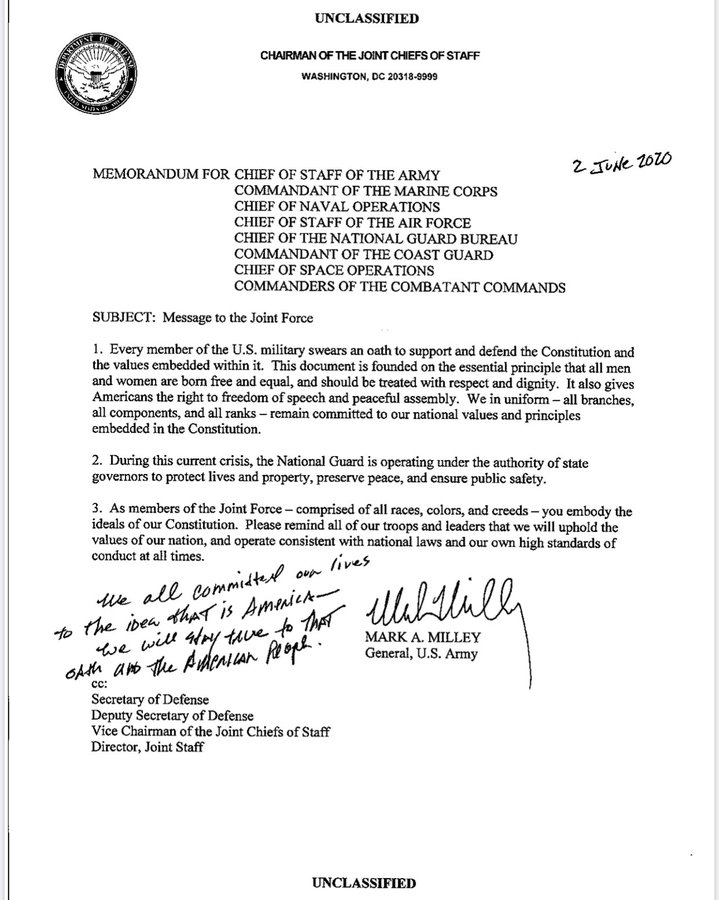
Update #2: From the current Chairman of the Joint Chiefs of Staff:
Update #3 on Wednesday June 4. Jonathan Bernstein weighs in on General Mattis's message:
It's hard to get across what a big deal it is that former Defense Secretary James Mattis has not only publicly criticized President Donald Trump, but done so in extremely strong terms. In a statement issued Wednesday, Mattis talked about “those in office who would make a mockery of our Constitution,” and said that “We are witnessing the consequences of three years without mature leadership.” He added that Trump was engaged in a “deliberate attempt” to “divide us,” something he says no other president in his lifetime has done. (For the record, Mattis is 69, so he’s talking about everyone since Harry Truman.)
I’m not sure that we’ve ever had a former cabinet secretary criticize a president he or she served this harshly, and certainly not one who was still in office and up for re-election. It’s all the more striking coming from a retired general, a group that tends to be relatively hesitant to jump into politics. Nor is Mattis standing alone. Trump’s conduct this week — in particular his militarized response to what still amounts to a lot of peaceful protest and a small amount of criminal activity — has also been denounced by former Chairman of the Joint Chiefs of Staff Mike Mullen and even some of those currently in office.
Mattis’s criticism probably won’t directly affect public opinion; there just aren’t a lot of people who pay close enough attention to the news to hear what he said and who are also open to changing their minds. But it will still prove consequential. Although some Republicans will join Trump in denouncing Mattis, others will hesitate or be even less inclined to defend the president’s actions than they had been (and most hadn’t exactly been leaping to the microphones to support him in any event). Democrats were already going to condemn Trump, but they’ll likely do so more harshly now. And those who aren’t aligned with either party may well feel that a “neutral” stance now requires more criticism of the president, given that it’s not just protesters who are judging him harshly.
Meanwhile, the list of Donald Trump’s terrible personnel choices according to Donald Trump gets one name longer, as the president reacted predictably by bashing Mattis. That list now includes a defense secretary, a secretary of state, an attorney general, at least one national security adviser and at least two White House chiefs of staff. Again, there are very few people who are otherwise undecided about Trump who would be swayed by what an awful job — according to Trump himself — he has done appointing people for the most important positions in government. But it’s a remarkable record nonetheless. (This is the column in its entirety.)
Josh Marshall thinks so, in a post titled "Rats Flee":
All at once this evening it seemed every major publication with solid Pentagon reporters had a story with unnamed Pentagon officials saying in so many words, “It Wasn’t Me!” Non-involvement in politics has been part of US military indoctrination, especially for high ranking officers, for generations – or at least until recently. But these denials had less the sound of something that was wrong than something that was proving unpopular or indefensible. In most cases the officials calling up reporters seem to have been civilian appointees. But the precise identities are not clear. Secretary of Defense Mark Esper sat for an interview with NBC News in which he claimed he was out of the loop about yesterday’s tear gas and photo op stunt. “I didn’t know where I was going … I thought I was going to do two things: to see some damage and to talk to the troops.”
This has the feeling of a turning point. (This is the post in its entirety.)
The New York Times says it was Ivanka's idea (and the bible was in her $1540 Max Mara totebag):
WASHINGTON — After a weekend of protests that led all the way to his own front yard and forced him to briefly retreat to a bunker beneath the White House, President Trump arrived in the Oval Office on Monday agitated over the television images, annoyed that anyone would think he was hiding and eager for action.
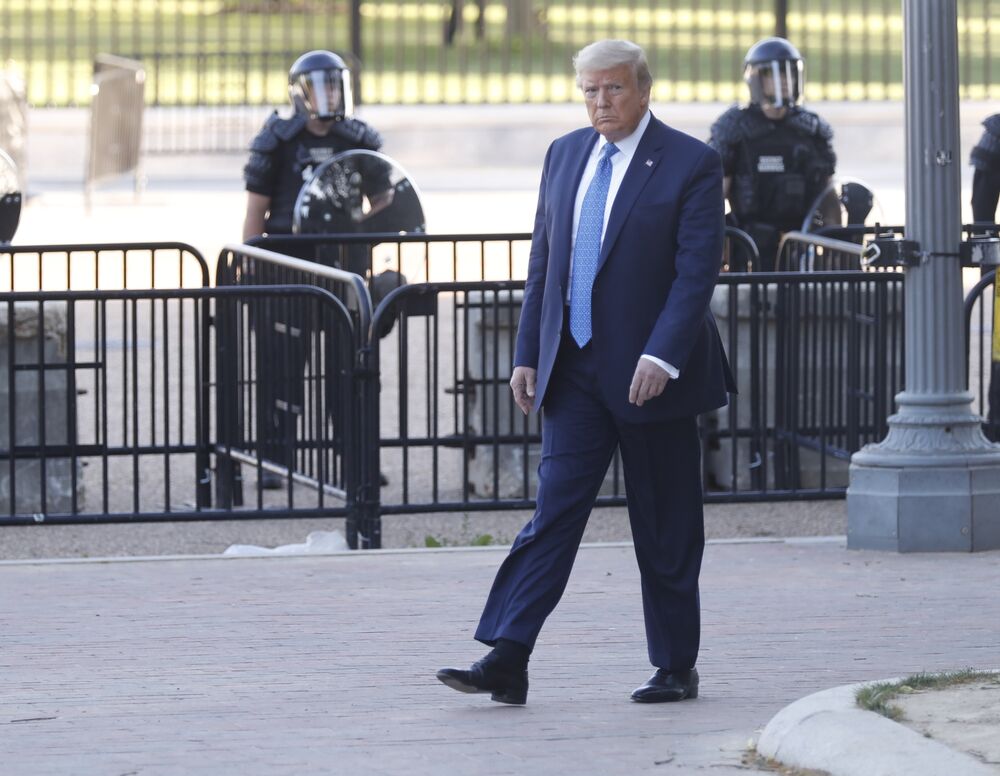
He wanted to send the military into American cities, an idea that provoked a heated, voices-raised fight among his advisers. But by the end of the day, urged on by his daughter Ivanka Trump, he came up with a more personal way of demonstrating toughness — he would march across Lafayette Square to a church damaged by fire the night before.
... The resulting photographs of Mr. Trump striding purposefully across the square satisfied his long-held desire to project strength, images that members of his re-election campaign team quickly began recirculating and pinning to their Twitter home pages once he was safely back in the fortified White House.
And when the history of the Trump presidency is written, the clash at Lafayette Square may be remembered as one of its defining moments.
Mr. Trump and his inner circle considered it a triumph that would resonate with many middle Americans turned off by scenes of urban riots and looting that have accompanied nonviolent protests of the police killing of a subdued black man in Minneapolis.
But critics, including some fellow Republicans, were aghast at the use of force against Americans who posed no visible threat at the time, all to facilitate what they deemed a ham-handed photo opportunity featuring all white faces. Some Democratic senators used words like “fascist” and “dictator” to describe the president’s words and actions.
Bishop Mariann Edgar Budde of the Episcopal Diocese of Washington, who was not consulted beforehand, said she was “outraged” over the use of one of her churches as a political backdrop to boast of squelching protests against racism. Even some White House officials privately expressed dismay that the president’s entourage had not thought to include a single person of color.
...The spectacle staged by the White House also left military leaders struggling to explain themselves in response to criticism from retired officers that they had allowed themselves to be used as political props. [See above.] Defense Secretary Mark T. Esper and Gen. Mark A. Milley, the chairman of the Joint Chiefs of Staff, put out word through military officials that they did not know in advance about the dispersal of the protesters or about the president’s planned photo op, insisting that they thought they were accompanying him to review the troops. (Read the entire article here.)
And just in case you haven't had enough of ridiculous photo ops featuring churches, consider this, from today:
How's Donald's re-election campaign going? Jonathan Bernstein says not that great:
After a month of bad news, President Donald Trump’s approval ratings have taken another hit. He’s in serious trouble for re-election.
Most of the damage is on the disapproval side. On May 1, Trump was at 43.3% approval and 50.7% disapproval, according to the estimate at FiveThirtyEight, which is based on an adjusted average of all the polls out there. Now? Although his approval is down just a bit, to 42.9%, his disapproval is up another three percentage points and sits at 53.6%. Two months ago, Trump was getting his best approval numbers since his brief honeymoon; now, he’s lost all of that and is back to where he’s been for most of the past two years.
As was the case last month, that means that his numbers resemble those of the last two elected presidents to be defeated for a second term, George H.W. Bush and Jimmy Carter. He’s solidly behind Barack Obama and George W. Bush, both of whom won re-election in reasonably contested efforts, and far behind landslide winners Richard Nixon, Ronald Reagan and Bill Clinton.
There’s a lot of speculation about how the current round of protests over police violence will affect Trump’s re-election prospects, including comparisons of his strategy to Nixon’s in 1968. I’m extremely skeptical that we can predict what effects these events will have — if any. After all, this would hardly be the first extremely important event that was either forgotten by Election Day or simply reinforced everyone’s previous vote choice.
If I had to guess, however, I’d say that the Nixon comparisons are off-base. Trump is the incumbent, so he’s not especially apt to pick up the support of undecided voters upset by the status quo. And Nixon was skilled at identifying issues that would put him on the side of large majorities, even at the cost of intensifying social fault lines. Trump is good at the inflaming part, but there’s just no evidence that he has any feel for where majorities are. Instead, while Nixon was willing to ignore “Goldwater conservatives” to appeal to the broad middle of the electorate, Trump specializes in appealing to only his strongest supporters — which since the early days of his presidency has essentially meant the core audience for Fox News and conservative talk radio.
His actions Monday brought home the point. After giving a statement about the protests at the Rose Garden, Trump had police and members of the National Guard clear out peaceful protesters from in front of the White House so he could take a brief walk to nearby St. John’s Church, which had been damaged during earlier demonstrations. The idea that anyone other than Trump’s most dedicated supporters would find walking a block and back heroic seems … unlikely. (This is the article in its entirety.)
Believe it or not, Survivor is still out there, still cranking out seasons. Confession: I've literally never watched a single minute of this show. (Blog readers know that The Bachelor, and all its various spin-offs, are my reality TV universe of choice. #BachelorNation)
Click here, here and here to read more about Survivor after 20 years.
Update on June 2: Today is the 67th anniversary of The Queen's coronation. I don't usually repeat This Day In History posts, but in this case I can't help myself. A 67-year reign is truly remarkable, and actually, it's a 68-year reign, because then-Princess Elizabeth became Queen when her father died in February, 1952. Traditionally, coronations are held a year or more after the death of the previous monarch.
So when will the next coronation take place? Obviously no one knows. The Queen really can't live forever, although she certainly appears to be in good health at age 94. Whenever it happens, the period of time between the death of the current queen and the coronation of the new King, as well as the coronation itself, will be fascinating on many levels, because most of us who are alive today have never even seen a British coronation. Unlike our presidential inaugurations, which happen every four years like clockwork, there have only been eight British coronations in the past 259 years (George III in 1761, 15 years before the U.S. came into existence, George IV in 1821, William IV in 1831, Victoria in 1838, Edward VII in 1902, George V in 1911, George VI in 1937 and Elizabeth II in 1953.)